
Vision-based modular platform relative pose estimation system
A relative pose, modular technology, applied in computing, image analysis, instruments, etc., can solve problems such as large error in attitude information estimation, failure to build a multi-module relative pose system, and failure to build a relative pose system. , to achieve the effect of simple module, improving relative pose estimation ability, and solving target loss
Patent Information
- Authority / Receiving Office
- CN · China
- Patent Type
- Applications(China)
- Current Assignee / Owner
- Publication Date
- 2022-01-28
Smart Images
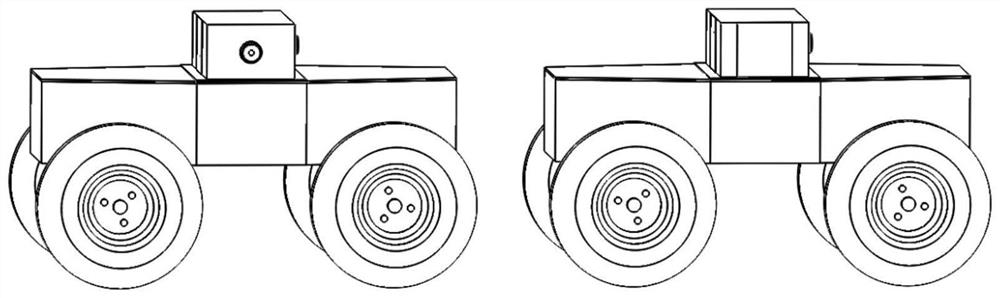
Figure 1 
Figure 2 
Figure 3
Abstract
Description
technical field
[0001] The invention relates to a system for obtaining overall relative pose information of a modular platform by means of a camera, and belongs to the technical field of positioning of the modular platform. Background technique
[0002] Modular robot platform refers to multiple mobile platforms with different functions, which can change its configuration autonomously without human participation according to the changing requirements of the working environment to adapt to the new working environment. In a modular system, in order to ensure the operating range and variable configuration capability of the modular platform, it is necessary to obtain the relative pose information between the robot modules, and at the same time ensure the real-time performance of the relative pose information between the robot modules, so that the control system can make each The module smoothly enters the predetermined function area of the platform to realize various functions ...
Examples
Embodiment Construction
[0051] The modularized platform in the present invention is made up of 4 identical four-wheel mobile robots, adopts the mode of four-wheel differential steering, and is a four-wheel differential steering mobile robot. Each mobile platform (four-wheeled mobile robot) has a camera on the front and right side respectively, and double QR code targets for pose detection on the back and left side respectively. like figure 1 , taking two four-wheel differential steering mobile robots as an example, a 300mm×300mm square box is placed on them to place industrial cameras and dual QR code target modules. The dual QR code target modules are as follows: figure 2 As shown, it consists of two 80mm×80mm two-dimensional codes. Each two-dimensional code represents a different number and can be detected by the ROS node respectively. The distance between the two two-dimensional code targets is 80mm. Encoders are set on the left and right wheels of each four-wheeled mobile robot to obtain the ro...