Intracorpoval urinary catheter for online monitoring sodium in urea

A urinary catheter and urinary sodium technology, which is applied in the field of medical devices, can solve the problems of inability to accurately reflect the immediate state of the patient, inability to be used as a dynamic monitoring method, and a large probability of human error, achieving significant clinical practical value, reducing the occurrence of renal failure and renal failure. Dialysis, fast response effect

CN1279872CInactive Publication Date: 2006-10-18北京爱思泰克科技开发有限责任公司
0 Cites 0 Cited by

Patent Information

Authority / Receiving Office
CN · China
Patent Type
Patents(China)
Current Assignee / Owner
Publication Date
2006-10-18
Estimated Expiration
Not applicable · inactive patent

Smart Images

  • Figure 1
    Figure 1
  • Figure 2
    Figure 2
  • Figure 3
    Figure 3
Patent Text Reader

Abstract

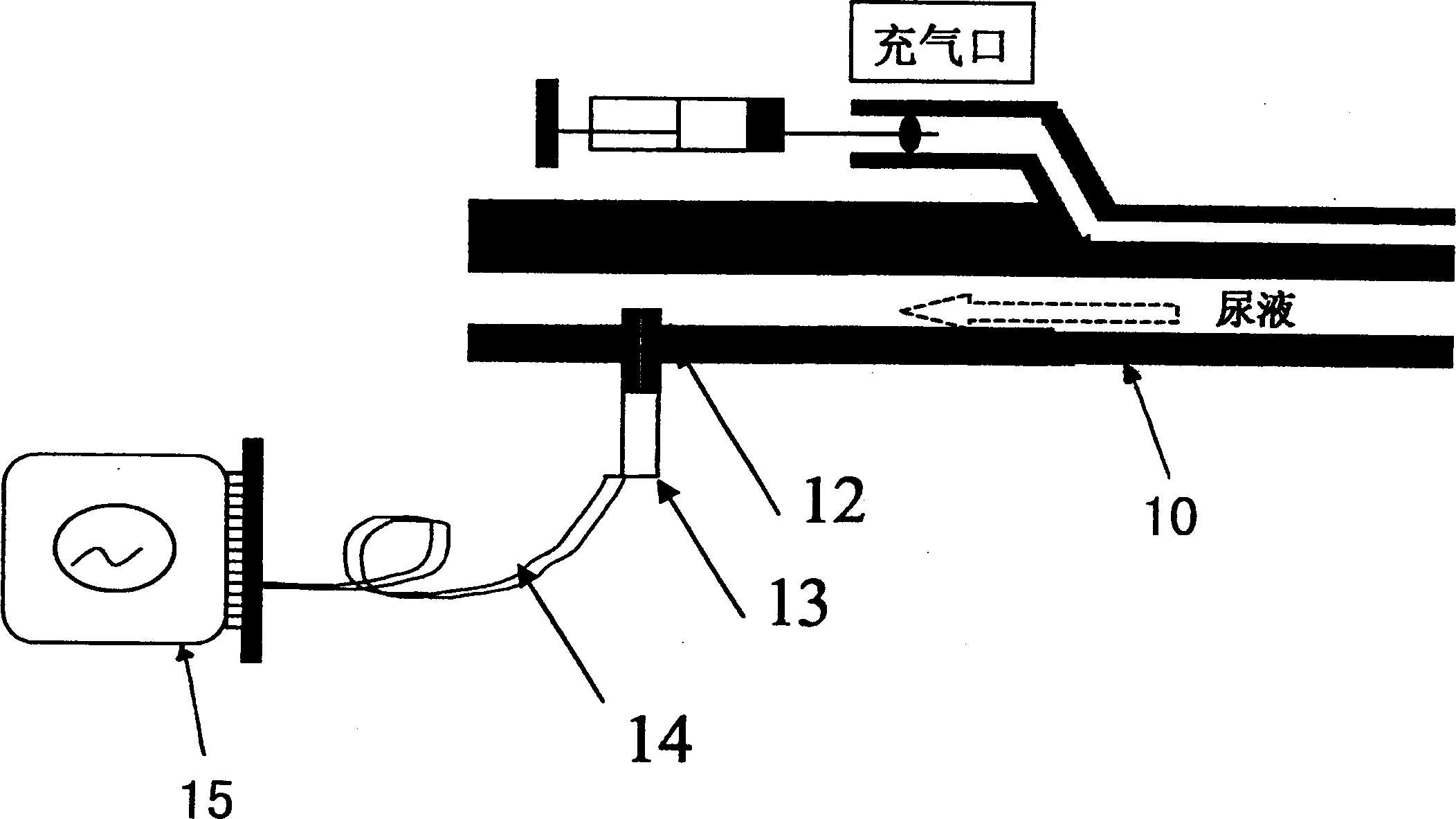
The invention belongs to a medical device, which is an indwelling urinary catheter with the function of on-line monitoring of urine sodium level in the body. The present invention is completed on the basis of the existing indwelling urinary catheter, that is, a miniature sodium sensor is fixed on the wall of the urine inflow end of the indwelling urinary catheter, and its leading wire is externally connected to a special display. The present invention can continuously monitor the urine sodium level in the body on-line, and provide doctors with the effective blood volume information, renal function status, and identification of three types of oliguria for doctors in critical care, emergency care, and surgical care. The sodium sensor type urinary catheter of the present invention has simple structure, is practical and convenient, does not require additional trauma, and provides very important clinical information.
Need to check novelty before this filing date? Find Prior Art

Description

technical field

[0001] The invention relates to a medical device, which belongs to an indwelling urinary catheter with function enhancement and improvement on the basis of the existing indwelling urinary catheter. Background technique

[0002] Indwelling catheterization is often used in clinical departments to monitor the effective blood volume of patients. It is especially basic and important in critical care, emergency care, and surgical monitoring. At present, clinicians mainly rely on the patient's heart rate, blood pressure, urine output, combined with esophageal ultrasound, pulmonary artery catheter incarceration pressure, and central venous pressure and other parameters for comprehensive judgment. Among them, esophagus ultrasonography and indwelling urinary catheter to measure urine volume are the best and most basic and effective blood volume detection methods currently clinically determined. However, the former is not widely used because of the high cost of inspect...

Examples

Embodiment Construction

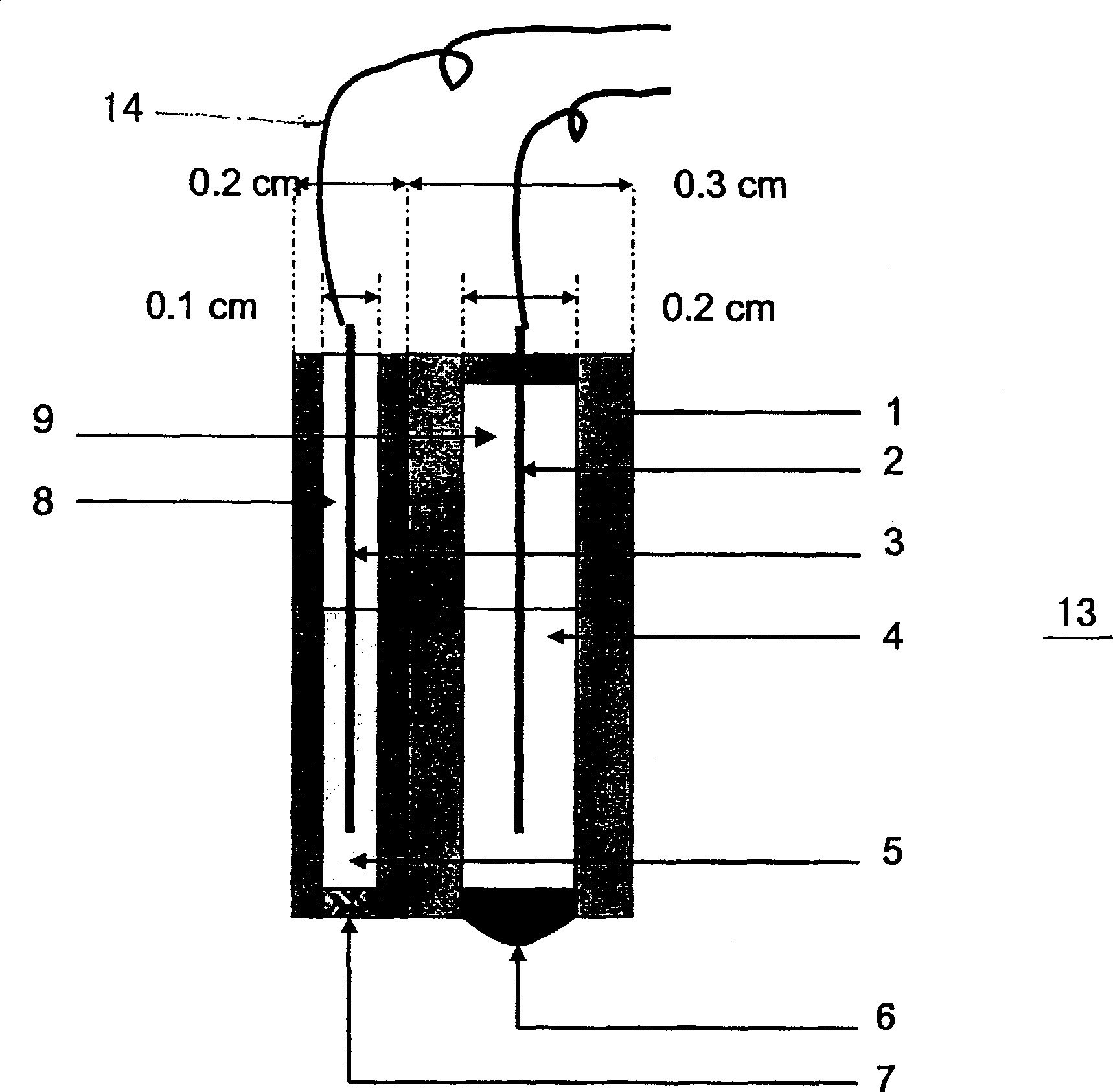
[0022] Such as figure 1 Shown is the miniature sodium sensor 13 of the present invention. In a cylindrical polyurethane housing 1 with a diameter of 0.5 cm, there are two cylindrical cavities 8, 9 longitudinally, and the diameter of the cavity 9 is twice the diameter of the cavity 8: the diameter of the cavity 9 is 0.2 cm, and the cavity The diameter of 8 is 0.1 cm. The upper ends of the two cylindrical cavities 8 and 9 are all closed, and each of the closed end centers has an inherent electrode. The cavity 8 is an external reference electrode (Ag / AgCl) 3, and the cavity 9 is a sodium internal reference electrode (Ag / AgCl). / AgCl) 2; the exposed ends of the two electrodes 2 and 3 are connected to lead wires 14; the lower end of the cavity 8 has a porous ceramic core 7, which is the liquid junction of the reference electrode, and the lower end of the cavity 9 is stuck with a sodium sensor film 6. The composition of the sodium sensor membrane 6 is: A) Selective active substanc...