
Astigmatism eliminating three reflector system
A three-mirror, astigmatism-eliminating technology, applied in the field of optical systems, can solve problems such as high difficulty in processing and assembly, high development costs, and difficulty in mass production, so as to reduce processing difficulty and cost, eliminate the influence of occlusion, and Effect of Difficulty Reduction
- Summary
- Abstract
- Description
- Claims
- Application Information
AI Technical Summary
Problems solved by technology
Method used
Image

Examples
Embodiment 1
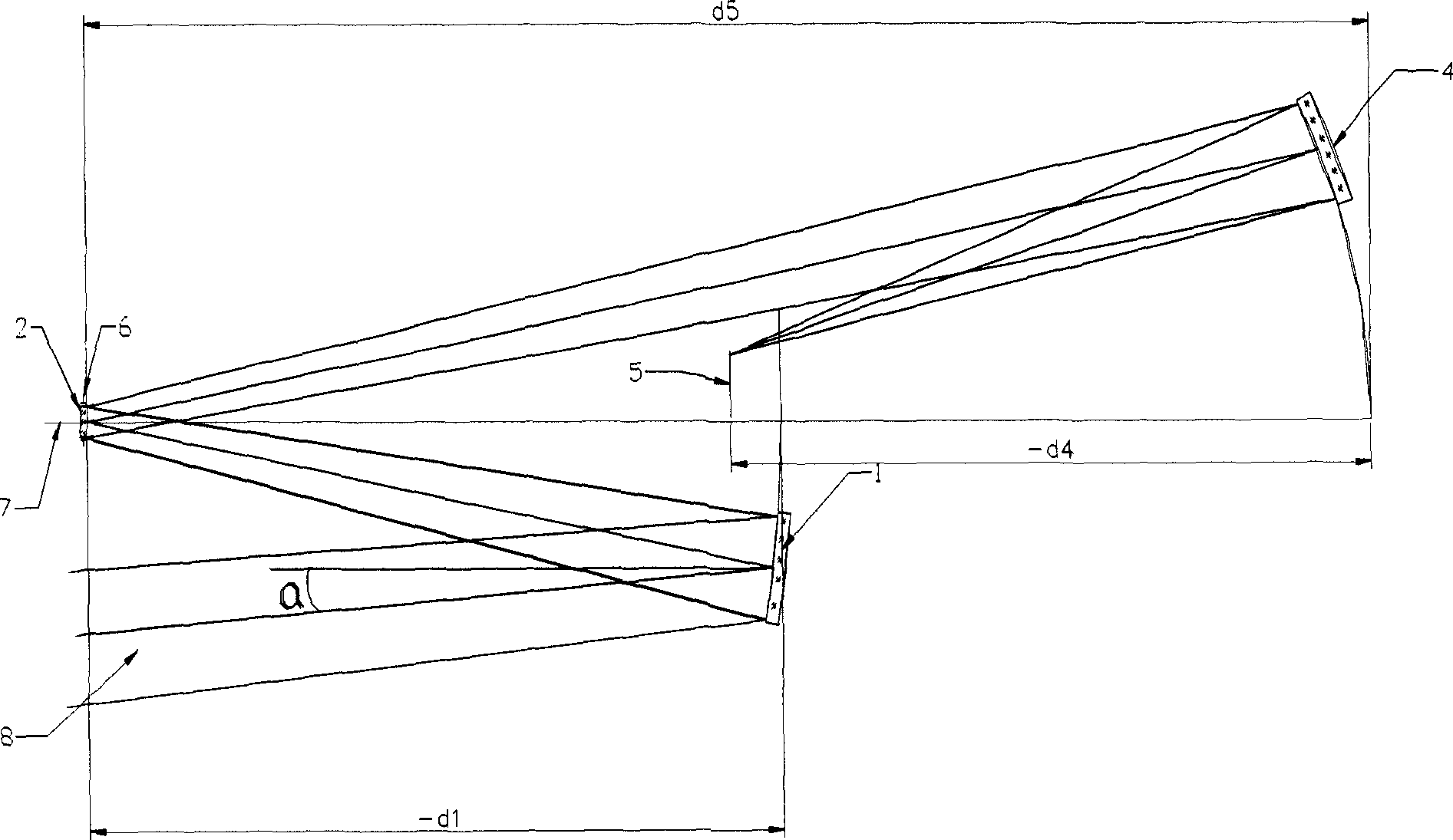
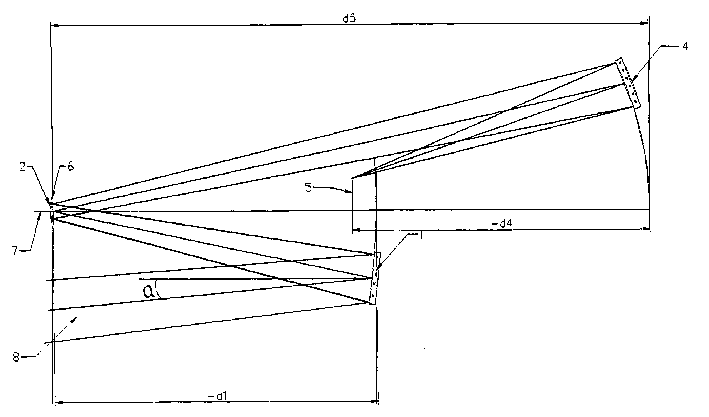
[0028] Embodiment 1 is an aerospace push-broom imaging optical system, and its structure is as follows: figure 1 Shown by:
[0029] Focal length f'=500mm; field of view is 10°×1°; relative aperture is 1 / 12;
[0030] Dimensions: (900×300×120)mm 3 ; Spectral segment: (0.5-0.78) micron;
[0031] System working field of view: X direction is (-5° to 5°); Y direction is (5° to 6°).
[0032] Structural parameters of primary mirror 1: radius of curvature is -1571.067mm (concave surface); spacing d1 between primary and secondary mirrors is -446.731mm; Y off-axis distance is -102.48mm; tilt is 0; eccentricity coefficient is 0; clear aperture (53.2×35.7)mm 2 .
[0033] Structural parameters of secondary mirror 2: radius of curvature is -473.5mm (convex); eccentricity coefficient is 2.2510; distance d5 from secondary mirror to third mirror is 875mm; Y off-axis is 0; tilt is 0; clear aperture diameter is 10.7mm.
[0034] The structural parameters of the third mirror 4: the radius of...
Embodiment 2
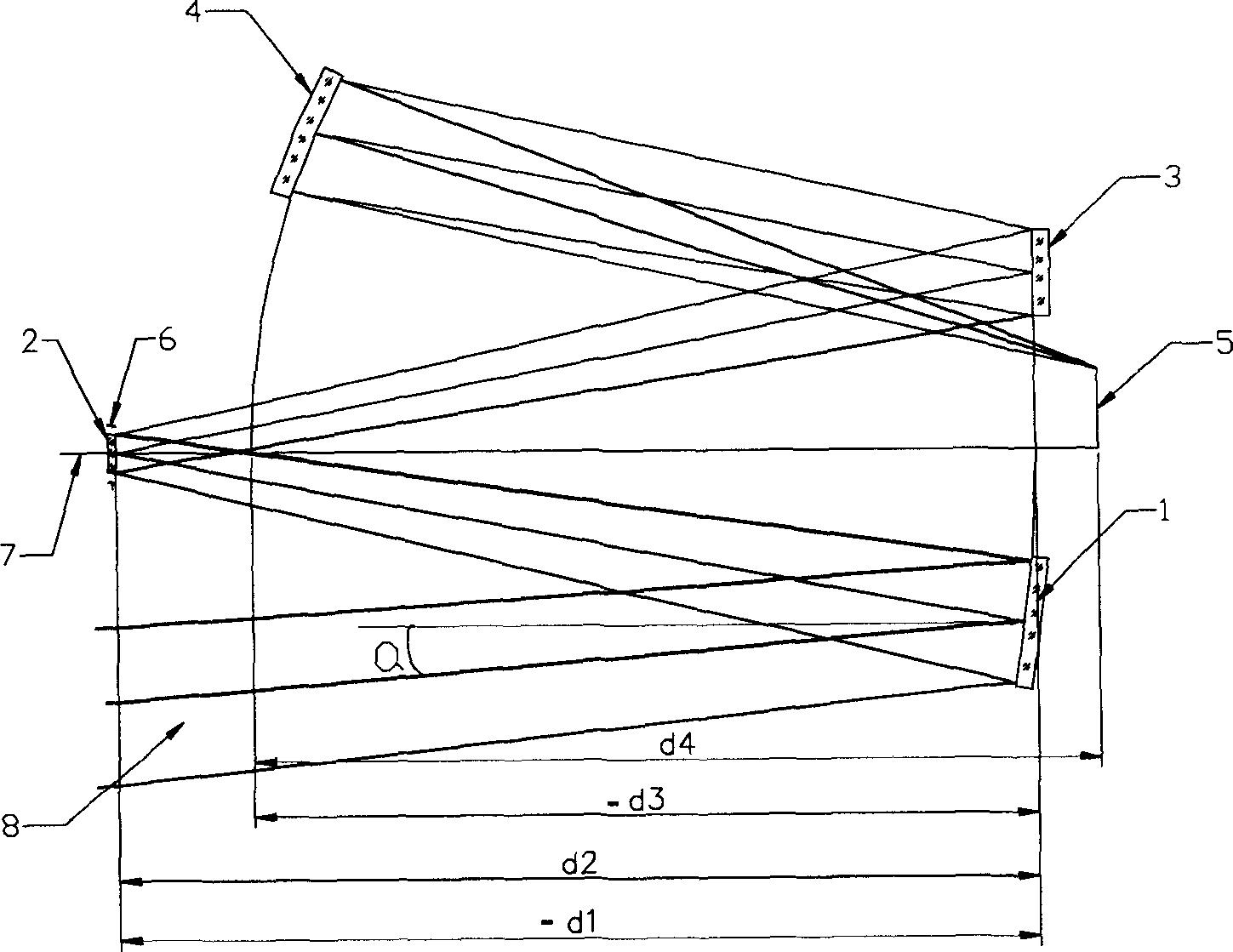
[0038] Embodiment 2 is a push-broom optical system for a microsatellite or a reconnaissance aircraft, and its structure is as follows: figure 2 Shown:
[0039] Focal length f'=500mm; field of view is 10°×1°; relative aperture is 1 / 12;
[0040] Dimensions: (482×440×260)mm 3 ; Spectral segment: (0.5-0.78) micron;
[0041] Offset field of view: (-3° to 3°) in the X direction; (4.2° to 5.0°) in the Y direction.
[0042] Structural parameters of primary mirror 1: radius of curvature is -1519.828mm (concave surface); distance d1 between primary mirror 1 and secondary mirror 2 is -440.791mm; Y off-axis is -101.35mm; inclination is 0; eccentricity coefficient is 0 ;The clear aperture is (67.7×31.9)mm 2 .
[0043] Structural parameters of the secondary mirror 2: the radius of curvature is -472.85mm (convex); the eccentricity coefficient is 2.1866; the distance d2 between the secondary mirror 2 and the folding mirror 3 is 450mm; the Y off-axis is 0mm; the tilt is 0; The aperture ...
PUM
 Login to View More
 Abstract
Description
Claims
Application Information
 Login to View More