Taking the waders and all of this equipment off to urinate is a real hassle.
Not only is it inconvenient, but in a driving rain
storm, one can get very wet during the process.
For an Alaska fly fisherman, taking off and laying down your fly
fishing vest and jacket often results in it being laid along the muddy banks of a river or worse.
Furthermore, taking off all of the gear could temporarily leave a fisherman or hunter without access to a firearm or bear spray if the need to defend themselves from
wildlife occurred at that same moment.
Even if this unfortunate situation never happens, it is still quite disconcerting to the fisherman or hunter every time they need to remove their gear and put themselves in greater harm.
Dehydration is another important issue which can happen to a fly fisherman or hunter.
The inventors found there is a tendency to drink very little water because it is so much of a hassle to remove all of the gear and the waders to urinate.
This is simply an unhealthy situation.
Many have already attempted to address such issues and concerns, yet were either unsuccessful or unable to bring their inventions to market.
U.S. Pat. No. 2,385,816 illustrates a waterproof sealing closure zipper, which again, is very difficult and cumbersome to use and also, is not completely waterproof during long-term immersion, for example, in a river or a lake.
Not only is it aesthetically unacceptable, it would also tend to be very messy.
Of course, all of this would be very cumbersome and probably no more efficient than simply removing the garment.
It is aesthetically unacceptable, messy and also cumbersome.
U.S. Pat. No. 4,601,085 illustrates a
water resistant slide
fastener which appears very cumbersome and difficult to use in practice.
Again, this is aesthetically not pleasing, messy and it is also dubious whether this would truly form a water tight seal.
In the field, this would be difficult to use and very difficult to close back up again.
Again, this looks like it would be very difficult to use and is of dubious quality during long-term immersion.
In any event, it would be difficult to use in the field and impractical for a chest
wader.
The drawing shown in FIG. 5 of the '349 patent is really not practical.
In other words, one is not going to be able to open up the zipper at the top of the garment analogous to a pair of Levis.
This is an essential problem with all of the zipper approaches in that there is really no way to open them in the traditional way at the top.
Zipping the entire garment, from the chest all the way down to the
groin then involves pockets, a safety belt and the suspenders which rapidly becomes very impractical.
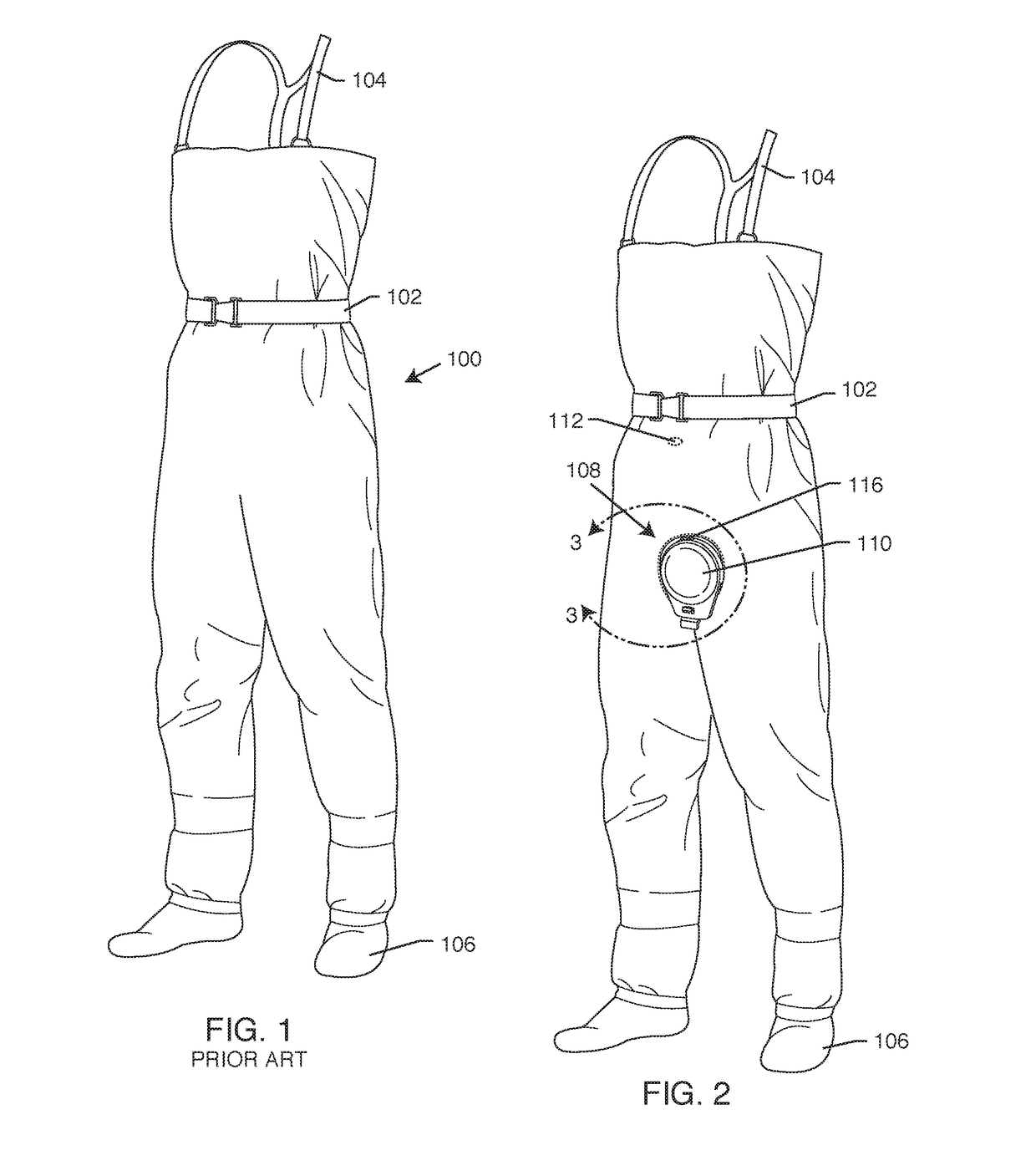
Wader safety belt 24 is essential because if the person wearing the
wader were to slip in a river or a lake, the
wader legs would very quickly fill with water which could immediately add a lot of weight to the
system and be life-threatening.
Even if the water was not life-threatening, it would certainly wet the undergarments and make the wearer very wet and miserable for the remainder of the day.
However, the next problem it ensues is one ends up with a very narrow slit, in terms of enough of an opening, to be able to conveniently urinate.
This creates problems in that the closure element must be placed on the ground during
urination or held with one of the user's hands.
This can become awkward and difficult to operate when in use.
If the closure element is placed down on the ground it can become soiled and then later interfere with the watertight seal when reattached.
Furthermore, this particular invention does not disclose or teach how such a structure will be manufactured as the wader material is not a suitable material to be used to form a water tight hatch.
Wader material is substantially flexible, malleable and flowing and does not hold its shape because it is not substantially rigid.
The disclosure of the patent fails to enable one skilled in the art to actually practice the invention because its structures cannot be manufactured nor do the structures work in reality.
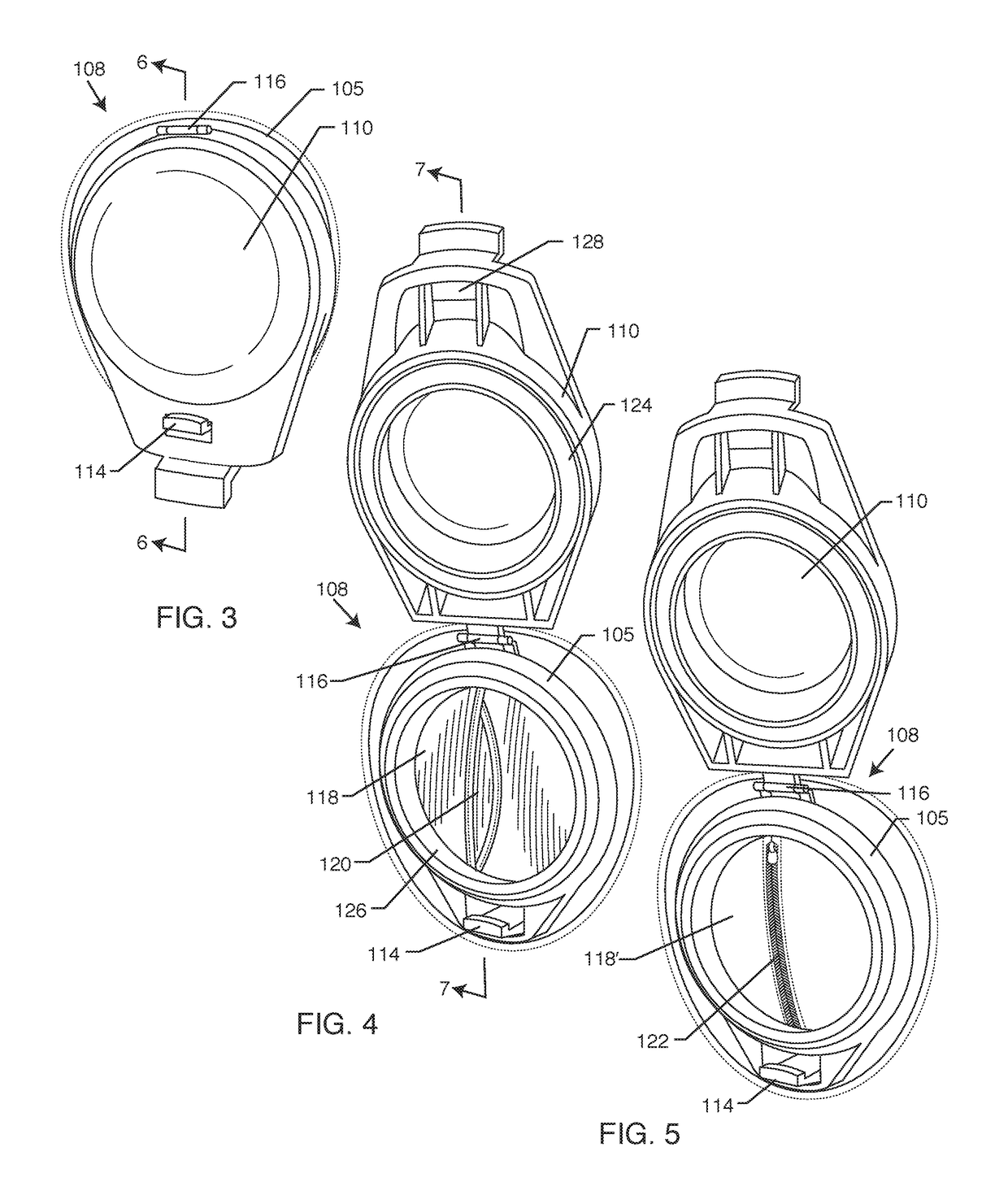
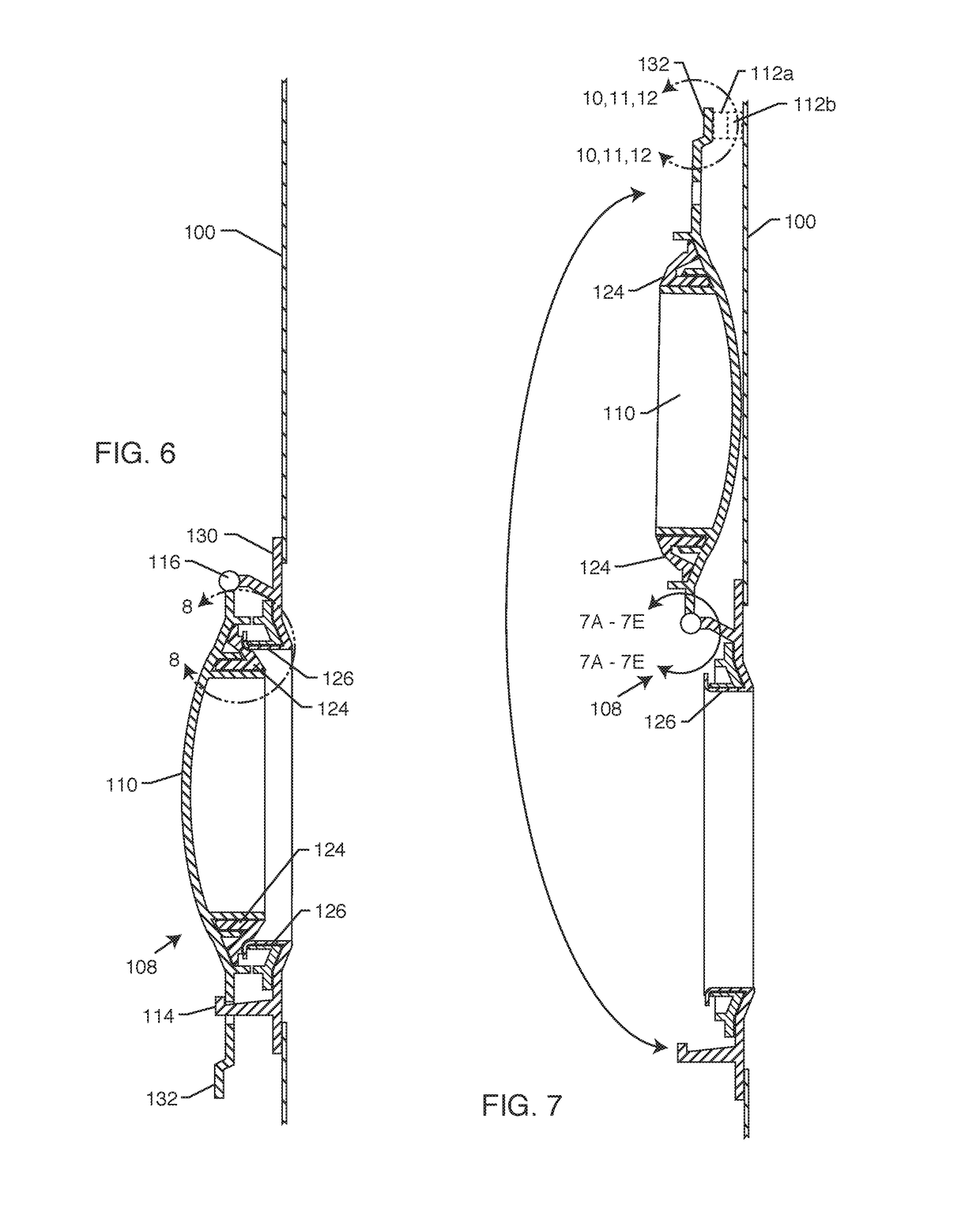
None of the prior art illustrates a sealed
enclosure area with a hinged lid, which can be quickly opened.


 Login to View More
  Login to View More