Unlock instant, AI-driven research and patent intelligence for your innovation.

Generic concurrency restriction

a technology of concurrency restriction and generic concurrency, applied in the direction of program control, multi-programming arrangement, instruments, etc., can solve the problems of scalability collapse phenomenon, affecting so as to improve the overall throughput of the underlying multi-threaded application, reduce overhead, and reduce the effect of overhead

Active Publication Date: 2020-02-18
ORACLE INT CORP
View PDF52 Cites 8 Cited by
  • Summary
  • Abstract
  • Description
  • Claims
  • Application Information

AI Technical Summary

Benefits of technology

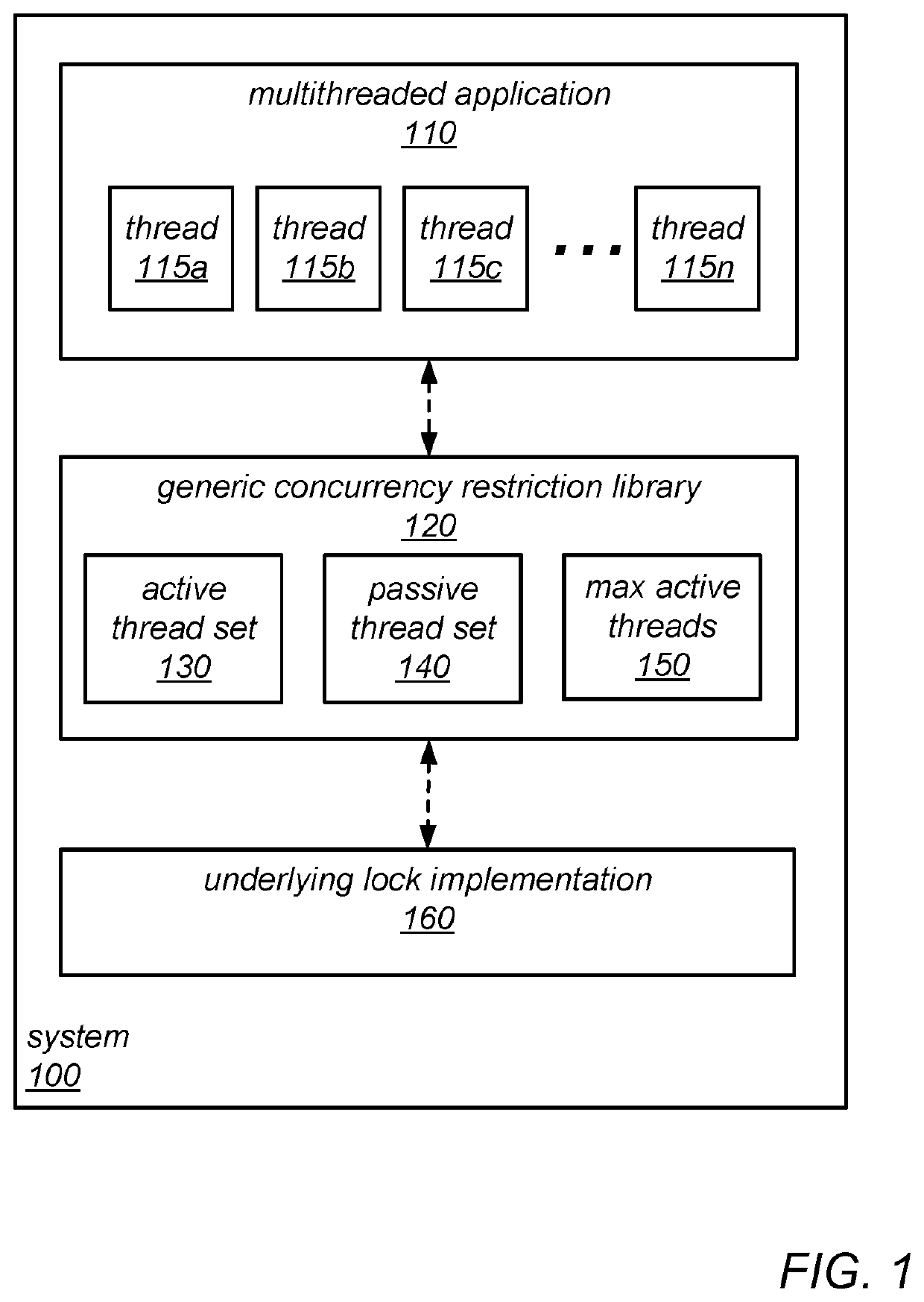
[0009]According to various embodiments, GCR may wrap virtually any lock implementation and may ensure that there are only a limited number (at most one, in some embodiments) of active threads waiting for the lock, while all other threads are passivated (e.g., they are passive, waiting to become active). Thus, GCR may achieve the goal of restricting concurrency under contention by controlling the set of threads allowed to invoke the API of the underlying lock. All this may be done without requiring any change to the lock implementation and / or to the application using these locks (except possibly recompiling the application to use a GCR library). In fact, GCR may be used by legacy applications through, e.g., LD_PRELOAD mechanism on Linux and / or Unix, even without recompiling those applications. While in some embodiments GCR may introduce small overhead when the underlying lock is not contended, GCR may, in some embodiments, bring substantial performance benefit in case of contention by avoiding the scalability collapse, as will be discussed in more detail subsequently

Problems solved by technology

Concurrent applications running on modern multicore architectures are quite often over-threaded, that is, they use more threads than needed to achieve optimal performance.
Very commonly, the degraded performance is the result of contended locks used by these applications to synchronize access to their shared data.
The excess threads may lead to a scalability collapse phenomenon, where the throughput of threads circulating through a contended lock fades (or even drops abruptly) with the increase in the number of threads.
For instance, the increase in the number of distinct threads circulating through the lock may lead to increased cache pressure, resulting in cache misses and memory thrashing.

Method used

the structure of the environmentally friendly knitted fabric provided by the present invention; figure 2 Flow chart of the yarn wrapping machine for environmentally friendly knitted fabrics and storage devices; image 3 Is the parameter map of the yarn covering machine
View more

Image

Smart Image Click on the blue labels to locate them in the text.
Viewing Examples
Smart Image
  • Generic concurrency restriction
  • Generic concurrency restriction
  • Generic concurrency restriction

Examples

Experimental program
Comparison scheme
Effect test

Embodiment Construction

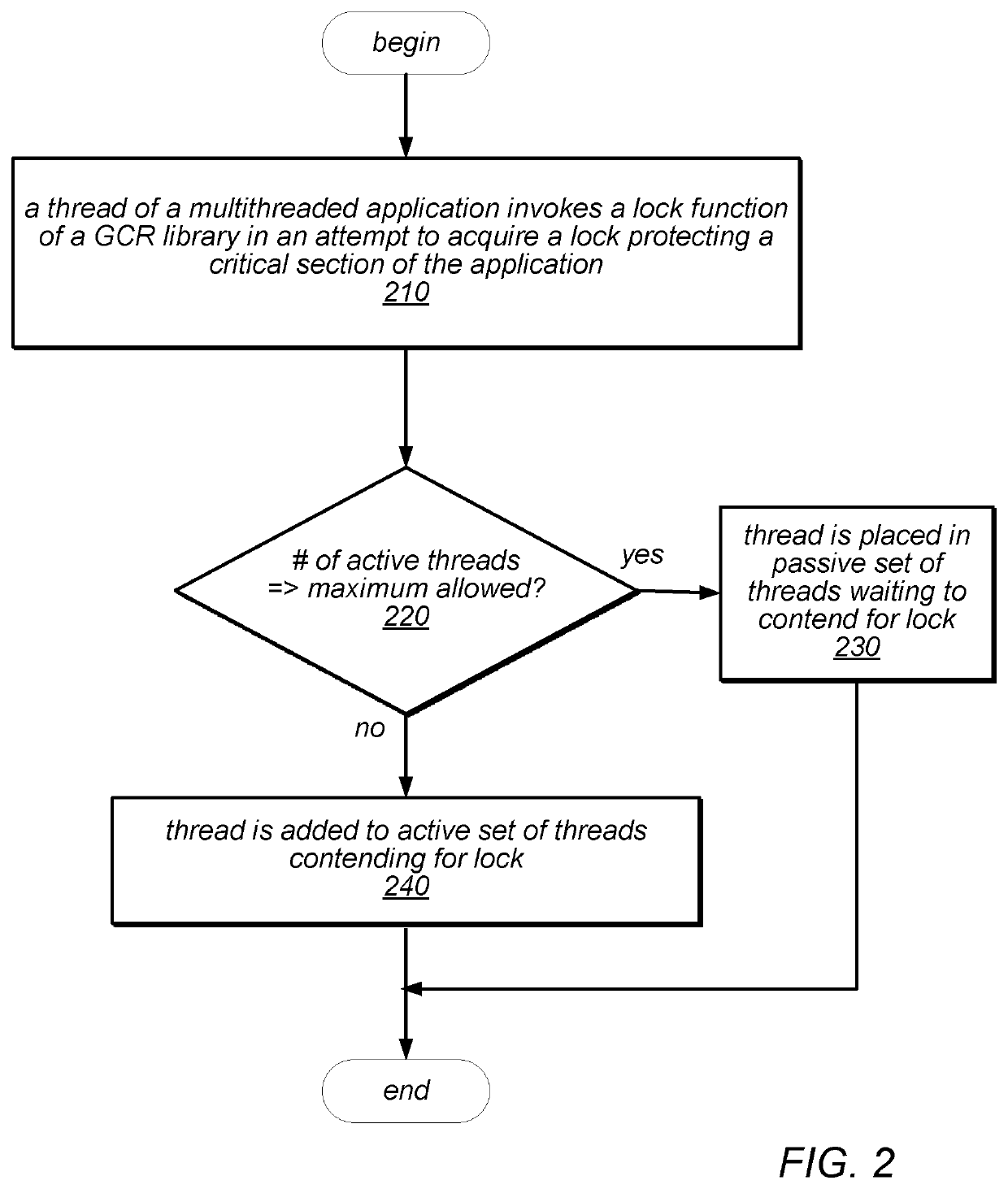
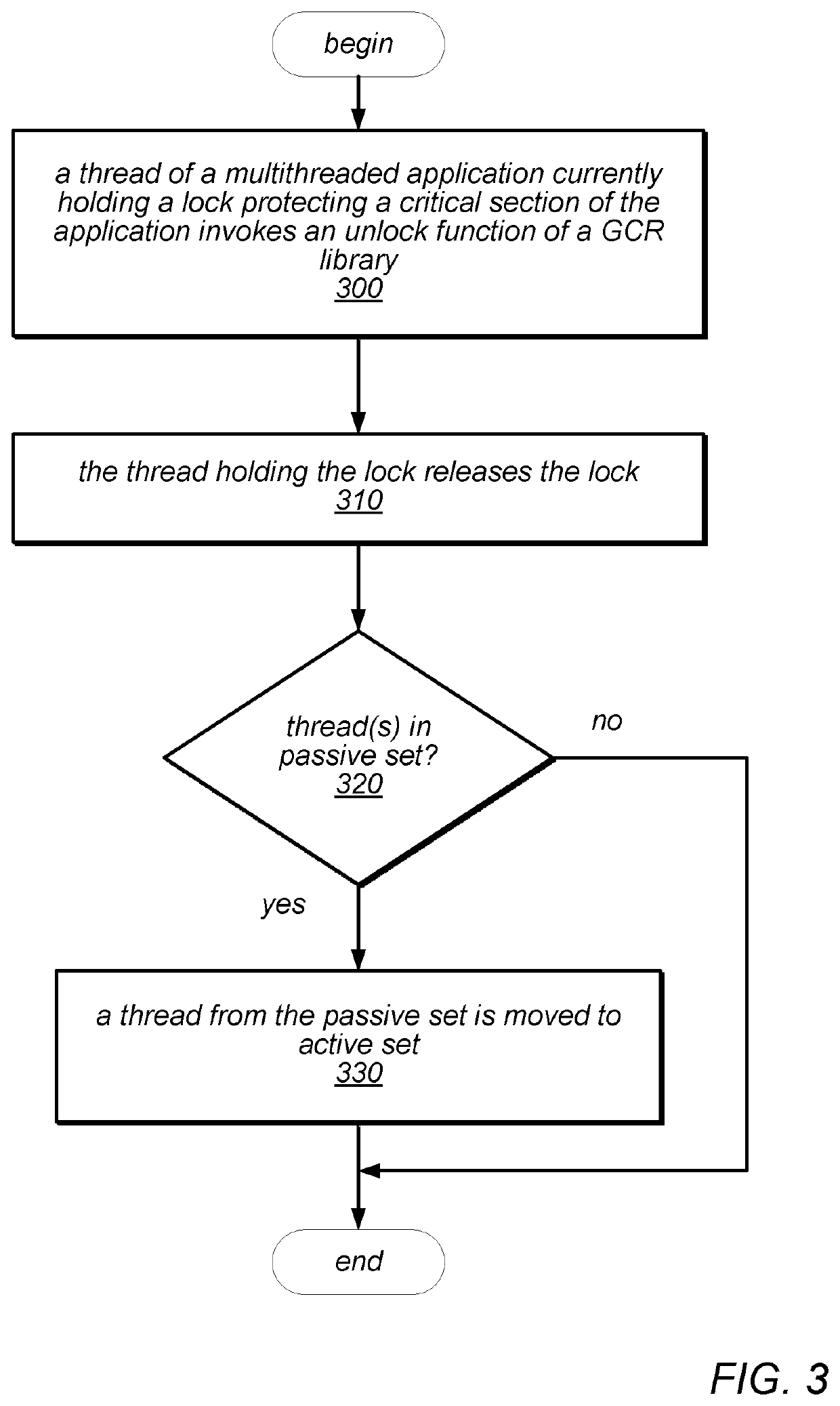
[0023]As noted above, Generic Concurrency Restriction (GCR), as described herein, may involve dividing a set of threads waiting to acquire a lock into two sets: an active set that is currently able to contend for the lock, and a passive set that awaits an opportunity to be able to contend for the lock (e.g., by joining the active set). Often, multithreaded systems have contended locks. In some embodiments of the systems described herein, generic concurrency restriction (GCR) may be leveraged to restrict the number of threads in circulation. In some embodiments, the number of threads in the active set may be limited to a predefined maximum and may, in some embodiments, be limited to a single thread. In some embodiments, each thread in the active set may circulate from executing its non-critical section to waiting, from waiting to lock ownership and execution of its critical section, and then back to executing its non-critical section.

[0024]Concurrency restriction has been shown to be...

the structure of the environmentally friendly knitted fabric provided by the present invention; figure 2 Flow chart of the yarn wrapping machine for environmentally friendly knitted fabrics and storage devices; image 3 Is the parameter map of the yarn covering machine
Login to View More

PUM

No PUM Login to View More

Abstract

Generic Concurrency Restriction (GCR) may divide a set of threads waiting to acquire a lock into two sets: an active set currently able to contend for the lock, and a passive set waiting for an opportunity to join the active set and contend for the lock. The number of threads in the active set may be limited to a predefined maximum or even a single thread. Generic Concurrency Restriction may be implemented as a wrapper around an existing lock implementation. Generic Concurrency Restriction may, in some embodiments, be unfair (e.g., to some threads) over the short term, but may improve the overall throughput of the underlying multithreaded application via passivation of a portion of the waiting threads.

Description

BACKGROUND[0001]Field of the Disclosure[0002]This disclosure relates generally to managing accesses to shared resources in a multithreaded environment, and more particularly to systems and methods for performing concurrency restriction and throttling over contended locks.[0003]Description of the Related Art[0004]Concurrent applications running on modern multicore architectures are quite often over-threaded, that is, they use more threads than needed to achieve optimal performance. In a multiprocessor environment with threads and preemptive scheduling, threads can participate in a mutual exclusion protocol through the use of lock or “mutex” constructs. A mutual exclusion lock can either be in a locked state or an unlocked state, and only one thread can hold or own the lock at any given time. The thread that owns the lock may be permitted to enter a critical section of code protected by the lock or otherwise access a shared resource protected by the lock. If a second thread attempts t...

Claims

the structure of the environmentally friendly knitted fabric provided by the present invention; figure 2 Flow chart of the yarn wrapping machine for environmentally friendly knitted fabrics and storage devices; image 3 Is the parameter map of the yarn covering machine
Login to View More

Application Information

Patent Timeline
no application Login to View More
Patent Type & Authority Patents(United States)
IPC IPC(8): G06F9/46G06F9/52G06F9/50
CPCG06F9/52G06F9/524G06F9/5022
Inventor DICE, DAVIDKOGAN, ALEX
Owner ORACLE INT CORP