Premium transition factor

a transition factor and premium technology, applied in the field of algorithms, can solve the problems of unintended consequences, high auto theft rate or unusually high traffic density, and significant increases

US20070118411A1Inactive Publication Date: 2007-05-24PLYMOUTH ROCK ASSURANCE CORP
21 Cites 28 Cited by

Patent Information

Authority / Receiving Office
US · United States
Current Assignee / Owner
Publication Date
2007-05-24
Estimated Expiration
Not applicable · inactive patent

Smart Images

  • Figure 1
    Figure 1
  • Figure 2
    Figure 2
  • Figure 3
    Figure 3
Patent Text Reader

Abstract

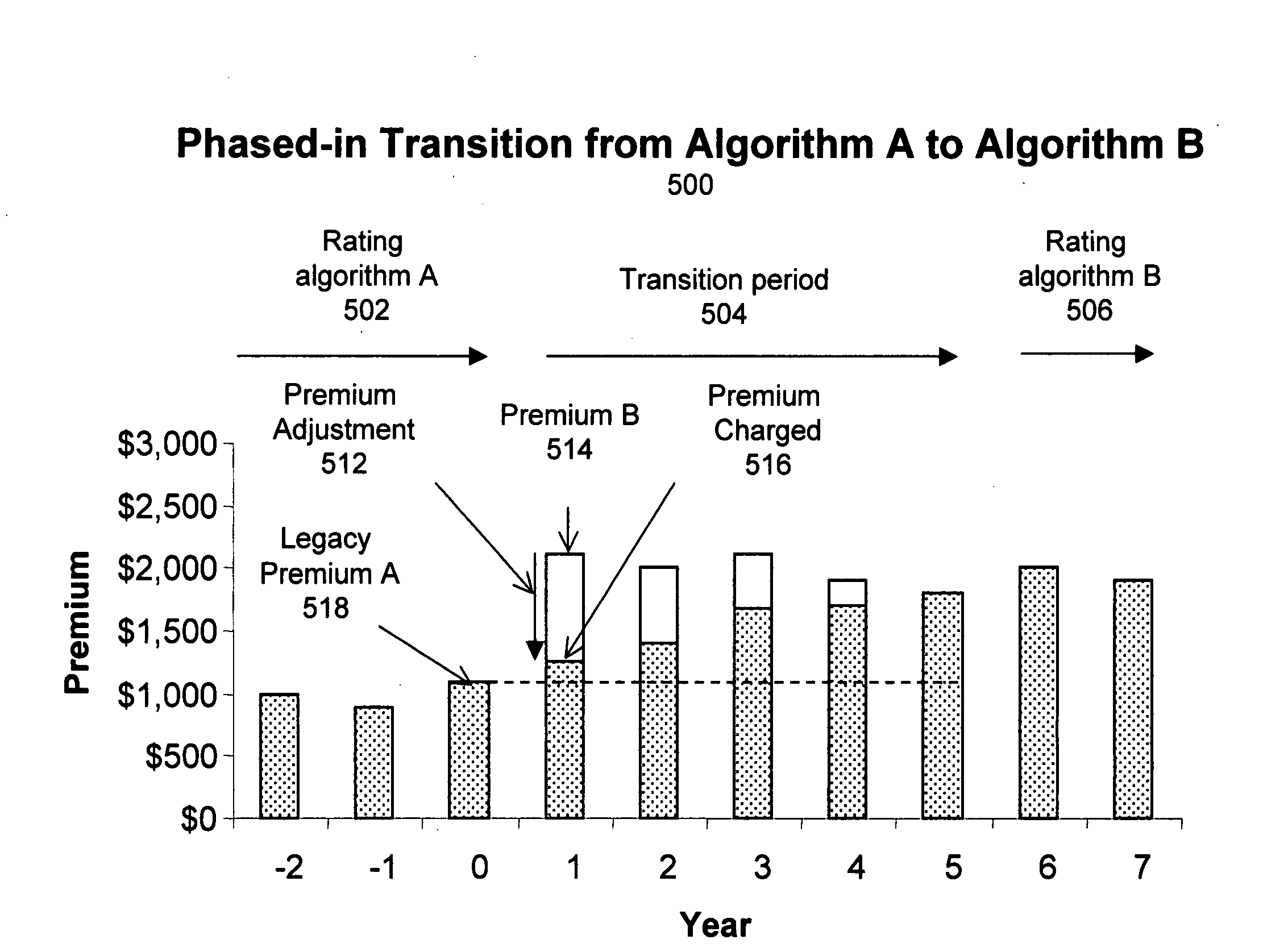
Auto insurance customers can be transitioned from an initial rating algorithm A to a subsequent algorithm B by phasing in the transition over a period of several years. The premium charged during the transition period is equal to the premium calculated under the rating algorithm B minus a premium adjustment. The premium adjustment is given by the difference between the premium according to algorithm B minus the legacy premium from algorithm A, said difference being multiplied by a rating transition factor. The rating transition factor may be a linearly decreasing function which has a value of 1 just before the transition period and a value of zero at the end of the transition period. The transition period may be in the range of 3 to 8 years long.
Need to check novelty before this filing date? Find Prior Art

Description

CROSS REFERENCE TO RELATED APPLICATION

[0001] This application claims the benefit of the filing date of U.S. provisional patent application Ser. No. 60 / 738,889, filed Nov. 22, 2005, entitled “Premium Transition Factor”. Said provisional application is incorporated herein by reference.FIELD OF THE INVENTION

[0002] This invention is in the field of automobile insurance. This invention is more particularly in the field of algorithms for setting auto insurance rates. BACKGROUND OF THE INVENTION

[0003] Automobile insurance premiums vary over time. The variations can be categorized as “normal” variations or “significant” variations. This invention seeks to mitigate at least one source of significant variations in an insured driver's automobile insurance rates so that said driver will be more satisfied with his or her insurance coverage.

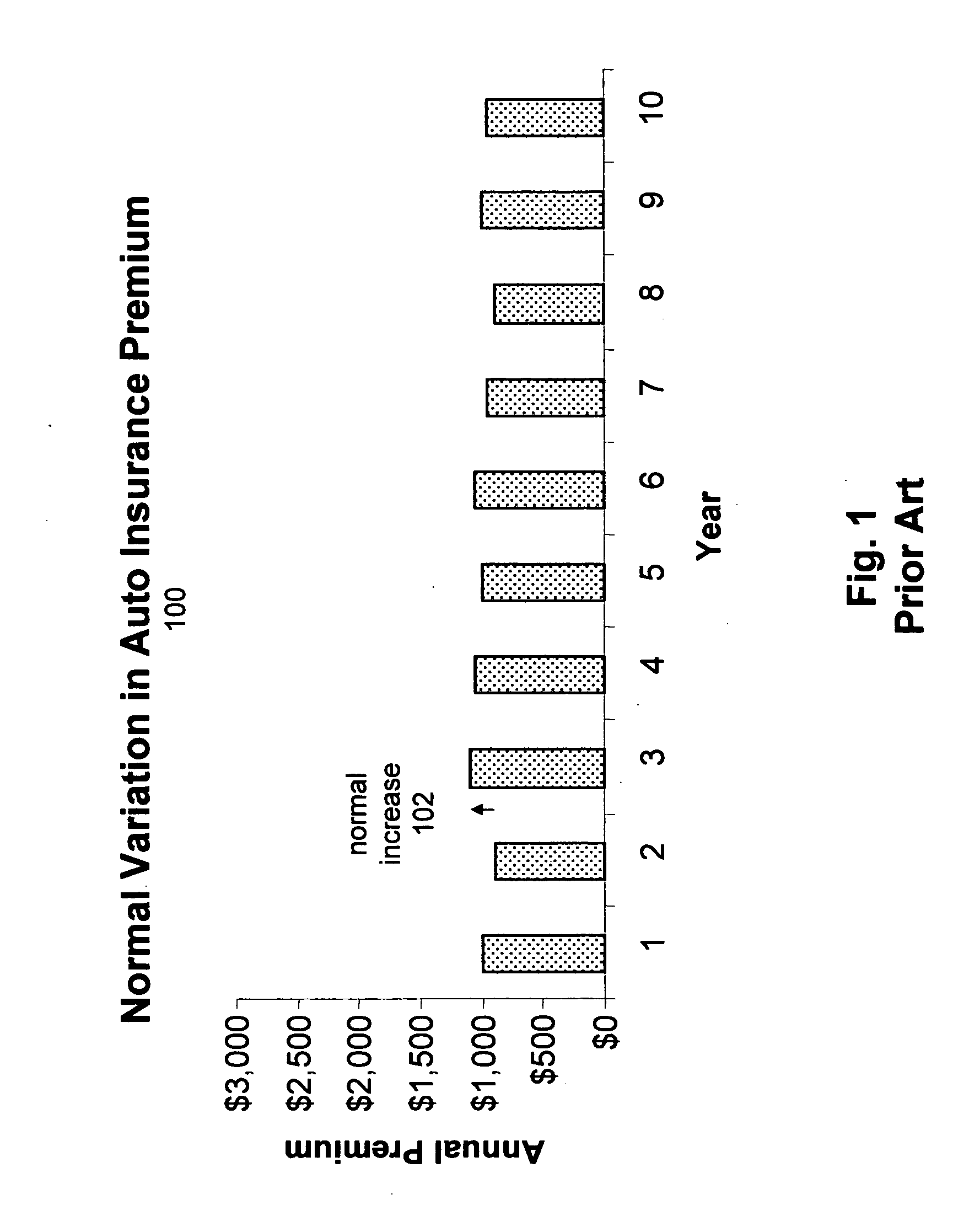
[0004] FIG. 1 illustrates normal variations in auto insurance rates. FIG. 1 shows a bar graph 100 of the annual premiums for a given insured driver over a ...

Examples

Embodiment Construction

[0029] The following detailed description discloses various embodiments and features of the invention. These embodiments and features are meant to be exemplary and not limiting.

[0030] In order to understand how the invention can provide for the gradual transition from the rating method of an insurance company A to the rating method of an insurance company B, it is first necessary to understand how automobile insurance rates are set.

Definitions

[0031] Auto insurance is a means by which at least some of the financial risks associated with operating an automobile are transferred from a driver to an insurance company. A driver that has auto insurance coverage is referred to as an “insured driver”. “Financial risks” include things such as the cost of repairing a car, compensating an injured person after a collision or providing legal defense for an insured driver.

[0032] An insurance policy is a document that specifies the financial risks for which an insured driver is covered. It furt...