
Screening Methods and Transgenic Animals for the Treatment of Beta-Globin Related Disease and Conditions
a technology of beta-globin and transgenic animals, which is applied in the direction of instruments, drug compositions, extracellular fluid disorders, etc., can solve the problem that the molecular basis of these regulatory mechanisms is still only incompletely defined
- Summary
- Abstract
- Description
- Claims
- Application Information
AI Technical Summary
Benefits of technology
Problems solved by technology
Method used
Image

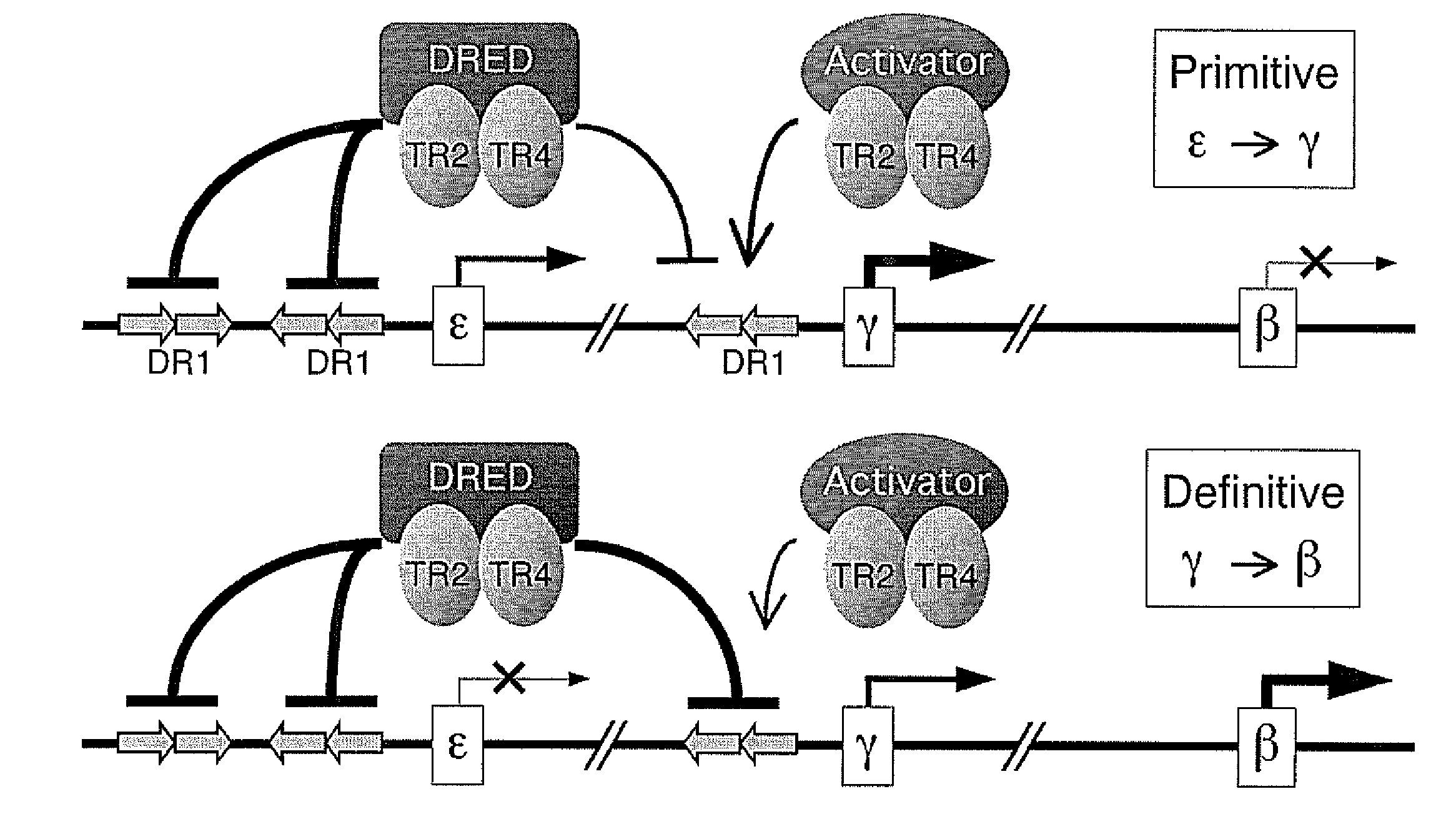
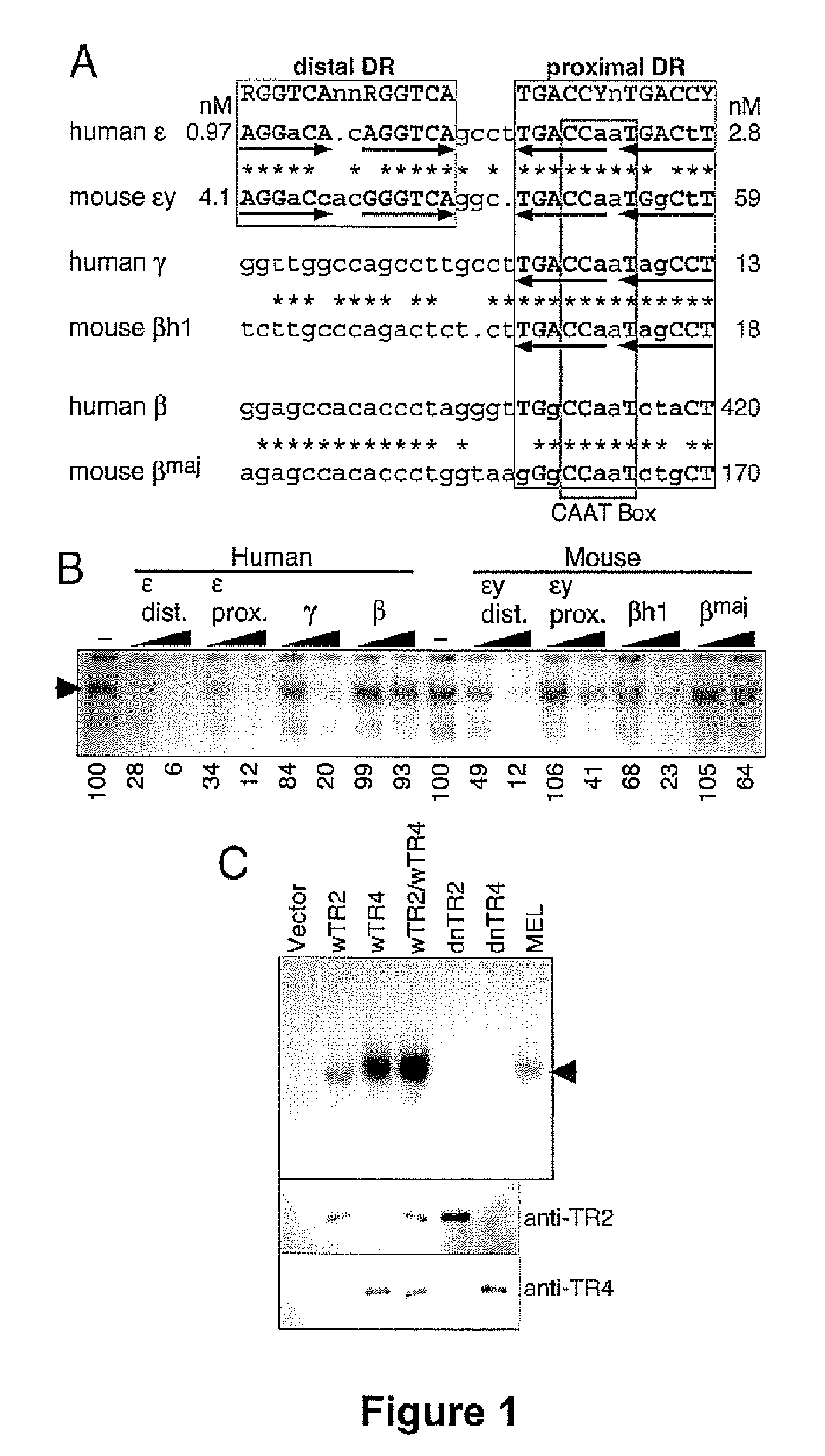
Examples
example 1
Materials and Methods
[0107] Plasmids. For transient expression in cell culture, the mouse TR2 and TR4 cDNAs were appended to Flag-tags at their amino-termini (Tanabe et al., 2002), and then cloned between the Nhe I and Not I sites of a CMV promoter-driven expression vector pEGFP-N3 (Clontech), replacing the eGFP gene. cDNAs encoding TR2 and TR4 mutants were generated by PCR-directed mutagenesis, and cloned into the same vector. For transgenic expression, the Flag-tagged mouse TR2 or TR4 cDNAs, the dominant negative TR4 mutant, and eGFP (Sma I-Not I fragment) from the pEGFP-N3 plasmid were ligated to the Kpn I-Not I fragment from IE3.9int-LacZ (GATA1-HRD, (Onodera et al., 1997)) followed by the SV40 polyadenylation signal.
[0108] Mice. The Tr2 and Tr4 null mutant mice were described previously (Shyr et al., 2002; Collins et al., 2004). For generation of transgenic mice expressing wild-type TR2 or TR4, or the dominant negative TR4 mutant, the expression DNAs were separated from the p...
example 2
Analysis of Tr2 and Tr4 Null Mutant Mice
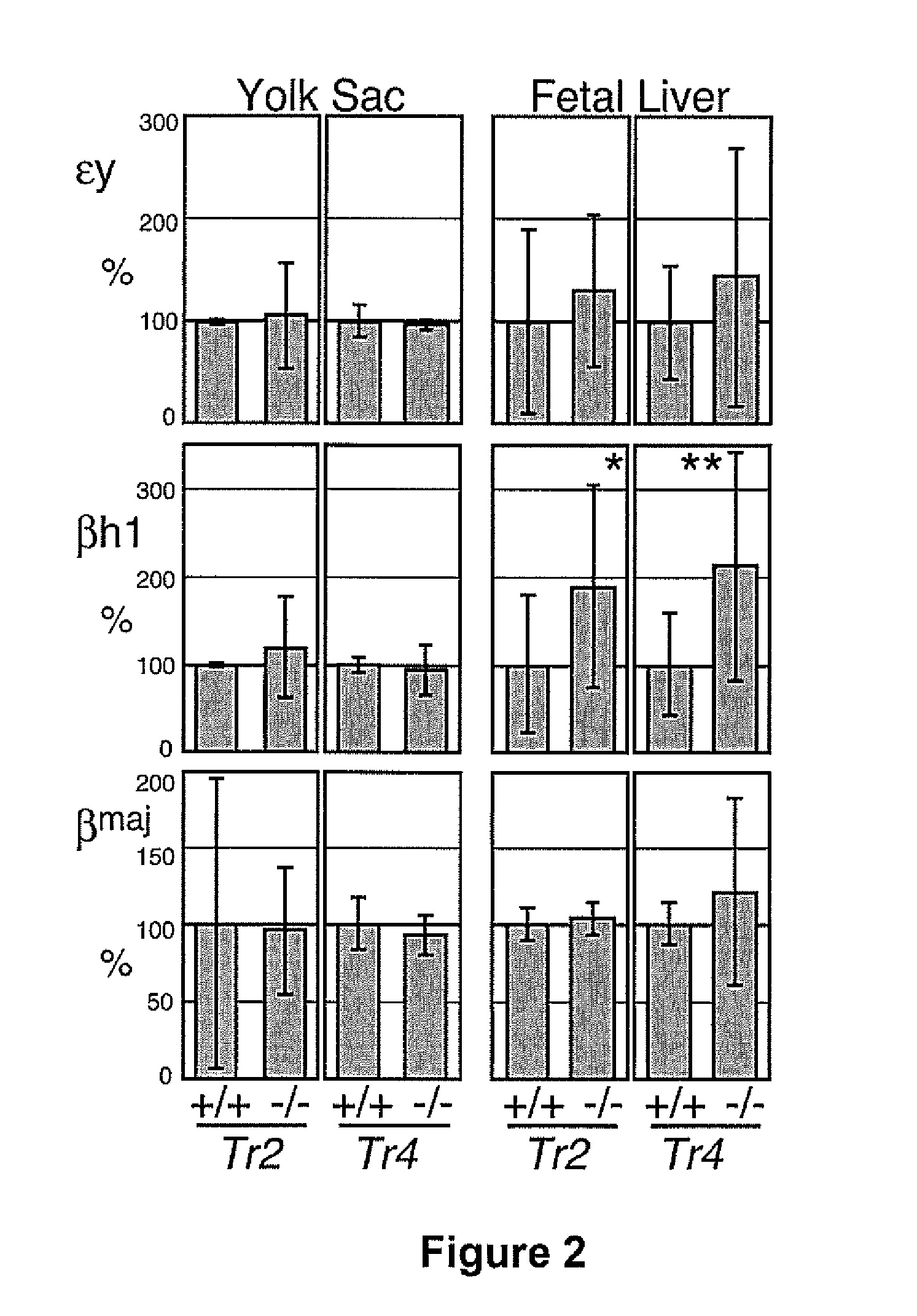
[0117] In order to investigate the in vivo roles of TR2 and TR4 in β-type globin gene regulation, the expression of the mouse globin genes in Tr2 or Tr4 null mutant mice (Shyr et al., 2002; Collins et al., 2004) was analyzed. The expression level of the embryonic εy-, βh1-, and adult βmajor globin genes in 10.5 dpc yolk sac, 13.5 dpc fetal liver, and adult spleen (from acetylphenylhydrazine-induced anemic animals) was determined by semi-quantitative RT-PCR, and normalized to endogenous α-globin mRNA (FIG. 2).
[0118] In the yolk sac, there was no significant difference in the expression of any of the globin genes between the homozygous null Tr2 or Tr4 mutant embryos and their wild-type littermates. In the fetal liver, the βh1 gene was induced approximately 2-fold in both Tr2 or Tr4 homozygous null mutant fetuses as compared to their wild-type littermates, but expression of the embryonic εy or adult βmajor genes was unaffected. In the adult spl...
example 3
TR2 and TR4 Forced Expression in Transgenic Mice
[0126] The present Example investigates the roles for TR2 and TR4 in β-type globin gene regulation after their transgenic forced expression.
[0127] In order to restrict expression exclusively to hematopoietic cells, the TR2 or TR4 cDNAs were placed under the control of the mouse Gata1 locus hematopoietic regulatory domain (G1-HRD), a regulatory construct that is sufficient to drive expression of the cDNAs exclusively in primitive and definitive erythroid cells (Onodera et al., 1997). The eGFP (enhanced green fluorescent protein) gene was also placed under G1-HRD control, and used to generate a fluorescent marker to reflect the specificity of transgene expression. By microinjecting the TR2 or TR4 construct, or both, together with the eGFP construct into fertilized oocytes, transgenic lines carrying the TR2 (4 lines of TgTR2 mice) or TR4 (5 lines of TgTR4 mice), or both (8 lines of TgTR2 / TR4 mice) were generated. After backcrossing the f...
PUM
| Property | Measurement | Unit |
|---|---|---|
| Atomic weight | aaaaa | aaaaa |
| Composition | aaaaa | aaaaa |
| Error | aaaaa | aaaaa |
Abstract
Description
Claims
Application Information
 Login to View More