
Scalable optical-core network
a technology of optical core network and optical core, applied in the field of telecommunications networks, can solve the problems of limiting the capabilities of the network, not being able to provide advanced services, and not being able to scale up, and achieve the effect of simplifying and robust routing schemes
- Summary
- Abstract
- Description
- Claims
- Application Information
AI Technical Summary
Benefits of technology
Problems solved by technology
Method used
Image

Examples
Embodiment Construction
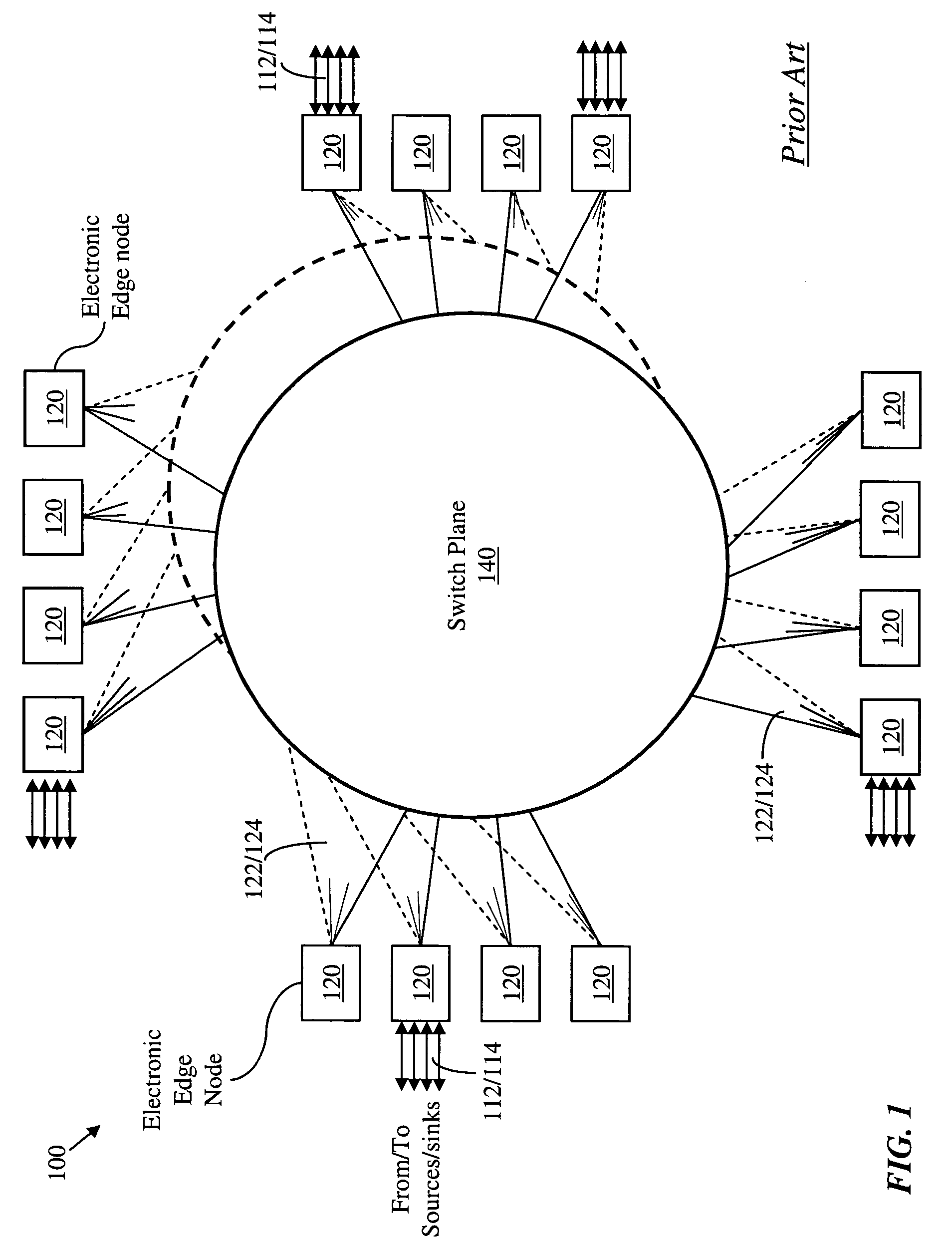
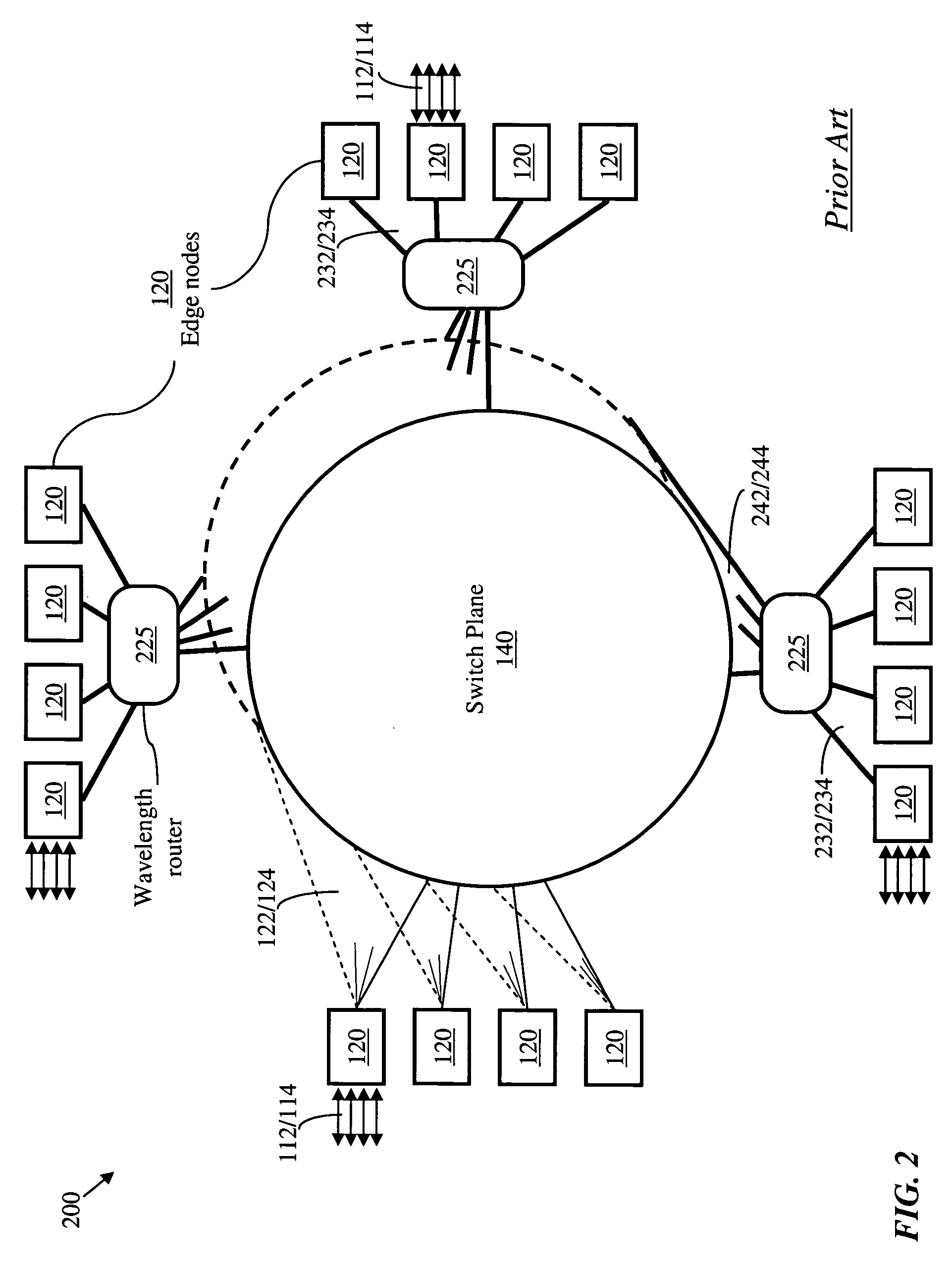
[0041]An envisaged new network structure, according to the present invention, employs an optical core of fine granularity and aims at reducing the mean number of hops between sources and sinks, weighted by the flow rates of the network's traffic streams. This is because, as a general rule, routing complexity increases rapidly, and network efficiency decreases rapidly, as the number of hops from source to sink increases. Therefore, it is desirable to explore a network architecture that provides very high access capacity and very wide coverage (i.e., accommodating a very large number of edge nodes) while realizing the minimum number of hops provided in the intermediate-coverage networks of the prior art, such as the networks taught in U.S. Pat. Nos. 6,570,872 and 6,882,799.
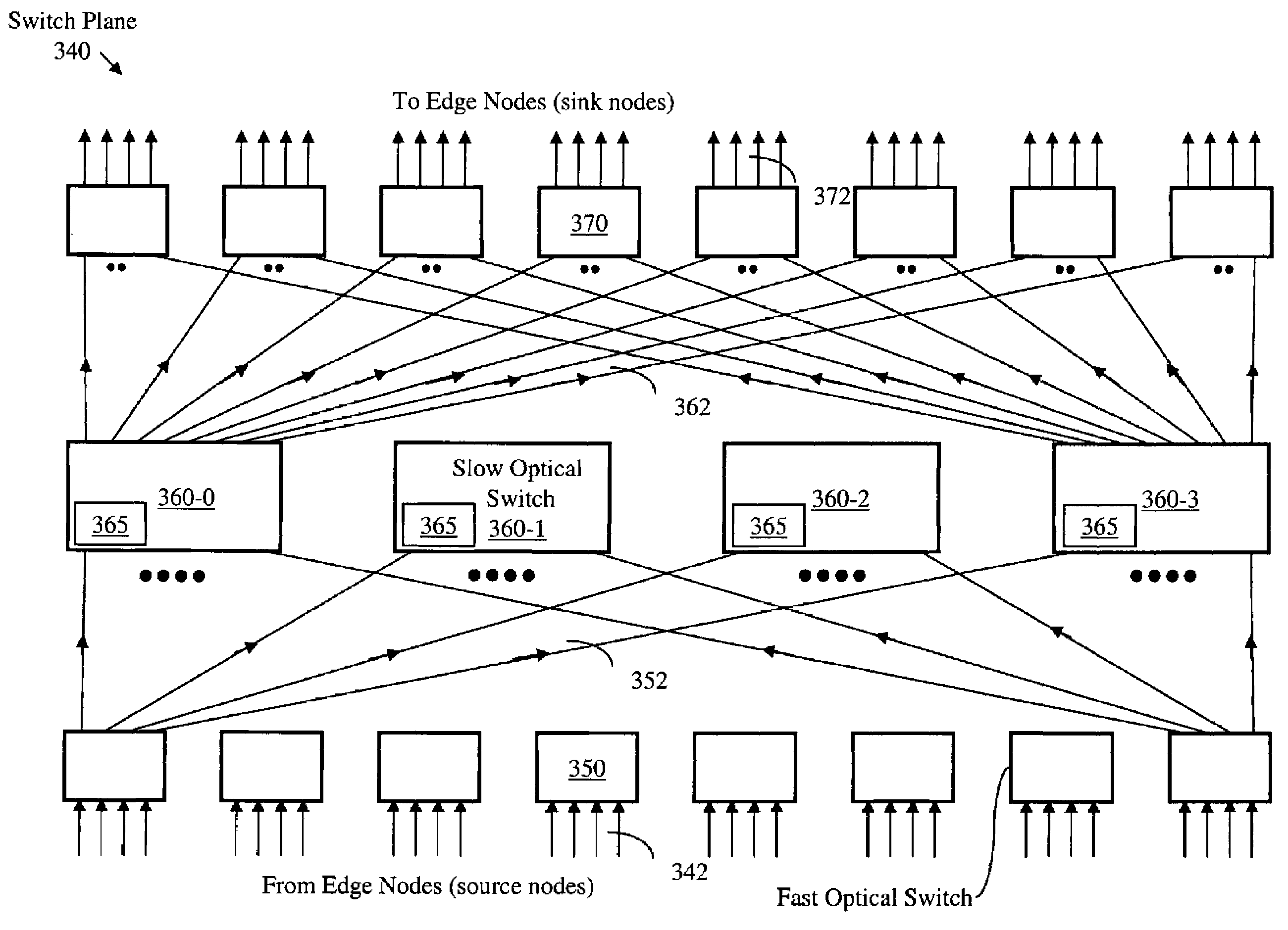
[0042]The present invention addresses these and other issues by providing novel switch planes that comprise both large-dimension optical switch units and fast optical switch units. (A switch having P input ports and...
PUM
 Login to View More
 Abstract
Description
Claims
Application Information
 Login to View More