
Plasmids for transforming bacteria of the acidithiobacillus spp. genus, and transformation method
a technology of acidithiobacillus and plasmids, which is applied in the field of plasmids for transforming bacteria of the acidithiobacillus spp. genus, and transformation methods, can solve the problems of complex manipulation of i>acidithiobacillus /i>spp., the use of substrates is not simple, and the culturing of acidithiobacillus in the laboratory is not simpl
- Summary
- Abstract
- Description
- Claims
- Application Information
AI Technical Summary
Problems solved by technology
Method used
Image

Examples
example 1
Construction of the Vector
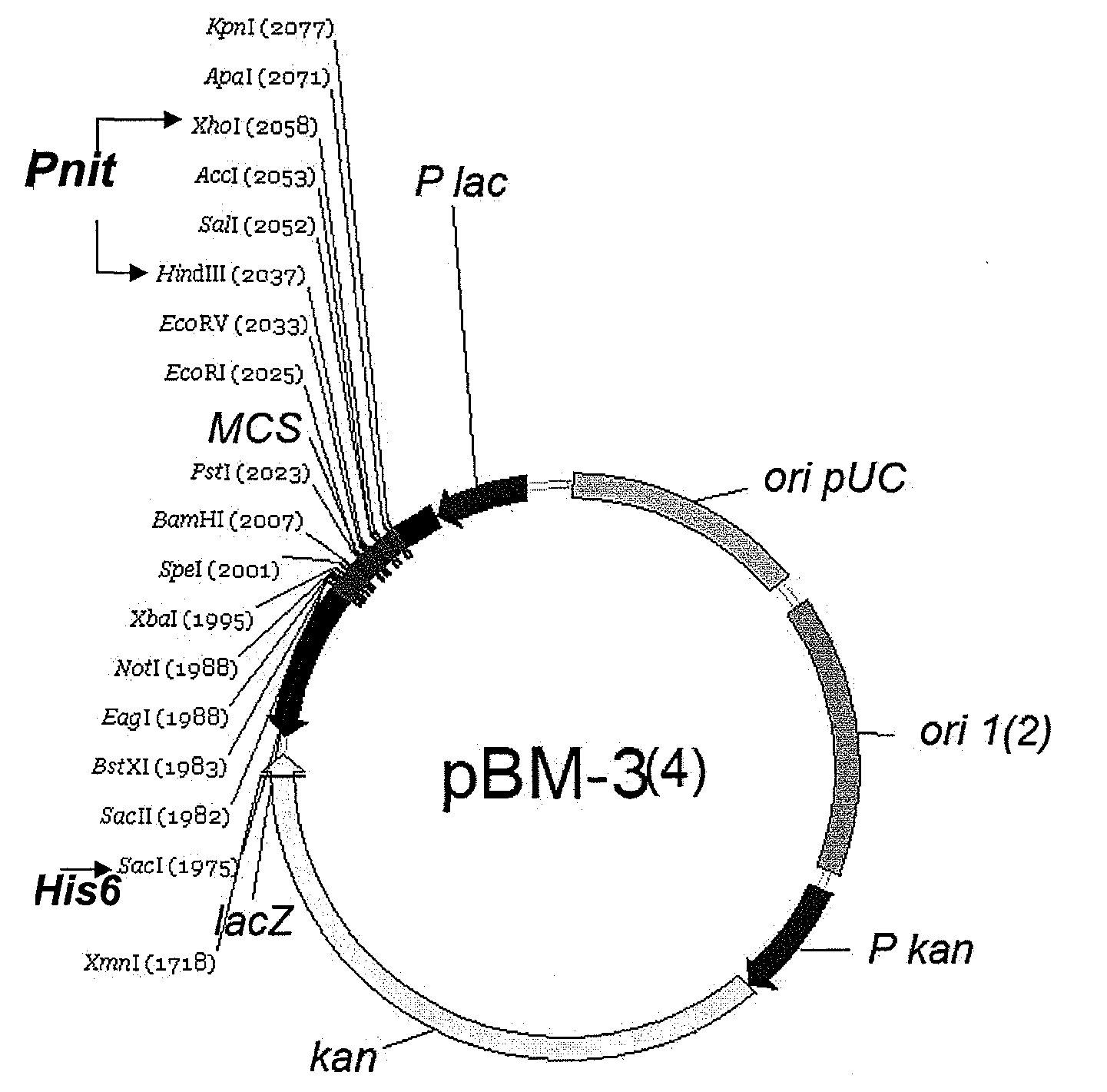
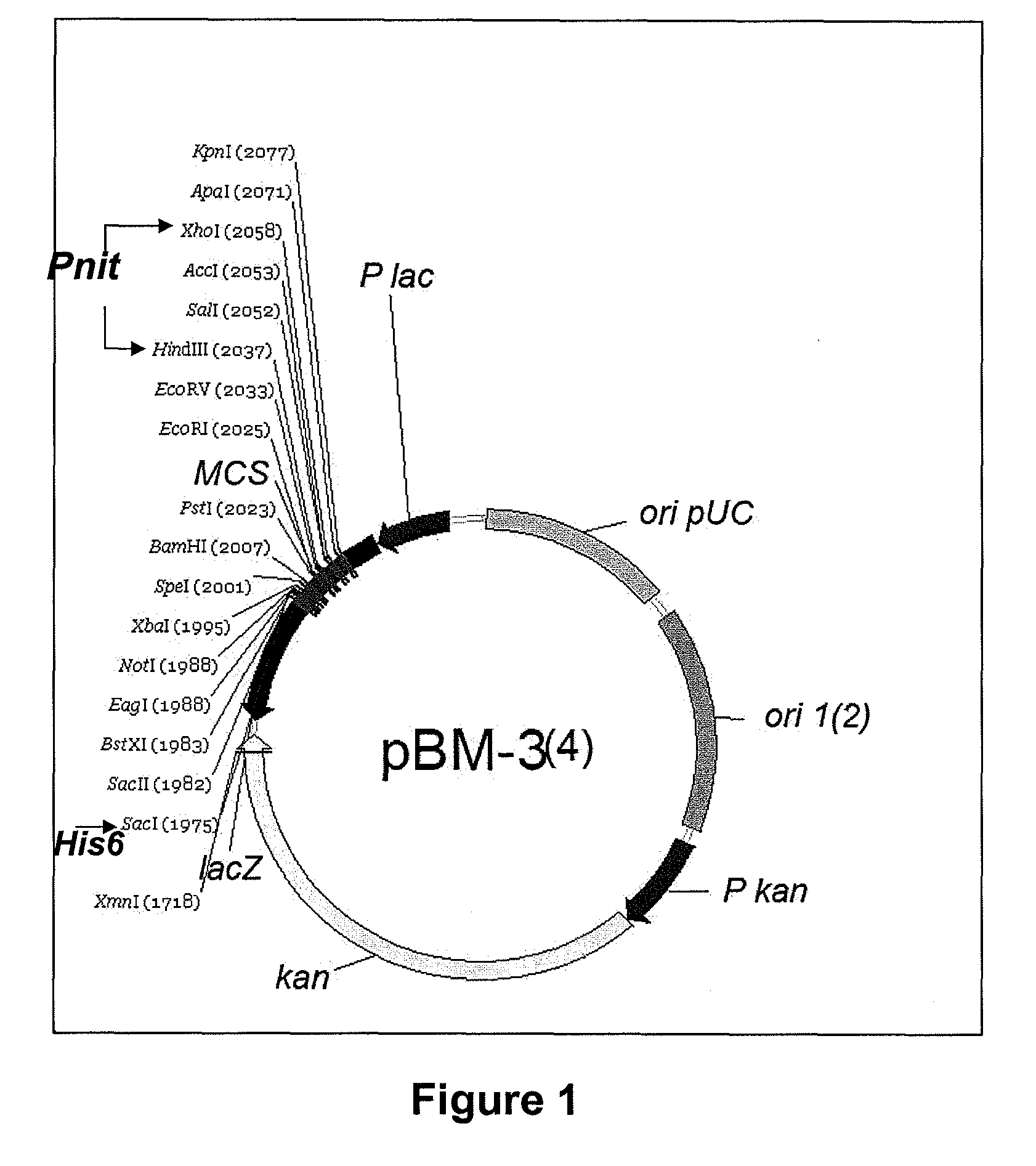
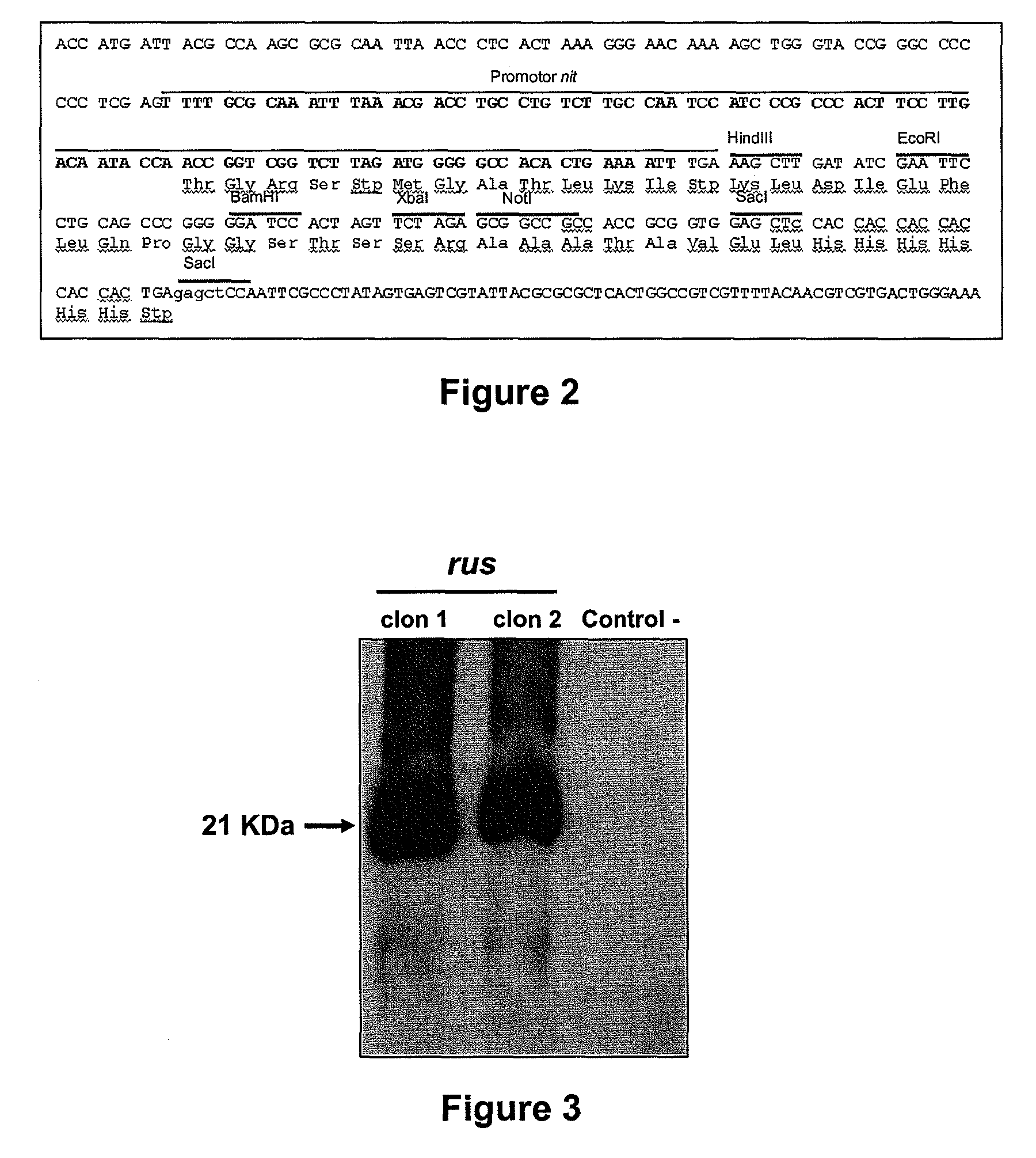
[0063]A fragment containing the or, represented in Sequence No 1 was amplified through PCR, and on completion, oriented by means of restriction enzymes (PagI / HpaI). The kan fragment was obtained from the pTOPO vector and connected in the ScaI site to the multiple cloning site (MCS) shown in FIG. 2, and to the pUC origin of replication obtained from the pBluescript vector. The resulting fragment was linked in the PagI / HpaI sites to ori 1, through the use of the T4 ligase enzyme. The Pnit promoter in the XhoI / HindIII restriction sites, and the sequence of 6 histadines in the SacI site, were subsequently added to the genetic vector.
[0064]The resulting plasmid, named pBM-3 PnH®, has an expected size of approximately 4500 bp, and its structure is presented in FIG. 1.
[0065]The product of the liaison was used for transforming E. coli by means of electroporation, under standard conditions. Transformants were selected in an LB agar medium containing 50 μg / mL of Kana...
example 2
Transformation by Electroporation of Acidithiobacillus ferrooxidans
[0067]Firstly, the culture substrate was adapted to the substrate of the invention, Tetrathionate salts, and the pH of the cultures was kept constant.
[0068]A culture of 10 mL of Acidithiobacillus ferrooxidans which uses ferrous sulfate as a source of sulfate, and grows at pH 2.5, was provided.
[0069]An inoculum of 1 mL of the said culture was sampled and transferred to 9 mL of a 1% S medium. The culture was incubated during 1 week at 30° C.
[0070]An inoculum of 1 mL of the culture in S was then transferred to 9 mL of 9K 0.1% Tetrathionate medium, the composition of which is shown in Table 1. The culture was incubated during 1 week at 30° C.
TABLE 19K Liquid Medium, 1XComponentConcentration, (g / L)(NH4)2SO43.0K2HPO40.5MgSO4 7 *H2O0.5KCl0.1Ca(NO3)20.01
[0071]The culture's pH was later adjusted to a pH close to neutral, maintaining the substrate.
[0072]To this end, 1 mL of the culture in 9K 1% Tetrathionate, pH 2.5, was samp...
example 3
Recovery of a Vector from a Transformed Strain of Acidithiobacillus Ferrooxidans
[0082]The Plasmidial DNA was isolated by the alkaline lysis method, from a clone of Acidithiobacillus ferrooxidans transformed with pBM-3 PnH®, and grown in a 9K sulfur medium with a kan of 50 ug / ml. An initial gel was prepared to verify the presence of the vector, as shown in FIG. 5, where 10 μL of extract mix were placed on the first lane, and 20 μL of the same extract mix of plasmidial DNA from the transformed Acidithiobacillus ferrooxidans strain were placed on the second lane. The third and fourth lanes correspond to molecular standards 100 pb and λHindIII, respectively. The band displayed conforms to the expected size of the vector. This shows that, given that the vector can be recovered, transformation is stable.
[0083]A second method of verification of the success of the transformation, a PCR amplification, was carried out on the Kanamycin (kan)-resistant gene included in the vector. PCR reaction...
PUM
| Property | Measurement | Unit |
|---|---|---|
| pH | aaaaa | aaaaa |
| pH | aaaaa | aaaaa |
| pH | aaaaa | aaaaa |
Abstract
Description
Claims
Application Information
 Login to View More