
Control device for mobile body
- Summary
- Abstract
- Description
- Claims
- Application Information
AI Technical Summary
Benefits of technology
Problems solved by technology
Method used
Image

Examples
Embodiment Construction
[0088]The following will describe an embodiment of the present invention by taking a bipedal mobile robot as an example of a mobile body.
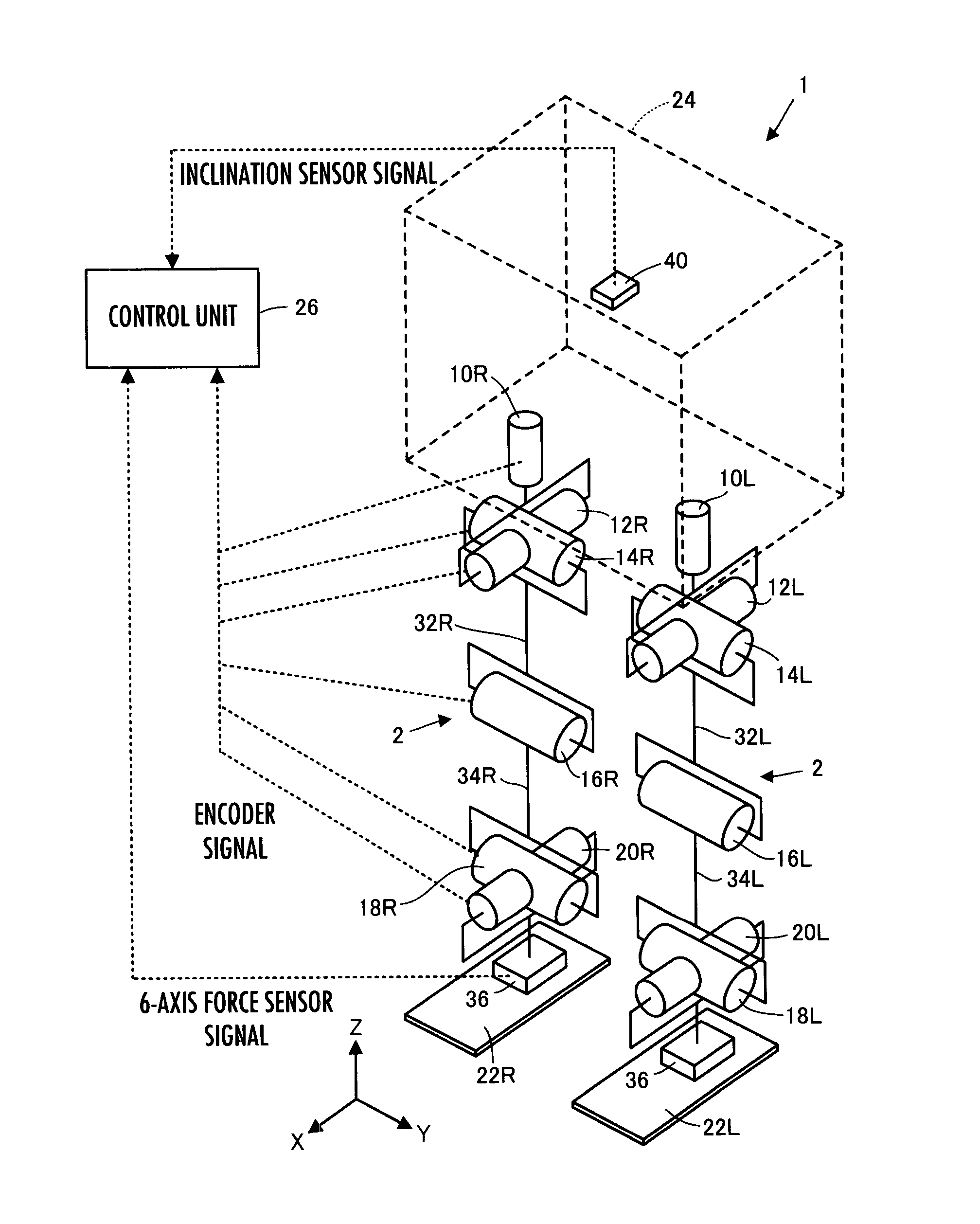
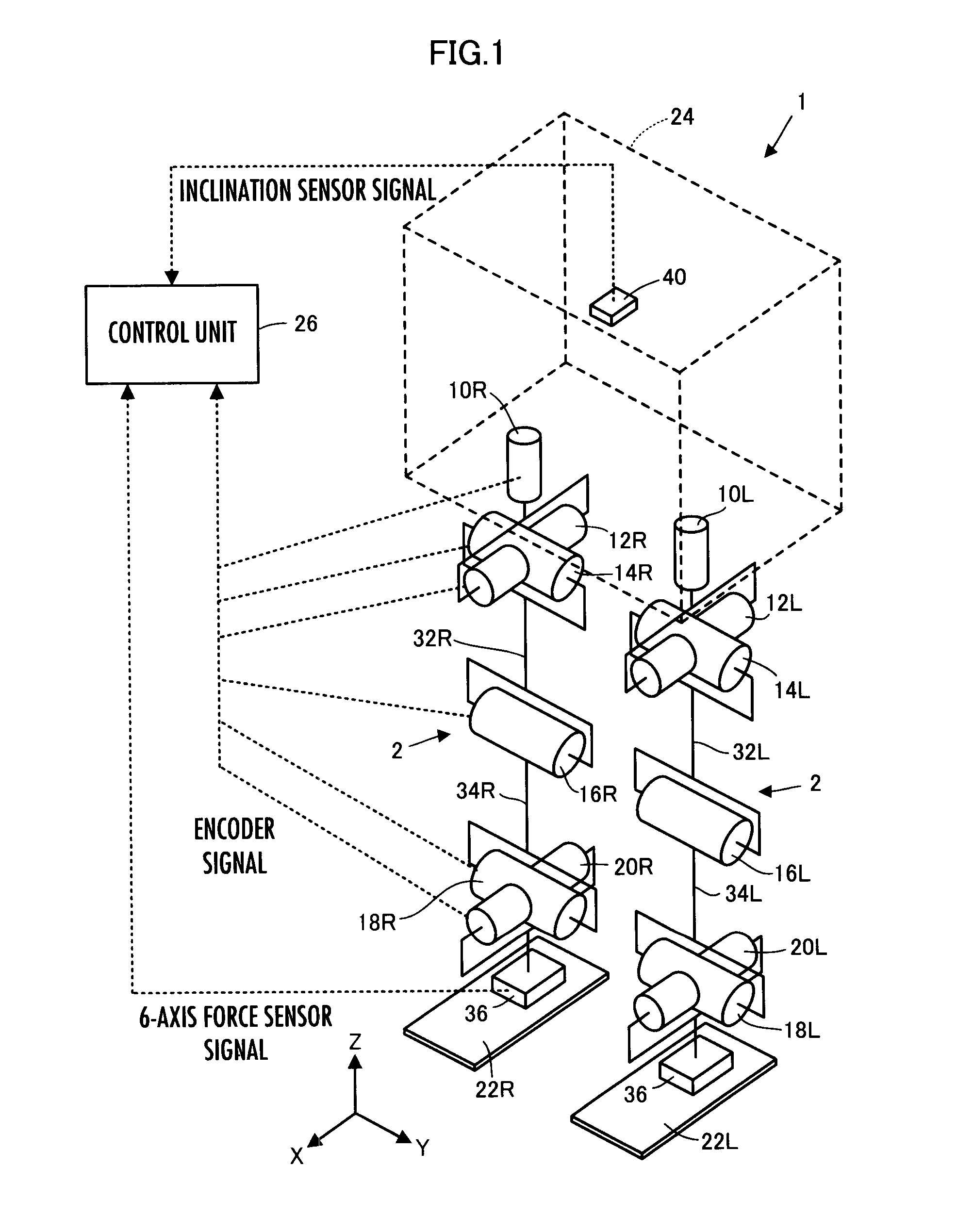
[0089]As illustrated in FIG. 1, a bipedal mobile robot 1 (hereinafter referred to simply as the robot 1) according to the present embodiment has a body 24 as a base body and a pair of right and left legs (leg links) 2, 2 interposed between the body 24 and a floor as a moving mechanism for moving the body 24 on a floor surface.
[0090]The body 24 is connected to the proximal end portions (upper end portions) of the two legs 2, 2 through the intermediary of a waist joint (hip joint), which will be discussed later, and is supported above the floor surface by one or both of the legs 2, 2 that are in contact with the ground.
[0091]The two legs 2, 2 share the same construction and each thereof has six joints. The six joints are a joint 10R or 10L for turning a waist (hip) (for the rotation in the yaw direction relative to the body 24), a joint 12R or 12L fo...
PUM
 Login to View More
 Abstract
Description
Claims
Application Information
 Login to View More