
Thermoplastic Acrylic Resin, and Molded Product Thereof
- Summary
- Abstract
- Description
- Claims
- Application Information
AI Technical Summary
Benefits of technology
Problems solved by technology
Method used
Image

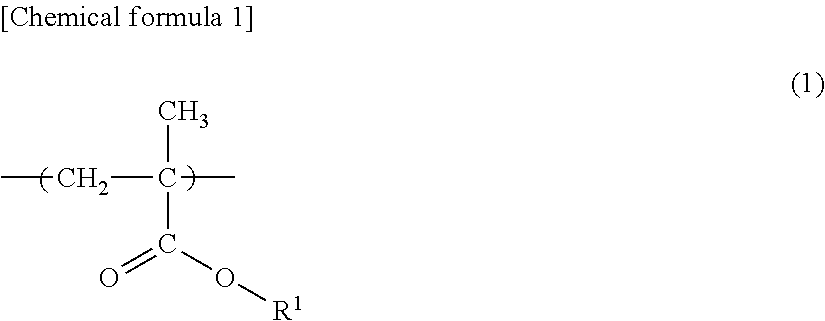
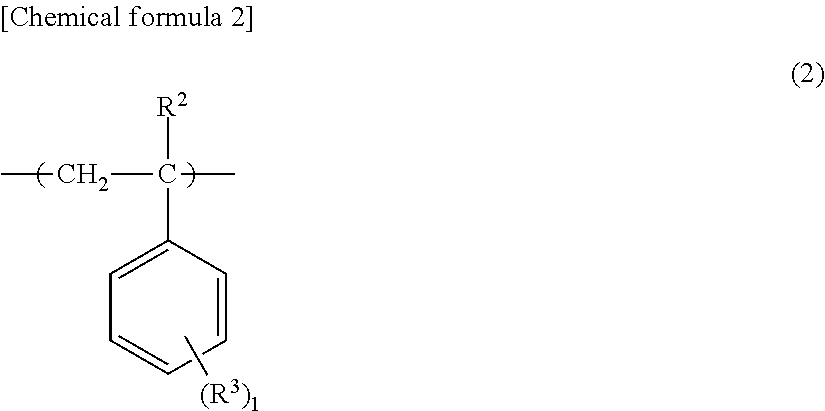
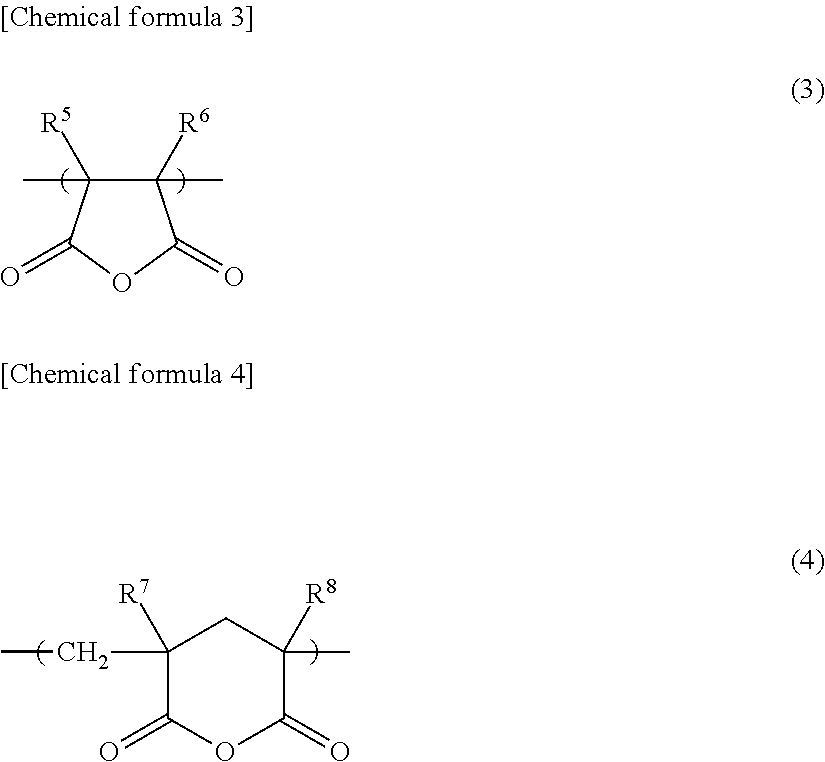
Examples
example 1
[0143]A glass reactor (1 L volume) with a jacket equipped with a stirrer, a temperature sensor, a cooling tube, a nitrogen gas introducing nozzle, a starting solution introducing nozzle, an initiator solution introducing nozzle and a polymer solution discharging nozzle was used. A pressure of the polymerization reactor was slightly increased, and a reaction temperature was controlled at 100° C.
[0144]A starting solution was prepared by mixing 518 g of methyl methacrylate (MMA), 48 g of styrene (St), 384 g of maleic anhydride (MAH), 240 g of ethylbenzene, 1.2 g of n-octyl mercaptane, and then replacing air in the reactor with nitrogen gas. An initiator solution was prepared by dissolving 0.364 g of 2,2′-azobis(isobutylonitrile) in 12.96 g of ethylbenzene, and then replacing air in the reactor with nitrogen gas.
[0145]The starting solution was introduced through the starting solution introducing nozzle at 6.98 ml / min. by using a pump. Furthermore, the initiator solution was introduced t...
example 2
[0147]The same procedures as in EXAMPLE 1 were repeated except that, different from EXAMPLE 1, 576 g of methyl methacrylate, 96 g of styrene, 288 g of maleic anhydride were used to obtain a thermoplastic acrylic resin.
Composition: MMA / St / MAH=58 / 19 / 23 wt % (mole ratio: B / A>1)
Molecular weight: Mw=19.7×10⁴; Mw / Mn=2.16
Tg: 144° C.
example 3
[0148]The same procedures as in EXAMPLE 1 were repeated except that, the same as in EXAMPLE 1, 518 g of methyl methacrylate, 48 g of styrene, 384 g of maleic acid anhydride were used to obtain a thermoplastic acrylic resin.
Composition: MMA / St / MAH=61 / 11 / 27 wt % (mole ratio: B / A>1)
Molecular weight: Mw=19.5×10⁴; Mw / Mn=2.23
Tg: 141° C.
Methyl methacrylate / styrene / maleic anhydride / benzyl methacrylate
PUM
| Property | Measurement | Unit |
|---|---|---|
| Fraction | aaaaa | aaaaa |
| Fraction | aaaaa | aaaaa |
| Percent by mass | aaaaa | aaaaa |
Abstract
Description
Claims
Application Information
 Login to View More