
Systems and Methods of Detecting and Demonstrating Hair Damage Via Evaluation of Protein Fragments
a technology of protein fragments and hair damage, which is applied in the field of systems and methods of detecting and demonstrating hair damage via evaluation of protein fragments, can solve the problems of hair damage through protein loss, most people have no recognition of the amount of protein loss experienced by their hair, and their level of hair health
- Summary
- Abstract
- Description
- Claims
- Application Information
AI Technical Summary
Problems solved by technology
Method used
Image

Examples
example a
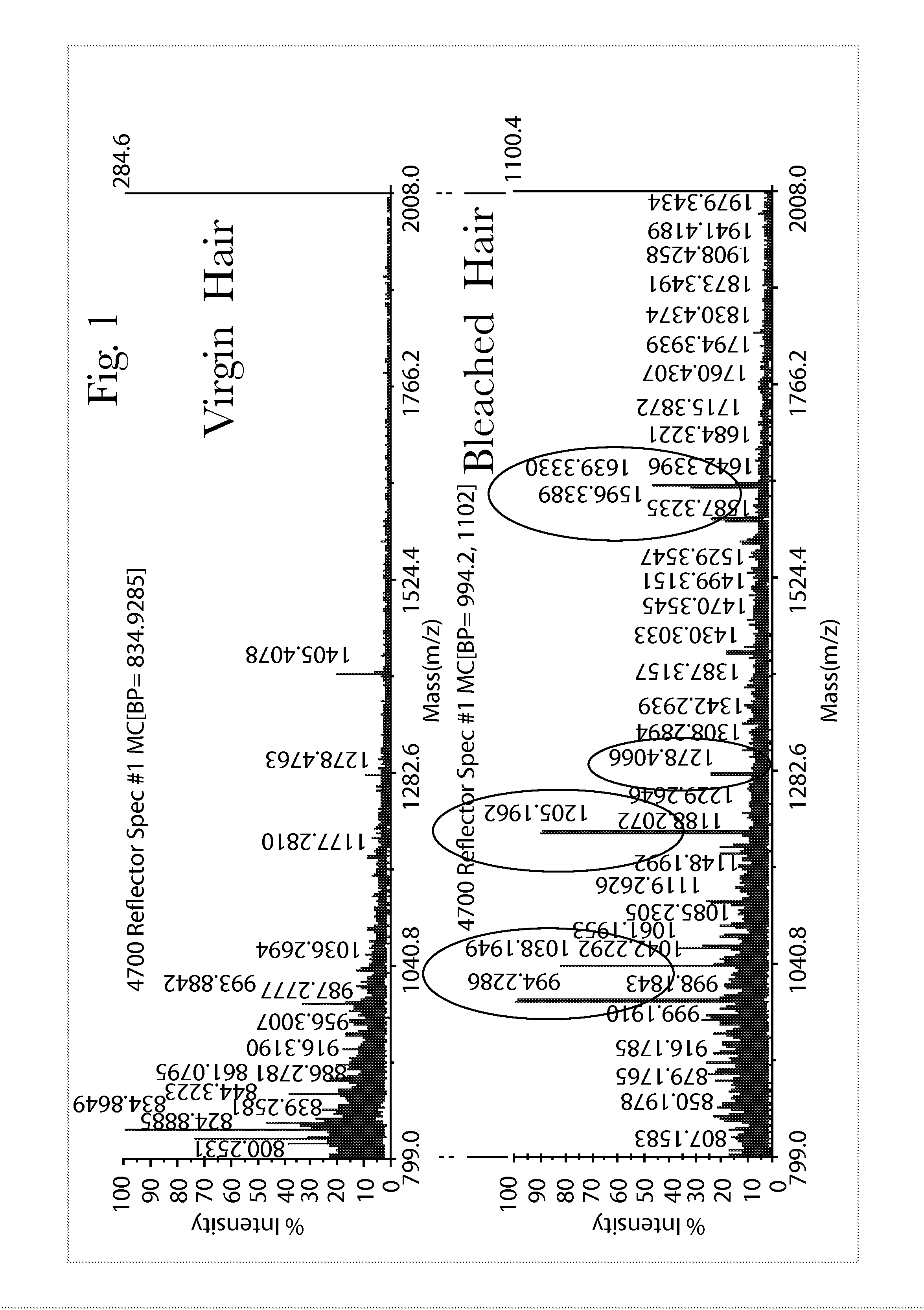
1. Bleaching of Hair to Generate Marker Protein Fragments Which indicate Damage from Bleach
[0024]Hair samples were bleached using the following protocols:
Protocol #1:
[0025]A bleaching solution consisting of 2% ammonium hydroxide, 0.2% tetrasodium EDTA (pH adjusted to 10.3 with acetic acid), and 6% hydrogen peroxide was prepared. Hair tresses (brown and natural white) were submerged in the bleaching solution and placed in a 40° C. oven. At timepoints of 30 to 90 minutes, hair tresses were removed from the bleaching solution, washed under DI tap water for two minutes, and dried.
Protocol #2:
[0026]Identical to Protocol #1, with the exception that hydrogen peroxide (H202) was excluded from the bleaching solution.
Protocol #3:
[0027]Identical to Protocol #1, with the exception that tetrasodium EDTA (C10H12N2O8Na4) was excluded from the bleaching solution.
2. Protein Loss Analysis of Hair Tresses Post-Bleaching
[0028]The amount of overall protein damage sustained by the hair tresses as a resul...
example b
[0033]Damage to hair fibers upon exposure to UV light have been documented, including impairment of mechanical properties, morphological damage, and protein loss. The specific protein breakdown caused by UV to identify peptide markers for UV damage to the hair is examined via the process defined below.
[0034]1. Ultraviolet (UV) radiation exposure of Hair to Generate Marker Protein Fragments Which indicate Damage from UV:
[0035]Protocol: Hair tresses (General Population brown hair) were exposed to UV light for time points of up to 75 h in an Atlas Ci3000+Xenon Arc Fade-Ometer at an irradiance setting of 1.48 W / m2 at 420 nm, a chamber temperature of 35° C., and 80% relative humidity. One hour of UV exposure under the these conditions is approximately equivalent to 7.5 hours of external sun exposure in Florida, according to calculations performed using an Outdoor to Xenon Radiant Energy Conversion program provided by the manufacturer (Atlas Material Testing Technology LLC).
[0036]2. Prote...
PUM
| Property | Measurement | Unit |
|---|---|---|
| Molecular Weights | aaaaa | aaaaa |
| delta mass | aaaaa | aaaaa |
| pH | aaaaa | aaaaa |
Abstract
Description
Claims
Application Information
 Login to View More