Silica Nanoparticles Incorporating Chemiluminescent And Absorbing Active Molecules

a technology of active molecules and silica nanoparticles, which is applied in the field of silica nanoparticles containing absorber dyes, can solve the problems of low efficiency of the designed reaction and unsuitable use in some applications

Inactive Publication Date: 2012-03-29
CORNELL UNIVERSITY
View PDF26 Cites 14 Cited by
  • Summary
  • Abstract
  • Description
  • Claims
  • Application Information

AI Technical Summary

Benefits of technology

The present invention provides nanoparticles that can detect an analyte by exhibiting chemiluminescent emission. The nanoparticles can be mesoporous silica nanoparticles or core-shell silica nanoparticles that have absorbing materials covalently linked to the silica network. The nanoparticles can be used as sensors to detect the analyte. The nanoparticles have pores of from 1 to 20 nm and can detect hydrogen peroxide or other chemical species. The nanoparticles can be functionalized with a surfactant to alter the diffusion of a chemical species through the nanoparticle. The invention provides a method for detecting a chemical species by exposing the nanoparticle to an environment comprising the analyte chemical species and detecting the chemiluminescent emission.

Problems solved by technology

Please note that this quantum efficiency is high for chemiluminescence reactions, but compared to living organisms, like fireflies, which produce bioluminescence (in fact, when a reaction of this nature occurs in living organisms, it is called bioluminescence), the efficiency of the designed reaction is very low.
Although the system that fireflies use is very quantum efficient, it is not desirable for use in some applications.

Method used

the structure of the environmentally friendly knitted fabric provided by the present invention; figure 2 Flow chart of the yarn wrapping machine for environmentally friendly knitted fabrics and storage devices; image 3 Is the parameter map of the yarn covering machine
View more

Image

Smart Image Click on the blue labels to locate them in the text.
Viewing Examples
Smart Image
  • Silica Nanoparticles Incorporating Chemiluminescent And Absorbing Active Molecules
  • Silica Nanoparticles Incorporating Chemiluminescent And Absorbing Active Molecules
  • Silica Nanoparticles Incorporating Chemiluminescent And Absorbing Active Molecules

Examples

Experimental program
Comparison scheme
Effect test

example 1

Preparation and Characterization of Mesoporous Silica Nanoparticles Containing Absorber Dye

Materials and Methods:

[0063]Step 1—Dye Preparation:

The NIR-dye, ADS832WS, is dissolved into DMSO to make a 4.5 mmolar solution. (e.g., 30.23 mg dye into 7.169 mL DMSO).

[0064]Step 2—Conjugation

The DMSO-dye solution is conjugated in a 1:50 ratio with 3-Isocyanatopropyltriethoxysilane (ICPTS). (e.g. 40 μL+22.5 μL ICPTS).

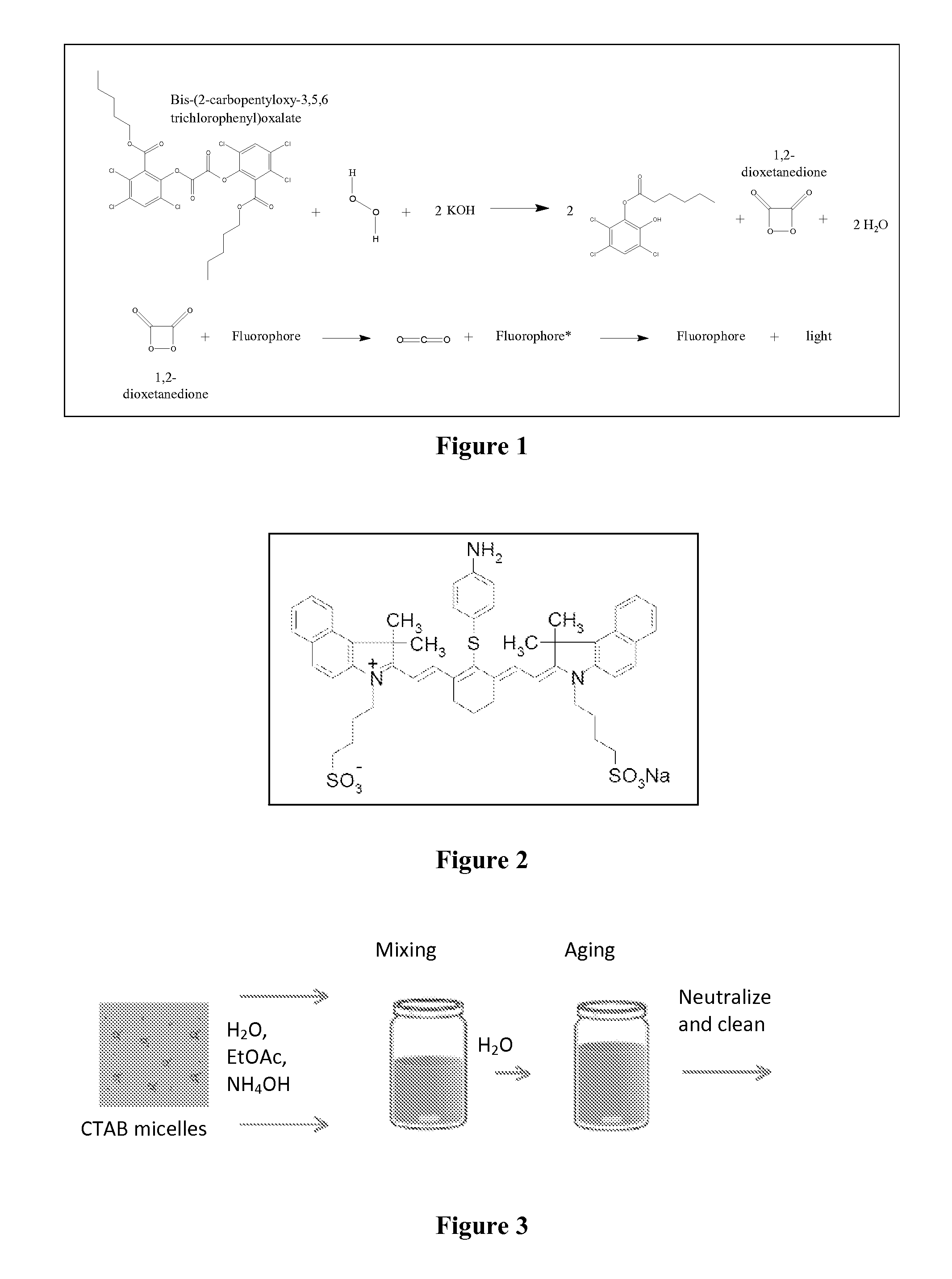
[0065]As mentioned before, ADS832WS was used as the NIR-dye (λAbs=832 nm). The chemical structure of the dye is shown in FIG. 2.

[0066]Nanoparticles with a porous structure were desired. Nanoparticles which match this requirement are known as mesoporous silica nanoparticles. By reacting a template of micelles with tetraethylorthosilicate (TEOS), mesoporous silica nanoparticles are synthesized as spheres or rods that are filled with a regular arrangement of pores. By adding a dye during the synthesis, the dye is integrated into the silica walls. The large surface area of the pores s...

example 2

Preparation and Characterization of Core-Shell Nanoparticles Containing Absorber Dye Experimental Methods

[0103]Dye Selection. The absorption dyes were selected based on their characteristic reactive groups and absorption peak wavelength. The dyes used in the experiments were 6-(2,4-dinitrophenyl)aminohexanoic acid, succinimidyl ester (DNP-X) with an absorption peak at approximately 350 nm and QXL490 C2 amine with an absorption peak at 485 nm. These two dyes allow research of core-shell nanoparticles with absorbing dyes to delve into both the ultraviolet (DNP-X) and visible (QXL490) regions of the absorption spectrum.

[0104]Particle Formation. To produce core-shell nanoparticles with the DNP-X and the QXL490 dyes three 25 mL, 20 nm particle reactions based on the Stober method for silica nanoparticle synthesis were sequentially run for each dye. One 25 mL, 100 nm particle reaction was also run for each dye.

[0105]The dyes, as purchased were packaged as a powder. For ease of handling an...

the structure of the environmentally friendly knitted fabric provided by the present invention; figure 2 Flow chart of the yarn wrapping machine for environmentally friendly knitted fabrics and storage devices; image 3 Is the parameter map of the yarn covering machine
Login to View More

PUM

PropertyMeasurementUnit
sizeaaaaaaaaaa
sizeaaaaaaaaaa
sizeaaaaaaaaaa
Login to View More

Abstract

Nanoparticles incorporating absorbing materials, e.g., an absorber dye, which under appropriate conditions exhibit chemiluminescence. The nanoparticles can be mesoporous silica nanoparticles or core-shell silica nanoparticles. The nanoparticles can be used as sensors to detect an analyte.

Description

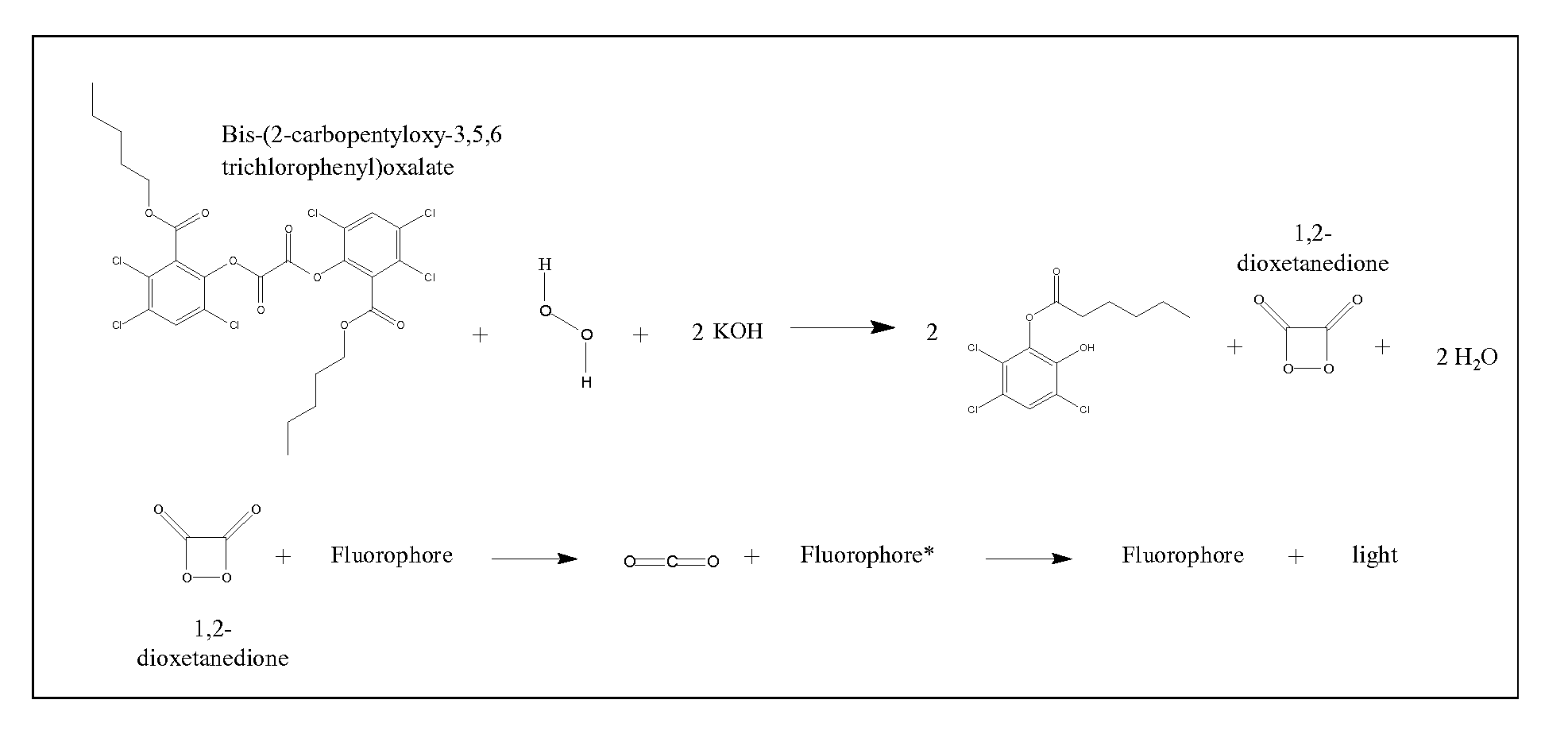
CROSS-REFERENCE TO RELATED APPLICATIONS[0001]This application claims priority to U.S. provisional patent application No. 61 / 169,605, filed Apr. 15, 2009, the disclosure of which is incorporated herein by reference.FIELD OF THE INVENTION[0002]The present invention relates generally to silica nanoparticles containing absorber dyes. More particularly, the present invention relates to mesoporous silica nanoparticles and core-shell nanoparticles containing absorbing and / or chemiluminescent materials and uses thereof.BACKGROUND OF THE INVENTION[0003]Chemiluminescence from concerted peroxide decomposition reactions was invented by M. M. Rauhut in 1969. This kind of light emission is the result of a chemical reaction in which a fluorophore is excited by a high energy product (in this case: 1,2-dioxethanedione). This highly unstable intermediate is produced in a SN2-reaction between hydrogen peroxide and a phenyloxalate. When the energy of the 1,2-dioxethanedione is transferred to the dye mo...

Claims

the structure of the environmentally friendly knitted fabric provided by the present invention; figure 2 Flow chart of the yarn wrapping machine for environmentally friendly knitted fabrics and storage devices; image 3 Is the parameter map of the yarn covering machine
Login to View More

Application Information

Patent Timeline
no application Login to View More
Patent Type & AuthorityApplications(United States)
IPC IPC(8): G01N21/76B32B5/16B82Y15/00
CPCG01N21/76Y10T436/206664Y10T428/2982
InventorWIESNER, ULRICH B.HERZ, ERIK
OwnerCORNELL UNIVERSITY