
Negative electrode for nonaqueous electrolyte secondary battery, method for producing same, and nonaqueous electrolyte secondary battery
a secondary battery and negative electrode technology, applied in the direction of cell components, electric/magnetic/electromagnetic heating, magnetic bodies, etc., can solve the problems of reducing discharge capacity, lithium ions cannot be efficiently inserted from the edge portions of respective layers of graphite, and discharge capacity decreases, so as to improve the large current characteristics, facilitate the inserting and extracting of lithium ions, and high capacity
- Summary
- Abstract
- Description
- Claims
- Application Information
AI Technical Summary
Benefits of technology
Problems solved by technology
Method used
Image

Examples
example 1
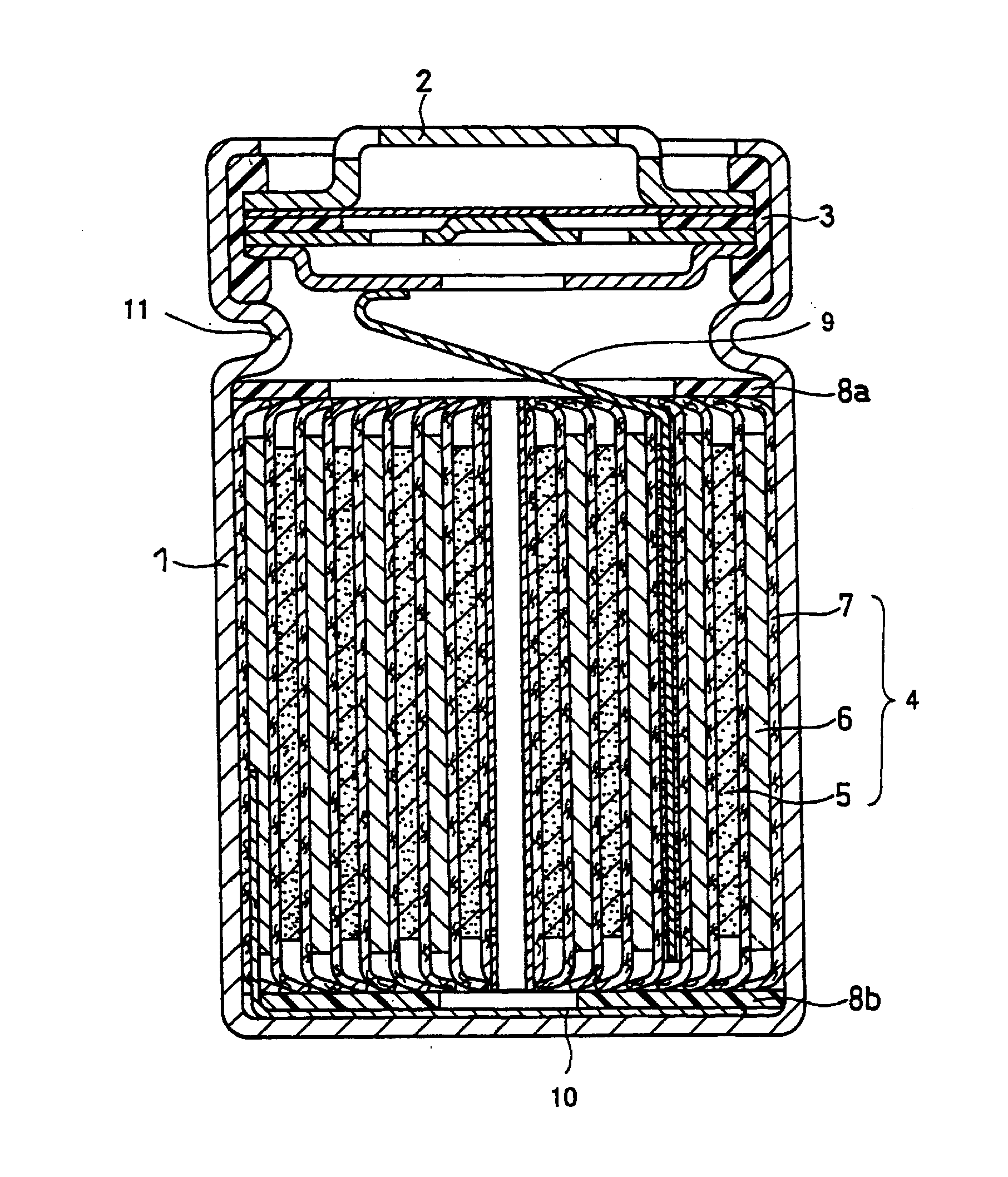
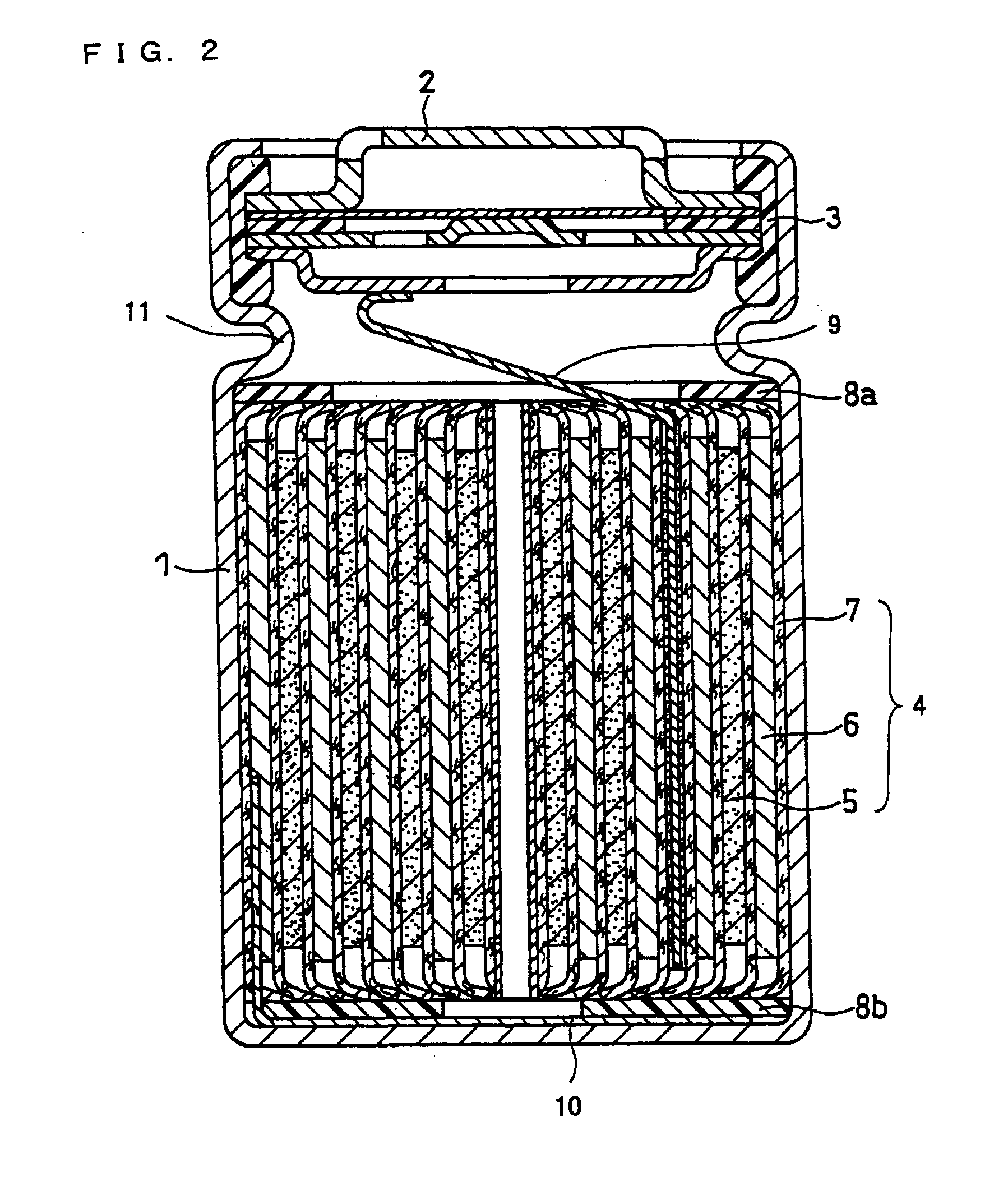
[0107]A nonaqueous electrolyte secondary battery illustrated in FIG. 2 was produced by the following procedure.
(1) Preparation of Positive Electrode
[0108]A mixture containing lithium nickelate (LiNiO2) as an active material, acetylene black as a conductive agent, and polyvinylidene fluoride (PVDF) as a binder in a weight ratio of 100:5:4 was mixed with a suitable amount of NMP. The resulting mixture was kneaded in a planetary mixer to form a positive electrode mixture slurry (positive electrode slurry).
[0109]The positive electrode slurry was applied onto both surfaces of a positive electrode current collector comprising an aluminum foil (thickness 15 μm, width 100 mm), and dried with a current of air at 80° C. for 20 minutes. The positive electrode current collector with the resulting coatings was rolled at a line pressure of 2000 kgf / cm (19.6 kN / cm) with rollers. In this manner, a positive electrode 5, in which a positive electrode mixture layer was formed on each surface of the po...
example 2
[0120]A negative electrode was produced in the same manner as in Example 1, except that the line pressure applied for rolling was set to 100 kgf / cm (980 N / cm). The density of the negative electrode mixture layer was 1.2 g / cm3. Using the negative electrode, a battery A2 was produced in the same manner as in Example 1.
example 3
[0121]A negative electrode was produced in the same manner as in Example 1, except that the rolling was performed twice. The density of the negative electrode mixture layer was 1.6 g / cm3. Using the negative electrode, a battery A3 was produced in the same manner as in Example 1.
PUM
| Property | Measurement | Unit |
|---|---|---|
| Density | aaaaa | aaaaa |
| Particle size | aaaaa | aaaaa |
| Particle size | aaaaa | aaaaa |
Abstract
Description
Claims
Application Information
 Login to View More