
Prostate cancer point of care diagnostics
a prostate cancer and diagnostic technology, applied in the field of point of care diagnostic disposables, can solve the problems of difficulty in urination, problems during sexual intercourse, or erectile dysfunction, and the total cost of prostate cancer treatment in the u.s. amounts to several billion dollars per year, and achieves the effects of easy exchange, rapid and easy reprogramming of the card, and demonstrated long-term stability
- Summary
- Abstract
- Description
- Claims
- Application Information
AI Technical Summary
Benefits of technology
Problems solved by technology
Method used
Image

Examples
example 1
Muliplex Test
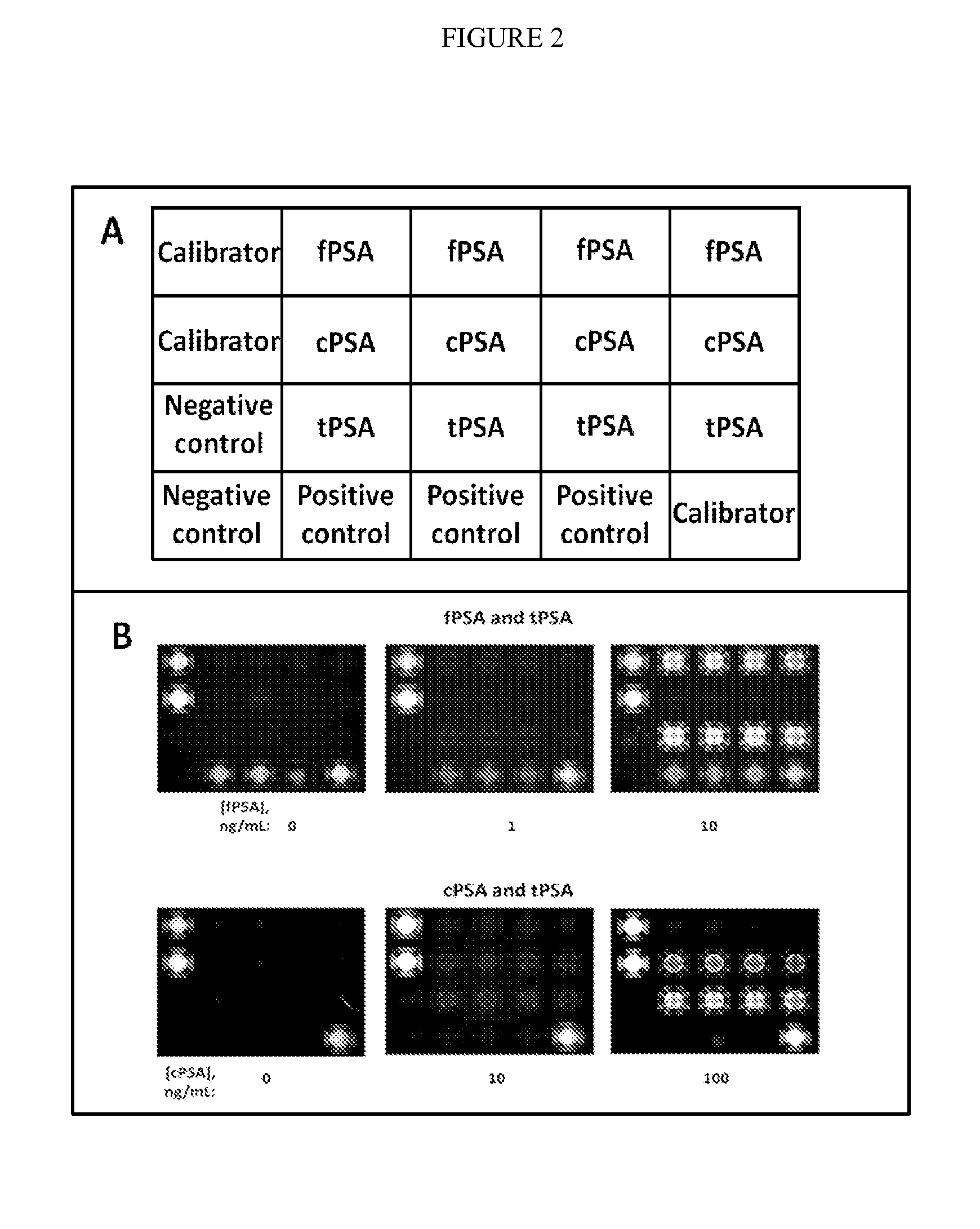
[0069]Sandwich antibody assays have been developed and multiplexed as a panel (FIG. 2) using reagents shown in Table 2. These were identified as optimal antibody reagents towards tests for PSA, complexed-PSA, and free-PSA on the P-BNC system. The promising biomarker complexed-PSA was developed as a replacement of the biomarker pro-PSA, because the reagents for pro-PSA (pending FDA approval) have not yet been released by the sole provider, but either marker can be used. The chip panel also includes internal (positive and negative) controls, as well as calibrators for the optical sensor analyzer.
TABLE 2Optimized ReagentsDetectionCapture AntibodyStandard AntigenAntibodyCoated on beadFor proof of concept and doseConjugated toBiomarkersensorscurveAlexafluor488Total PSATotal PSA mAbArtificial combinations of free PSATotal PSA mAb,Clone M212091,and PSA-ACT standards in PBSClone 5A6 Cat#Cat# 10-P20CProMedDX Patient PSA SerumMBS311572(Fitzgerald)Samples(MyBioSource)Sunnylab Pati...
example 2
Risk Calculator
[0077]The Prostate Cancer Prevention Trial Risk Calculator (prostate-cancer-risk-calculator.com) was developed as an outgrowth of the observation that PSA cannot be used as a dichotomous predictor of prostate cancer risk (e.g., PSA10 ng / mL=elevated), but that PSA is linearly related to risk of cancer as well as risk of high grade, potentially-lethal disease. Thus, researchers developed a multi-variable risk assessment tool that predicts the risk of prostate cancer and risk of high grade disease for an individual patient. This tool is used world-wide for risk assessment of men who are considering prostate biopsy.
[0078]More recently, our group added other biomarkers and risk variables (e.g., biomarkers: PCA3, percent free-PSA, proPSA, body mass index (BMI) and finasteride use) to the risk calculator and these have led to more precise and updated risk assessment.
[0079]Several of these biomarkers are only approved for certain ranges of PSA. For example, percent free-PSA, ...
PUM
| Property | Measurement | Unit |
|---|---|---|
| thick | aaaaa | aaaaa |
| thick | aaaaa | aaaaa |
| volume capacity | aaaaa | aaaaa |
Abstract
Description
Claims
Application Information
 Login to View More