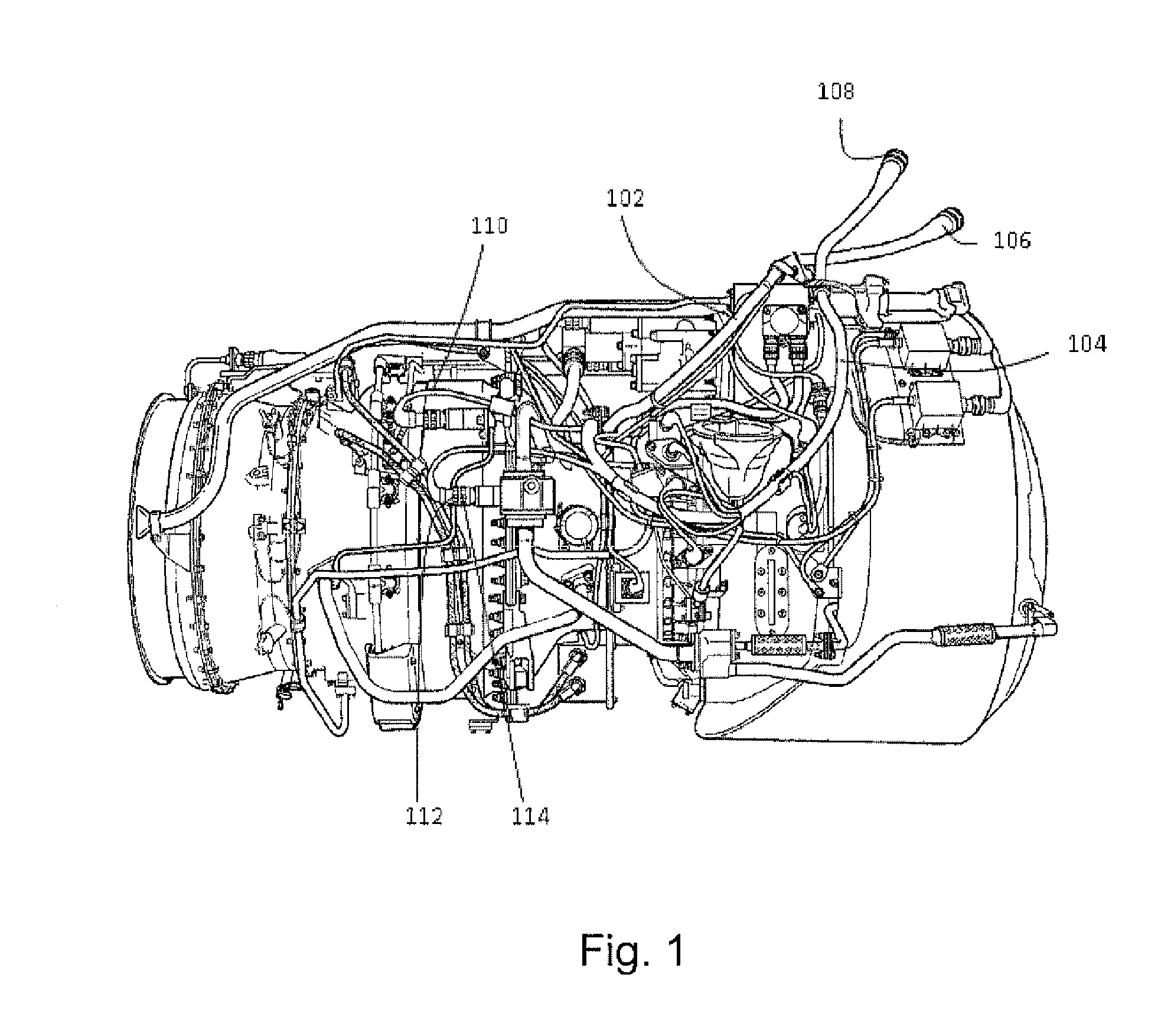
This makes the conventional harness itself bulky, heavy and difficult to manipulate.
The conventional harnesses occupy significant space within a gas
turbine engine (for example within the
nacelle of a gas turbine engine), and thus may compromise the design of the aircraft, for example the size and / or weight and / or shape of the
nacelle.
Disassembly of the conventional harnesses (for example removal of the conventional harnesses from a gas turbine engine during maintenance) may also be complicated and / or
time consuming.
Thus, in many maintenance (or repair or overhaul) procedures on a gas turbine engine, removal and subsequent refitting of the conventional electrical harness may account for a very significant portion of the
operation time and / or account for a significant proportion of the potential
assembly errors.
The electrical conductors in the conventional harnesses may be susceptible to mechanical damage.
For example, mechanical damage may occur during installation (for example through accidental piercing of the protective sleeves / braiding) and / or during service (for example due to vibration).
In order to reduce the likelihood of damage to the conductors in a conventional harness, the protective sleeves / braiding may need to be further reinforced, adding still further weight and reducing the ease with which they can be manipulated.
Similarly, the exposed electrical connectors used to connect one conductor to another conductor or conductors to electrical units may be susceptible to damage and / or may add significant weight to the engine.
During manufacture, such contaminants can interfere with the positions of the
electrical contacts, whereby the mated contacts may be unable to move sufficiently to ensure good electrical contact.
During use, such contaminants can interfere with the proper electrical functioning of the connector, e.g. by preventing
electrical contacts or producing short-circuits.
Indeed, it is particularly desirable to prevent any such ingress when such a seal is used, as ingressing
polymer can reduce compliance at the seal, reducing sealing effectiveness and allowing other contaminants (e.g. oil or fuel) to enter the connector during use.
For example, some maintenance procedures may only require access to a certain portion of the gas turbine engine that only requires a part of the harness to be removed.
It may be difficult and / or
time consuming, or not even possible, to only remove the required part of a conventional harness from a gas turbine engine.
However, it may be relatively straightforward to only remove the relevant electrical raft, for example by simply disconnecting it from the engine and any other electrical rafts / components to which it is connected.
The environment of a gas turbine engine during operation may be particularly severe, with, for example, high levels of vibration and / or differential expansion between components as the temperature changes through operation and as the components move relative to each other.


 Login to View More