
Analysis system and method thereof
a technology of an analysis system and a method, applied in the field of an analysis system, can solve the problems of inability to know individual overall trend toward and change physiological parameters, inability to collate information for each time in a systematic way, and inability to effectively get their physical condition and related information
- Summary
- Abstract
- Description
- Claims
- Application Information
AI Technical Summary
Benefits of technology
Problems solved by technology
Method used
Image

Examples
first embodiment
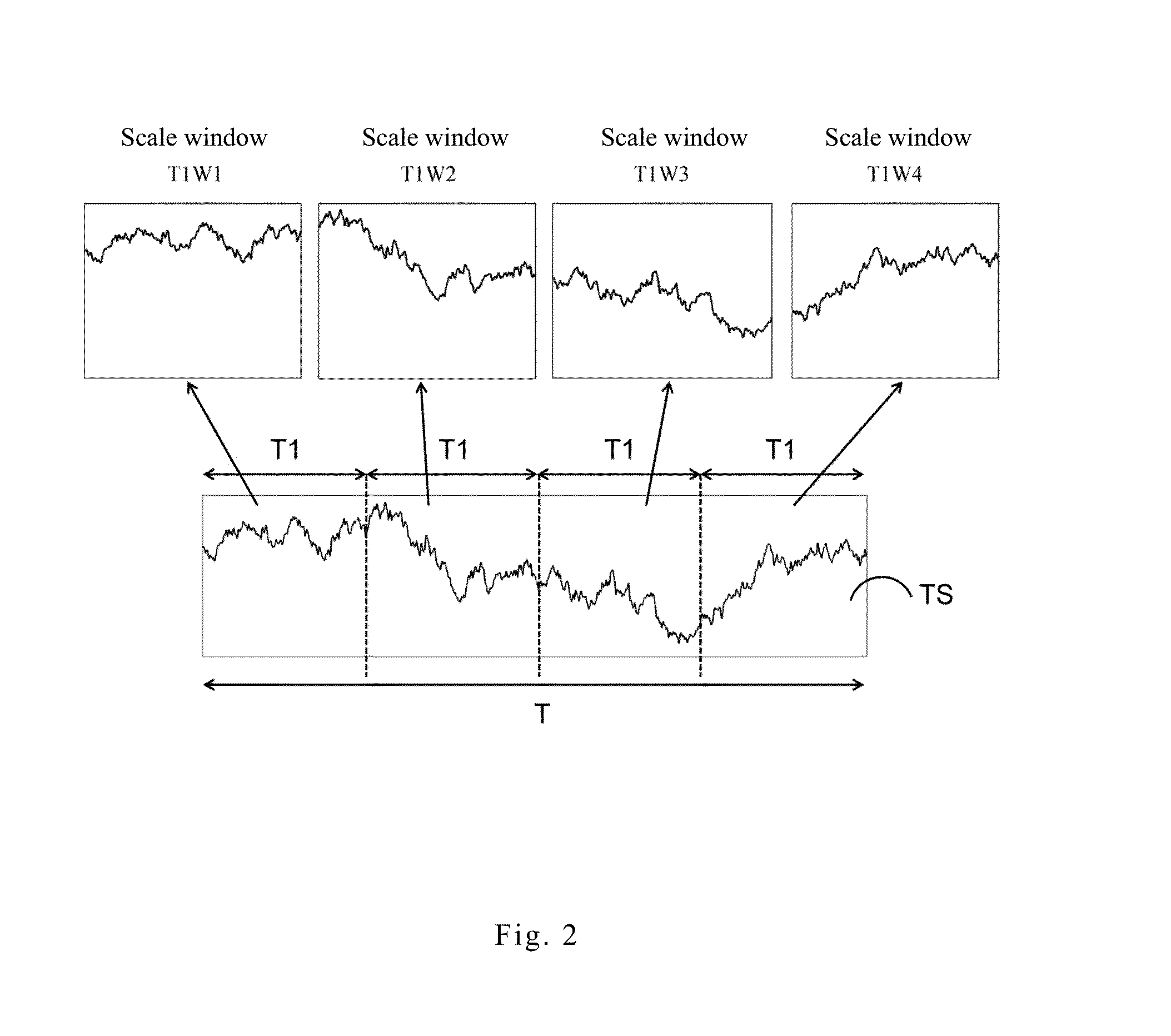
[0032]Please refer to FIG. 2 showing a diagram of the signal segmented in the invention. The segmenting unit 210 of the invention divides the time period T into a plurality of scale windows according to one of interval scales. The time period T can be divided by any one of different interval scales. In an embodiment, the interval scale is T1. When the time period T is 600 seconds and the interval scale is T1 is 20 seconds, the time period T is divided into 30 scale windows. When the interval scale is T1 is 40 seconds, the time period T is divided into 15 scale windows, which is not limited herein.
[0033]Please refer to FIG. 2, in order to clearly describe the features of the invention, the time period T being divided into 4 scale windows by the interval scale T1 is taken as an example. The 4 scale windows are respectively a scale window T1W1, a scale window T1W2, a scale window T1W3 and a scale window T1W4, which is not limited herein.
[0034]The analyzing unit 220 of the invention pro...
second embodiment
[0038]In another embodiment, please refer to FIG. 5 showing a diagram of the signal segmented in the invention. The segmenting unit 210 dividing the time period T into 6 scale windows by the interval scale T2 is taken as an example. The 6 scale windows are respectively a scale window T2W1, a scale window T2W2, a scale window T2W3, a scale window T2W4, a scale window T2W5, and a scale window T2W6, which is not limited herein.
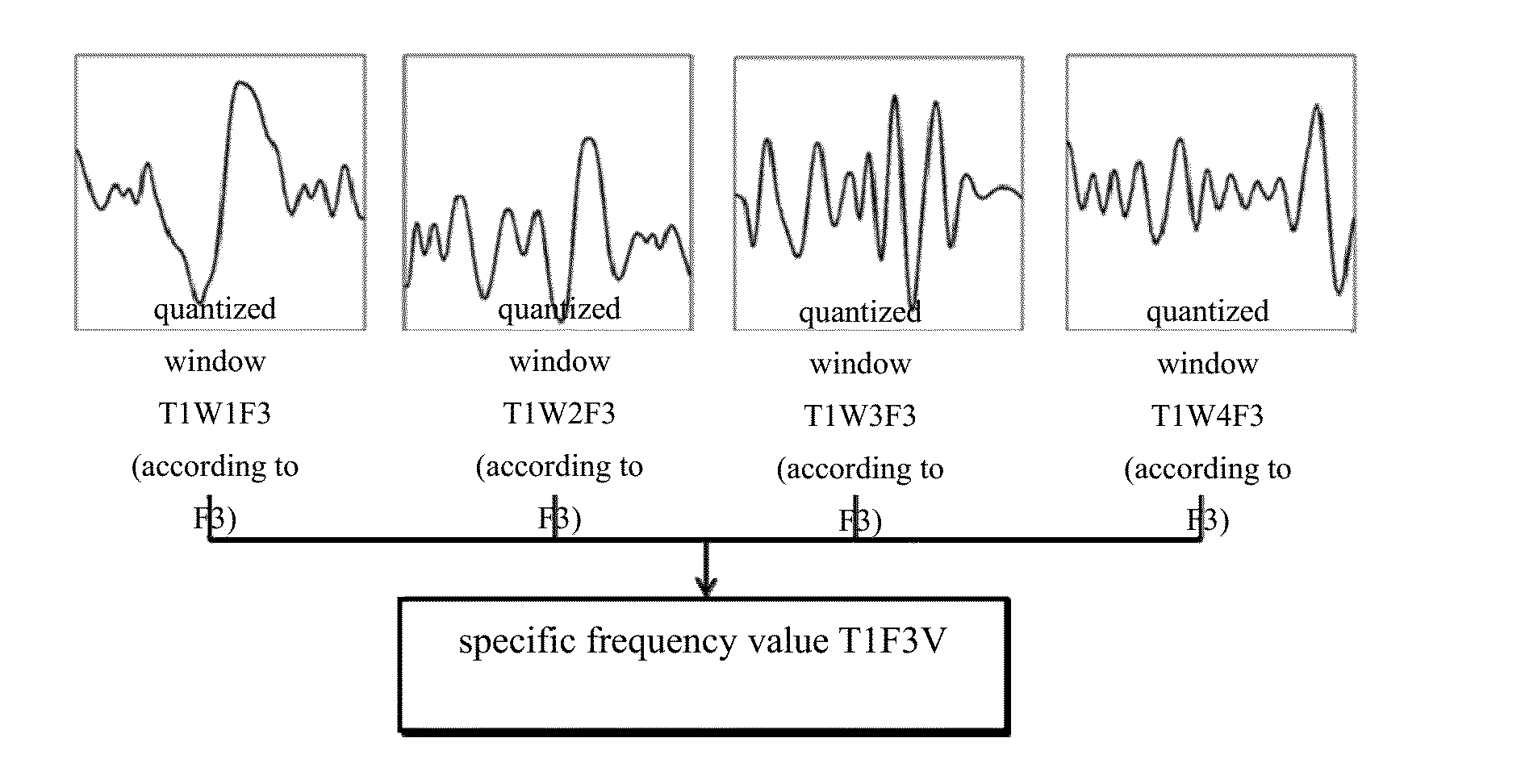
[0039]The analyzing unit 220 processes the scale window T2W1, the scale window T2W2, the scale window T2W3, the scale window T2W4, the scale window T2W5, and the scale window T2W6 to generate the quantized windows (T2W1F1, T2W1F2, T2W1F3, T2W1F4; T2W2F1, T2W2F2, T2W2F3, T2W2F4; T2W3F1, T2W3F2, T2W3F3, T2W3F4; T2W4F1, T2W4F2, T2W4F3, T2W4F4; T2W5F1, T2W5F2, T2W5F3, T2W5F4; T2W6F1, T2W6F2, T2W6F3, T2W6F4) respectively according to the first component F1, the second component F2, the third component F3, and the fourth component F4, which is not limited herein.
[0040]...
PUM
 Login to View More
 Abstract
Description
Claims
Application Information
 Login to View More