Varying a numerical aperture of a laser during lens fragmentation in cataract surgery

a laser and numerical aperture technology, applied in laser surgery, eye surgery, etc., can solve the problems of affecting the efficacy of laser lens fragmentation and the patient's vision, and achieve the effects of reducing the overall amount of energy delivered, reducing the amount of cumulative dispersion energy (cde), and being difficult to cut and/or remov

a laser and numerical aperture technology, applied in laser surgery, eye surgery, etc., can solve the problems of affecting the efficacy of laser lens fragmentation and the patient's vision, and achieve the effects of reducing the overall amount of energy delivered, reducing the amount of cumulative dispersion energy (cde), and being difficult to cut and/or remov

US20160310321A1Active Publication Date: 2016-10-27AMO DEVMENT

Image

Smart Image Click on the blue labels to locate them in the text.
Viewing Examples
Smart Image
  • Varying a numerical aperture of a laser during lens fragmentation in cataract surgery
  • Varying a numerical aperture of a laser during lens fragmentation in cataract surgery
  • Varying a numerical aperture of a laser during lens fragmentation in cataract surgery

Examples

Experimental program
Comparison scheme
Effect test

Embodiment Construction

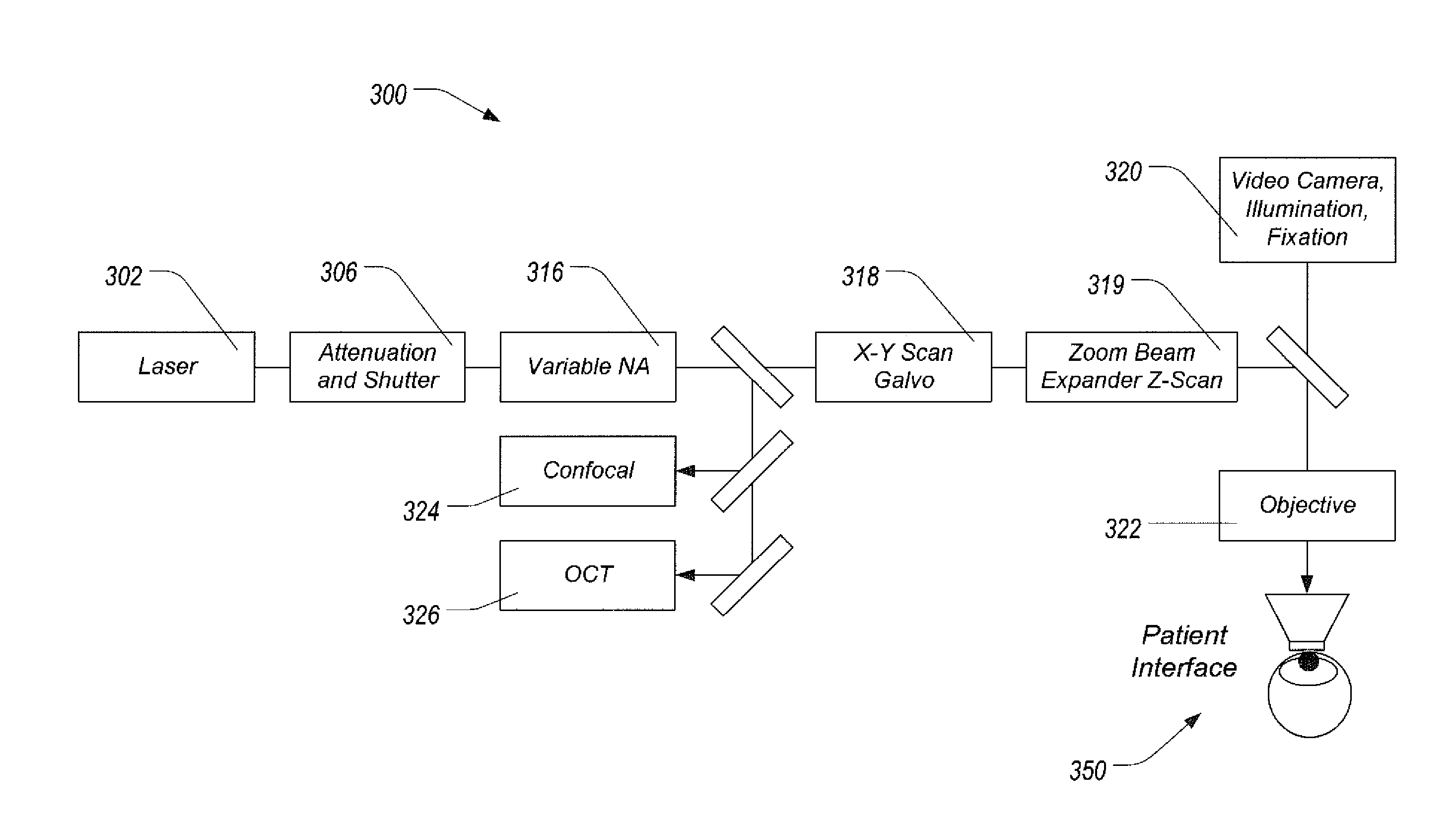
[0032]It is to be understood that the figures and descriptions of the present invention have been simplified to illustrate elements that are relevant for a clear understanding of the present invention, while eliminating, for the purpose of clarity, many other elements found in typical laser cataract surgery systems. Those of ordinary skill in the arts can recognize that other elements and / or steps are desirable and may be used in implementing the embodiments described here.

Laser Lens Fragmentation

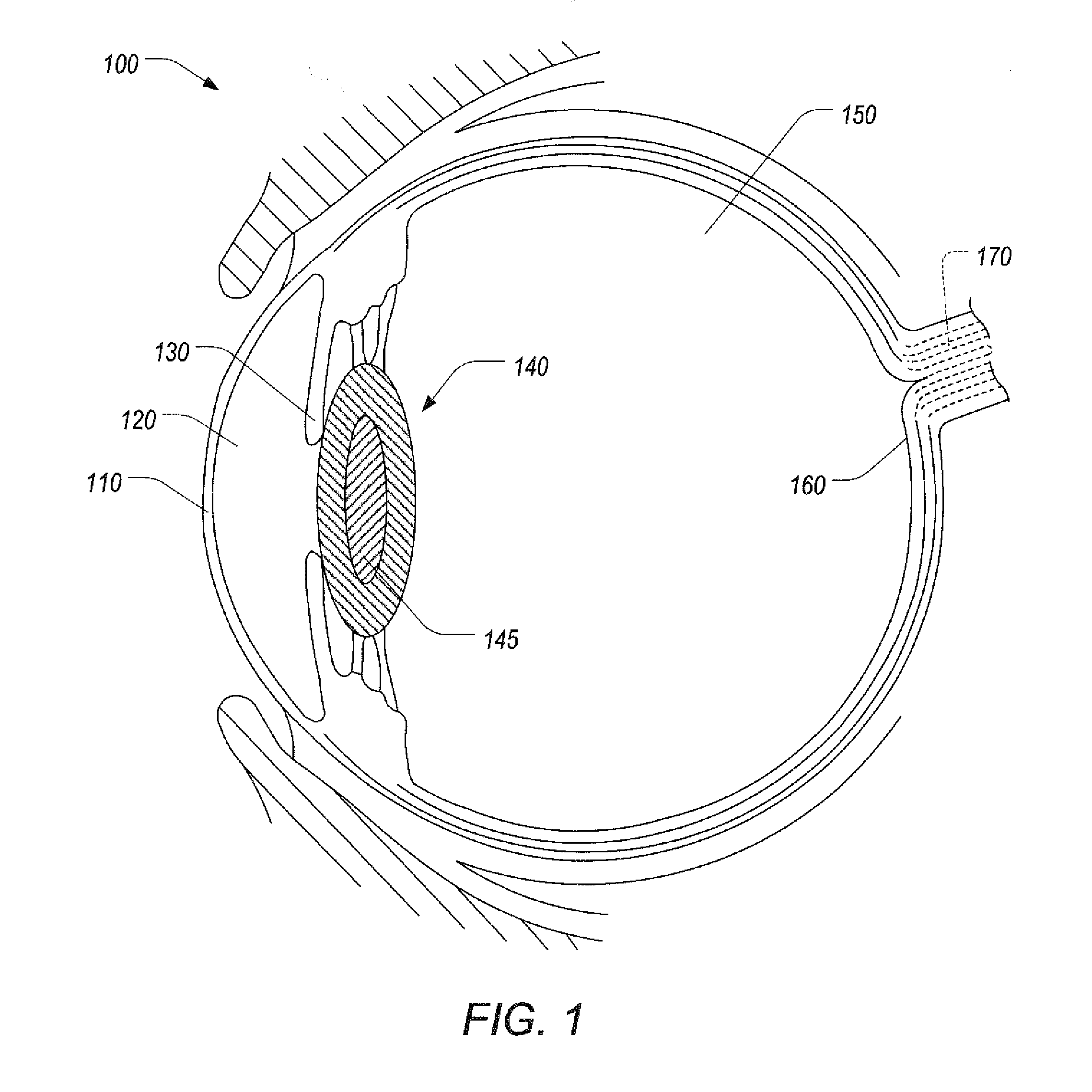
[0033]FIG. 1 is a schematic drawing of a human eye 100. Light enters the eye from the left of FIG. 1, and passes through the cornea 110, the anterior chamber 120, a pupil defined by the iris 130, and enters lens 140. After passing through the lens 140, light passes through the vitreous chamber 150, and strikes the retina 160, which detects the light and converts it to a signal transmitted through the optic nerve 170 to the brain (not shown).

[0034]Laser cataract surgery involves the removal ...

the structure of the environmentally friendly knitted fabric provided by the present invention; figure 2 Flow chart of the yarn wrapping machine for environmentally friendly knitted fabrics and storage devices; image 3 Is the parameter map of the yarn covering machine
Login to View More

PUM

No PUM Login to View More

Abstract

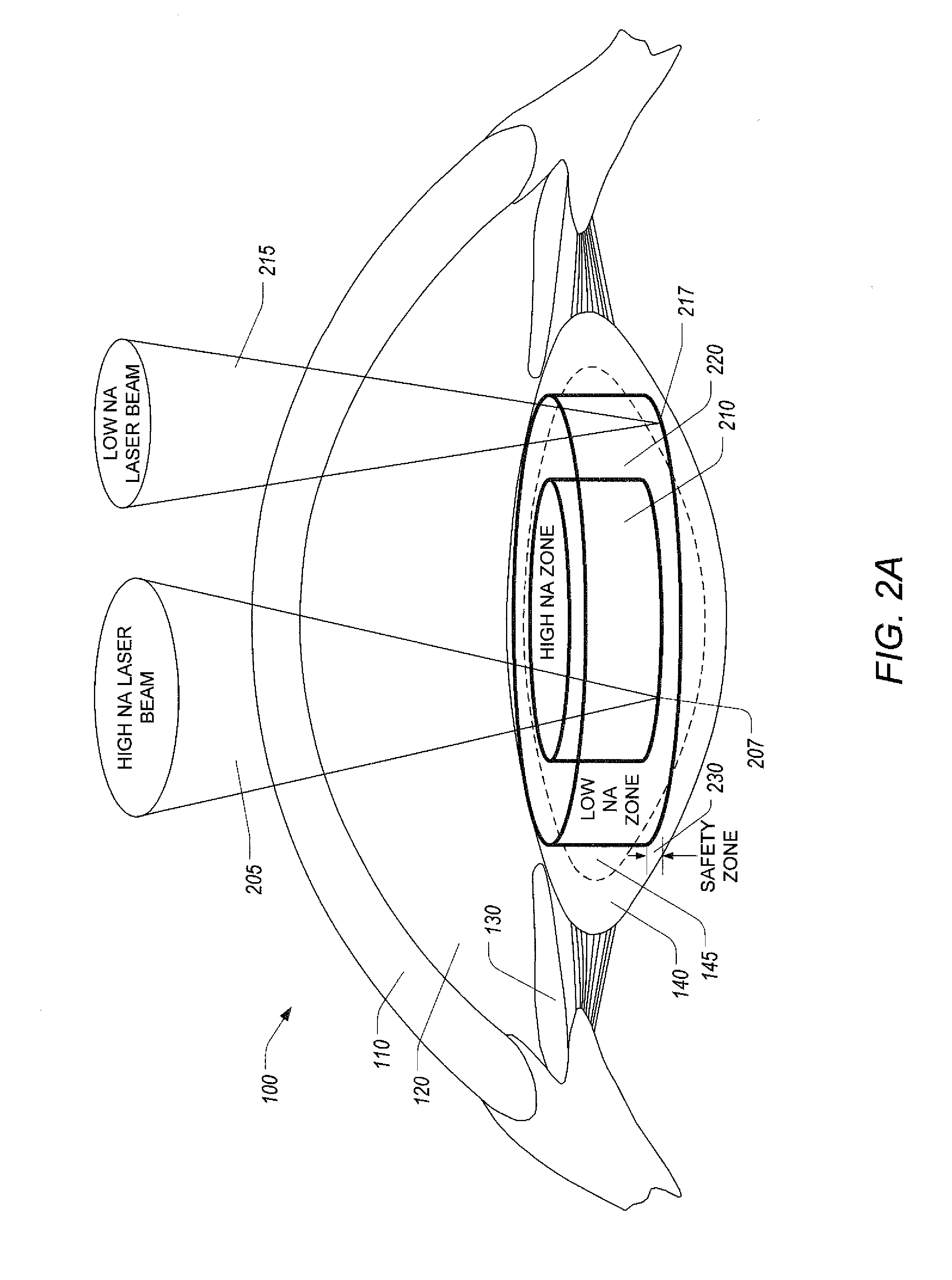
Some embodiments disclosed here provide for a method fragmenting a cataractous lens of a patient's eye using an ultra-short pulsed laser. The method can include determining, within a lens of a patient's eye, a high NA zone where a cone angle of a laser beam with a high numerical aperture is not shadowed by the iris, and a low NA zone radially closer to the iris where the cone angle of the laser beam with a low numerical aperture is not shadowed by the iris. Laser lens fragmentation is accomplished by delivering the laser beam with the high numerical aperture to the high NA zone, and the laser beam with the low numerical aperture to the low NA zone. This can result in a more effective fragmentation of a nucleus of the lens without exposing the retina to radiation above safety standards.

Description

CROSS REFERENCE TO RELATED APPLICATIONS[0001]This application is a divisional of and claims priority to U.S. patent application Ser. No. 14 / 193,740, filed Feb. 28, 2014, which claims the benefit of priority to U.S. Provisional Application No. 61 / 794,359, filed Mar. 15, 2013, the entire contents of which are incorporated herein by reference.BACKGROUND[0002]1. Field[0003]Embodiments of this invention generally relate to laser cataract surgery, and more particularly to a method of laser-assisted lens fragmentation.[0004]2. Description of Related Art[0005]Eye disease can impair a patient's vision. For example, a cataract can increase the opacity of an ocular lens, and eventually, cause blindness. To restore the patient's vision, the diseased lens may be surgically removed and replaced with an artificial lens, known as an intraocular lens, or IOL. A number of medically recognized techniques are utilized for removing a cataractous lens based on, for example, phacoemulsification, mechanica...

Claims

the structure of the environmentally friendly knitted fabric provided by the present invention; figure 2 Flow chart of the yarn wrapping machine for environmentally friendly knitted fabrics and storage devices; image 3 Is the parameter map of the yarn covering machine
Login to View More

Application Information

Patent Timeline
27 Oct 2016
Publication
US20160310321A1
IPC
A61F9/008
CPC
A61F9/0084; A61F9/00825; A61F2009/00851; A61F2009/00887; A61F2009/00863; A61F2009/0087
Inventors
DENNISON, ANTHONY W.; CAMPOS, MICHAEL A.