
Polymer containing scattering type vertically aligned liquid crystal device
a liquid crystal display and polymer dispersed technology, applied in optics, non-linear optics, instruments, etc., can solve the problems of hysteresis, the hysteresis of state of the art va va polymer dispersed liquid crystal displays is too high to display grey scale images with high quality, and achieves the effect of display performance without hysteresis
- Summary
- Abstract
- Description
- Claims
- Application Information
AI Technical Summary
Benefits of technology
Problems solved by technology
Method used
Image

Examples
example 1
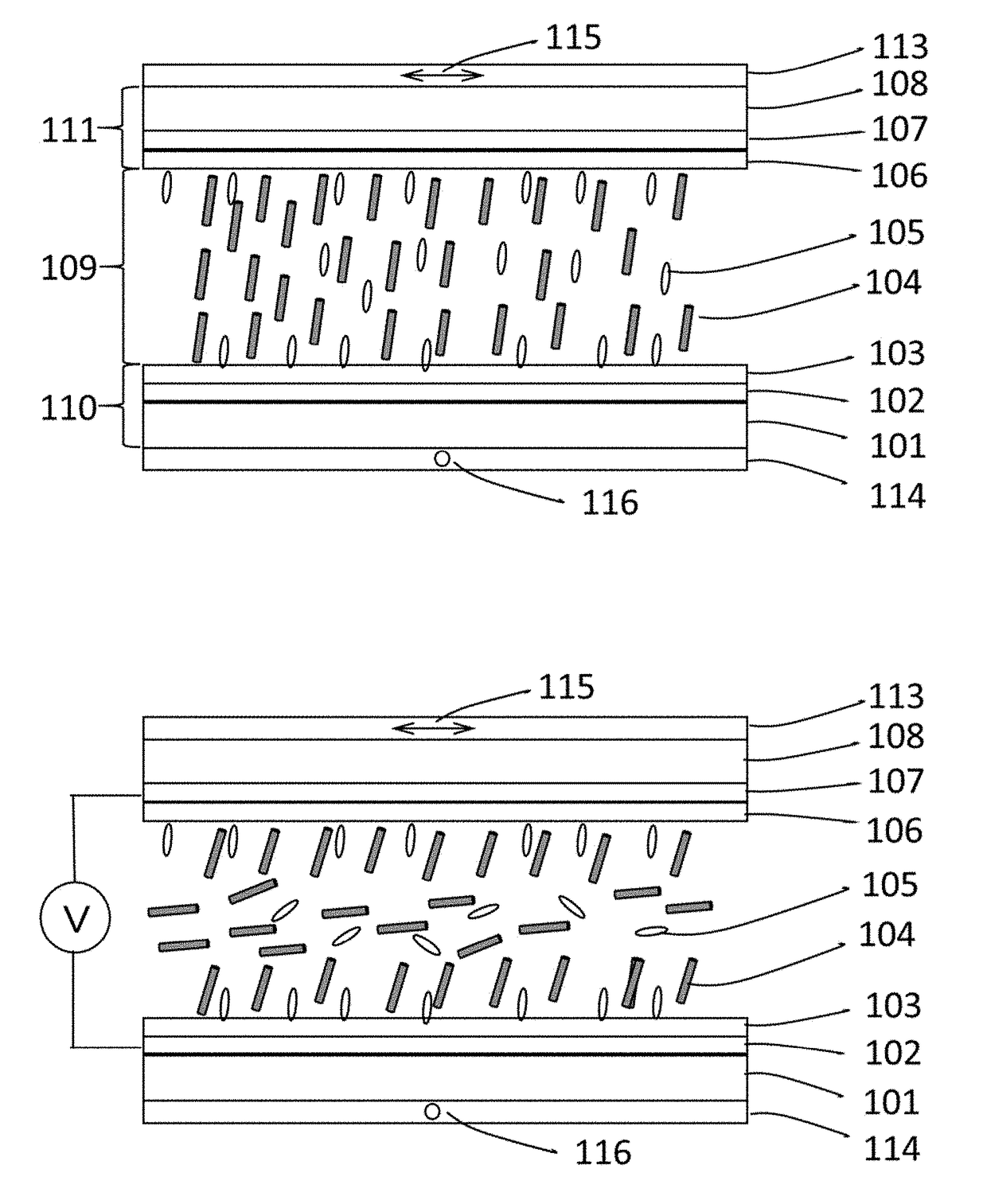
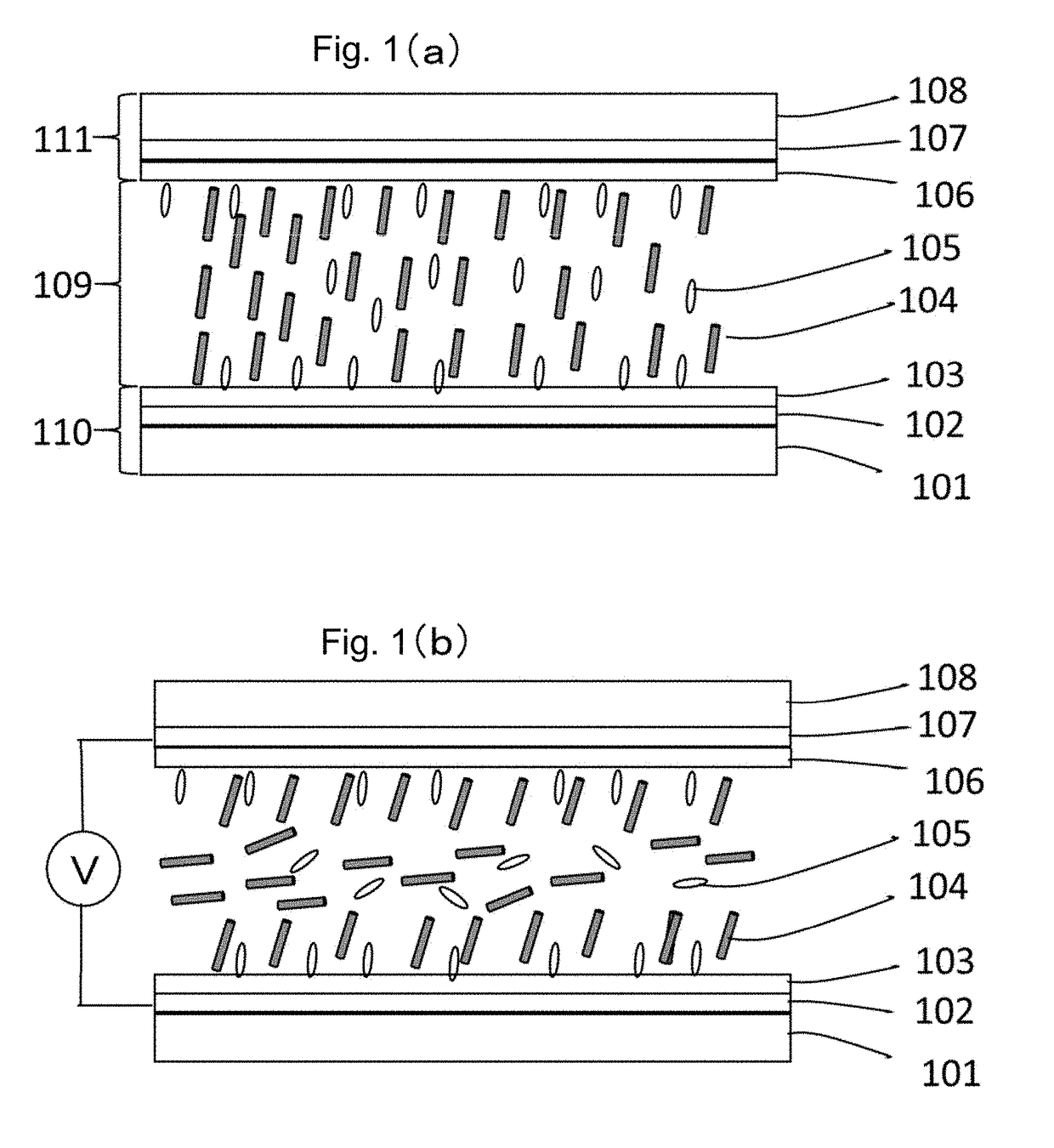
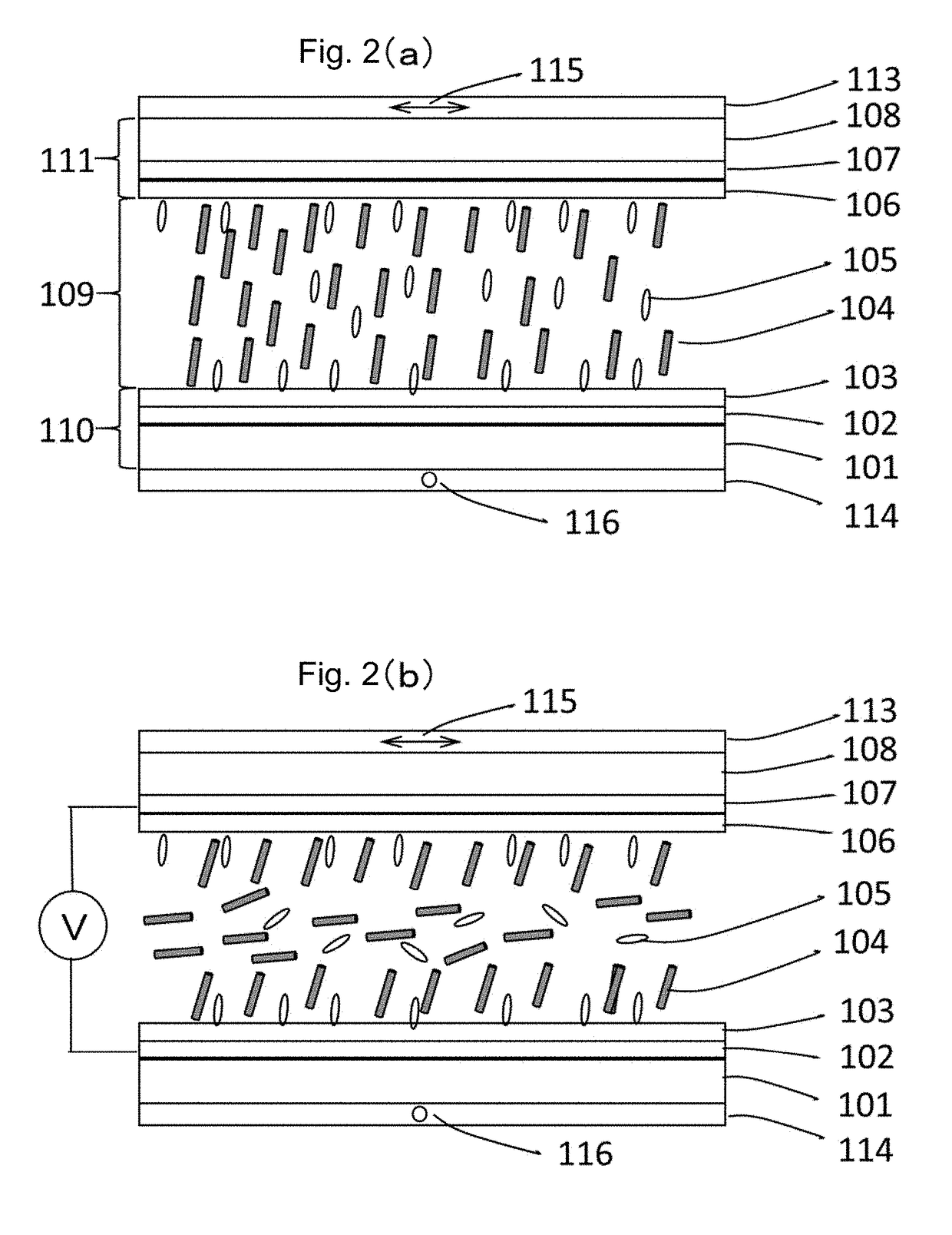
[0046]On the surfaces of two substrates 101 and 108 transparent conductive films ITO (Indium Tin Oxide) are formed by the sputtering method. On top of the electrodes the material for vertical alignment 4811 (available from Nissan Chemical Industries, Ltd.) is coated using a spin coater. The coated substrates 110 and 111 are prebaked on a hot plate at 80° C. for 60 seconds, and then baked in an oven at 200° C. for 40 minutes. Thus, the alignment films 103 and 106 for vertical alignment each having a thickness of about 100 nm are formed. The surfaces of the alignment films 103 and 106 are subjected to rubbing treatment for 10 times, using a rubbing equipment, in which a polyester nonwoven fabric (fiber length: 2.0 mm) is wound on a roller having a diameter of 30 mm and the pressure is set to about 40 g. Spacers having a diameter of 3 μm are spread on the coated substrate 110, a binary epoxy adhesive is coated onto the outer periphery of the substrate 110, and the coated substrates 110...
example 2
[0051]As in example 1, layers of the vertical alignment material 4811 (Nissan Chemical Industries, Ltd.) are applied by spin coating on substrates 101 and 108, having conductive ITO films. After thermal treatment, the alignment films 103 and 106 are subjected to the rubbing treatment for 10 times. Spacers having a diameter of 3 μm are spread onto the substrate 101, a binary epoxy adhesive is coated onto the outer periphery of the substrate 101, the substrates 101 and 102 are so fixed that the cell thickness is 3 μm.
[0052]As the liquid crystal 104, No. 820050 (available from LCC Corporation), NI point: 100.5° C., dielectric anisotropy Δε=−5.69 is used. The UV curable monofunctional monomer
is added as a polymer precursor in an amount of 0.7 to 2.0 wt % with regard to the mixture comprising the liquid crystal and the polymer precursor. As the polymerization initiator, Irgacure 907 (available from BASF AG) is added in an amount of 15 wt % based on the amount of the monofunctional monome...
PUM
| Property | Measurement | Unit |
|---|---|---|
| pretilt angle | aaaaa | aaaaa |
| pretilt angle | aaaaa | aaaaa |
| pretilt angle | aaaaa | aaaaa |
Abstract
Description
Claims
Application Information
 Login to View More