New method for producing 2-acrylamido-2-methylpropane sulphonic acid
Active Publication Date: 2020-01-23
S P C M SA
View PDF0 Cites 0 Cited by
Summary
Abstract
Description
Claims
Application Information
AI Technical Summary
This helps you quickly interpret patents by identifying the three key elements:
Problems solved by technology
Method used
Benefits of technology
Benefits of technology
The invention provides a method where solvent and thermal energy consumption is reduced compared to traditional recrystallization methods. This is achieved by forming a suspension of solid particles, rather than dissolving them all simultaneously. The result is a more efficient process for purifying and obtaining high-quality crystals.
Problems solved by technology
Despite the good purity of the resulting 2-acrylamido-2-methylpropane sulfonic acid, the process, whose yield is limited, calls for multiple steps of dissolution / cooling and requires the acetic acid used to be distilled to regenerate it before later reuse in a new 2-acrylamido-2-methylpropane sulfonic acid recrystallization batch.
Although, this washing step allows to shorten the synthesis duration of 2-acrylamido-2-methylpropane sulfonic acid, solvent and thermal energy consumptions required to achieve such purification by recrystallization are still important.
Method used
the structure of the environmentally friendly knitted fabric provided by the present invention; figure 2 Flow chart of the yarn wrapping machine for environmentally friendly knitted fabrics and storage devices; image 3 Is the parameter map of the yarn covering machine
View more
Image
Smart Image Click on the blue labels to locate them in the text.
Viewing Examples
Smart Image
Click on the blue label to locate the original text in one second.
Reading with bidirectional positioning of images and text.
Smart Image
Examples
Experimental program
Comparison scheme
Effect test
example 1
[0123]1522 g of acrylonitrile containing 0.4% by weight of water and 180 g of fuming sulfuric acid titrating 104% H2SO4 (18% oleum) were added to a stirred 2000 mL double-wall reaction vessel. The resulting sulfonating mixture was stirred for one hour and cooled by the double wall of the reaction vessel which kept the temperature of the sulfonating mixture at −20° C.
[0124]97 g of isobutylene was added to the preceding sulfonating mixture at a flow rate of 1.6 g per minute. The temperature of the resulting reaction mixture was held at 45° C. during addition of the isobutylene. The 2-acrylamido-2-methylpropane sulfonic acid particles precipitated in the reaction mixture and the proportion of 30 solids was about 20% by weight.
[0125]The reaction mixture was filtered on a Büchner type filter; the resulting composition 1 contained 70% particles.
[0126]100 g of water, representing the aqueous solution A, was placed in a 500 mL stirred reaction vessel. The composition 1 recovered on the Büch...
example 2
[0129]The conditions for obtaining composition 1 were identical to example 1.
[0130]100 g of liquid resulting at the end of example 1, representing the aqueous solution A, was placed in a 500 mL stirred reaction vessel. Composition 1, undried on the Büchner filter, was added to the reaction vessel. The temperature was held at room temperature, meaning 25° C.
[0131]After three hours in suspension, the resulting suspension 1 was filtered on a Büchner type filter. The resulting composition 2 was undried and 340 g of ATBS was recovered. The yield was 91% relative to the isobutylene.
[0132]138 g of liquid containing water, acrylonitrile, sulfuric acid and 2-acrylamido-2-methylpropane sulfonic acid was recovered.
example 3
[0133]1215 g of acrylonitrile containing 0.2% by weight of water, 130 g of sulfuric acid (98% concentration) and 130 g of fuming sulfuric acid titrating 105.62% H2SO4 (25% oleum) were added to a stirred 2000 mL double-wall reaction vessel. The resulting sulfonating mixture was stirred for one hour and cooled by the double wall of the reaction vessel which kept the sulfonating mixture at −20° C.
[0134]135 g of isobutylene was added to the preceding sulfonating mixture at a flow rate of 1 g per minute. The temperature of the resulting reaction mixture was held at 40° C. during addition of the isobutylene. The 2-acrylamido-2-methylpropane sulfonic acid particles precipitated in the reaction mixture and the proportion of solids was about 30% by weight.
[0135]The reaction mixture was filtered on a Büchner type filter; the resulting composition 1 contained was 70% crystals.
[0136]120 g of water, representing the aqueous solution A, was placed in a stirred 1000 mL reaction vessel. The composi...
the structure of the environmentally friendly knitted fabric provided by the present invention; figure 2 Flow chart of the yarn wrapping machine for environmentally friendly knitted fabrics and storage devices; image 3 Is the parameter map of the yarn covering machine
Login to View More
PUM
Property
Measurement
Unit
temperature
aaaaa
aaaaa
temperature
aaaaa
aaaaa
temperature
aaaaa
aaaaa
Login to View More
Abstract
The present invention relates to a production process for 2-acrylamido-2-methylpropane sulfonic acid including at least the following successive steps:1) mixing of acrylonitrile with at least one compound contributing SO3 at a temperature included between −80 and 30° C.;2) placing in contact and mixing isobutylene and the sulfonating mixture with a molar ratio of SO3 to isobutylene included between 0.2:1 and 2:1 and a molar ratio of acrylonitrile to isobutylene included between 3:1 and 60:1 at a temperature included between −40 and 100° C.;3) solid / liquid separation of the reaction mixture and isolation of the solid particles in the form of a composition 1;4) mixing composition 1 at the end of step 3) with an aqueous solution A included at a temperature comprised between −20 and 70° C. in order to obtain a suspension 1 of 2-acrylamido-2-methylpropane sulfonic acid crystals;5) solid / liquid separation of the suspension 1 and isolation of the crystals in form of composition 2.
Description
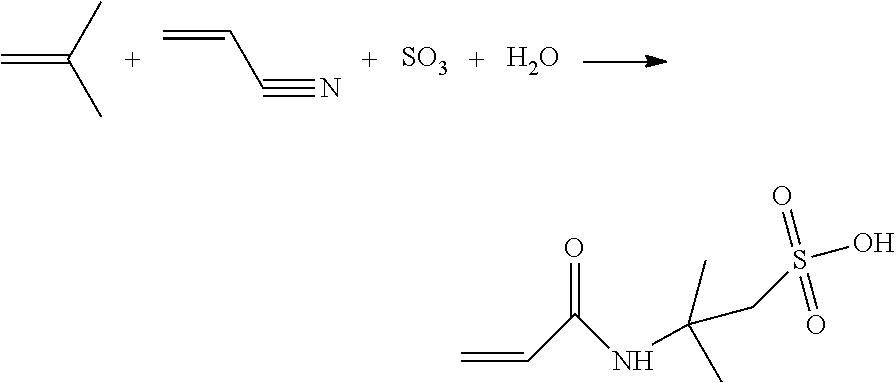
FIELD OF THE INVENTION[0001]The field of the invention relates to a new process for obtaining 2-acrylamido-2-methylpropane sulfonic acid. More precisely, the subject of the present invention is a production process for 2-acrylamido-2-methylpropane sulfonic acid consisting of co-reacting acrylonitrile, fuming sulfuric acid and isobutylene.DESCRIPTION OF THE PRIOR ART[0002]2-Acrylamido-2-methylpropane sulfonic acid is widely used as an additive in acrylic fibers and as a raw material for obtaining polymers used as dispersant, hydrogel or thickening agent in various sectors like the oil industry, construction, water treatment (desalination of seawater, mineral industry, etc.) or cosmetics.[0003]The reaction used in the process for preparation of 2-acrylamido-2-methylpropane sulfonic acid follows the reaction scheme below in which acrylonitrile is present in excess so as to be both solvent for the reaction and a reagent. The acrylonitrile is brought into contact with fuming sulfuric aci...
Claims
the structure of the environmentally friendly knitted fabric provided by the present invention; figure 2 Flow chart of the yarn wrapping machine for environmentally friendly knitted fabrics and storage devices; image 3 Is the parameter map of the yarn covering machine
Login to View More
Application Information
Patent Timeline
Application Date:The date an application was filed.
Publication Date:The date a patent or application was officially published.
First Publication Date:The earliest publication date of a patent with the same application number.
Issue Date:Publication date of the patent grant document.
PCT Entry Date:The Entry date of PCT National Phase.
Estimated Expiry Date:The statutory expiry date of a patent right according to the Patent Law, and it is the longest term of protection that the patent right can achieve without the termination of the patent right due to other reasons(Term extension factor has been taken into account ).
Invalid Date:Actual expiry date is based on effective date or publication date of legal transaction data of invalid patent.
Login to View More
Patent Type & AuthorityApplications(United States)


 Login to View More