Dye composition, dyeing apparatus and dyeing method
What is AI technical title?
AI technical title is built by Patsnap AI team. It summarizes the technical point description of the patent document.
a technology of dyeing apparatus and composition, applied in the direction of dyeing process, textile/flexible product manufacturing, final product manufacturing, etc., can solve the problems of air or liquid pollution, slow and inefficient each of these procedures, and achieve the effect of no crocking problems
Inactive Publication Date: 2003-06-24
TATE JOHN E
View PDF7 Cites 2 Cited by
Summary
Abstract
Description
Claims
Application Information
AI Technical Summary
This helps you quickly interpret patents by identifying the three key elements:
Problems solved by technology
Method used
Benefits of technology
Benefits of technology
It is a further objective of the present invention to provide a dye composition which suitably, uniformly dyes polymeric textile structures repeatedly over extended periods of time without the disadvantages of prior dyeing compositions and techniques.
It is still another objective to provide a dyeing apparatus which directs the textile structure through a flowing dye composition where both the textile structure and the dye composition move at the same rate so as not to stress the textile structure.
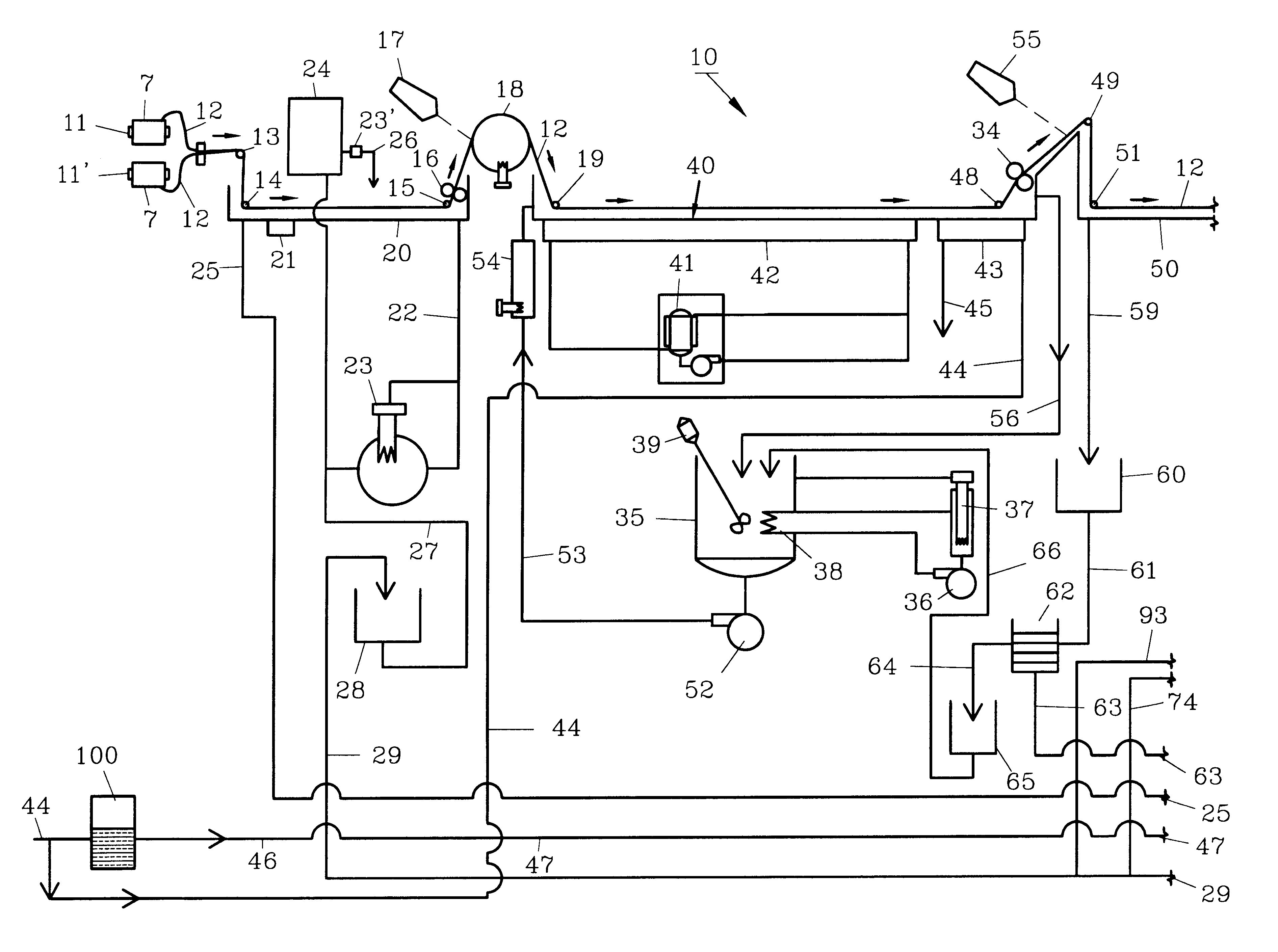
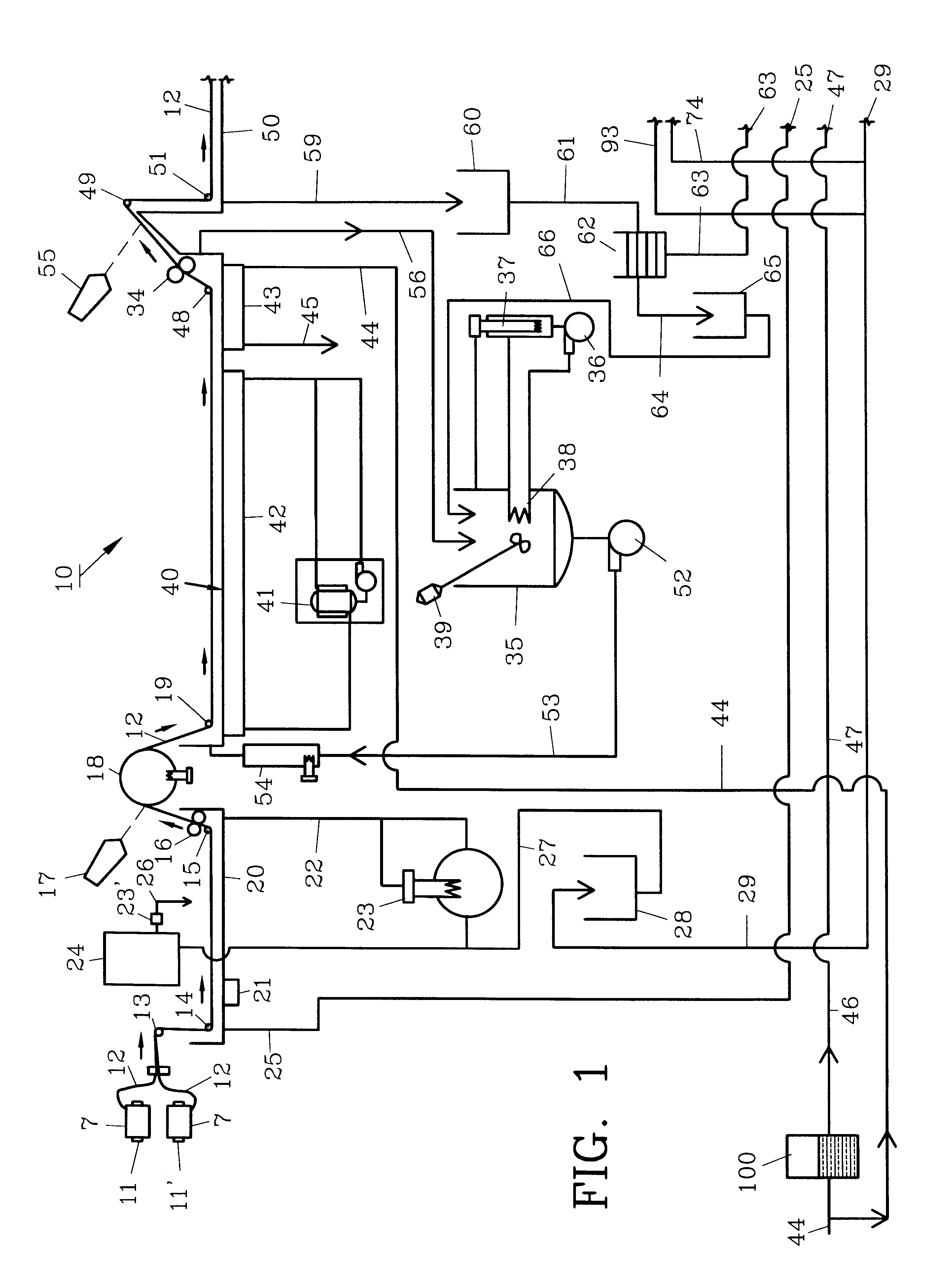
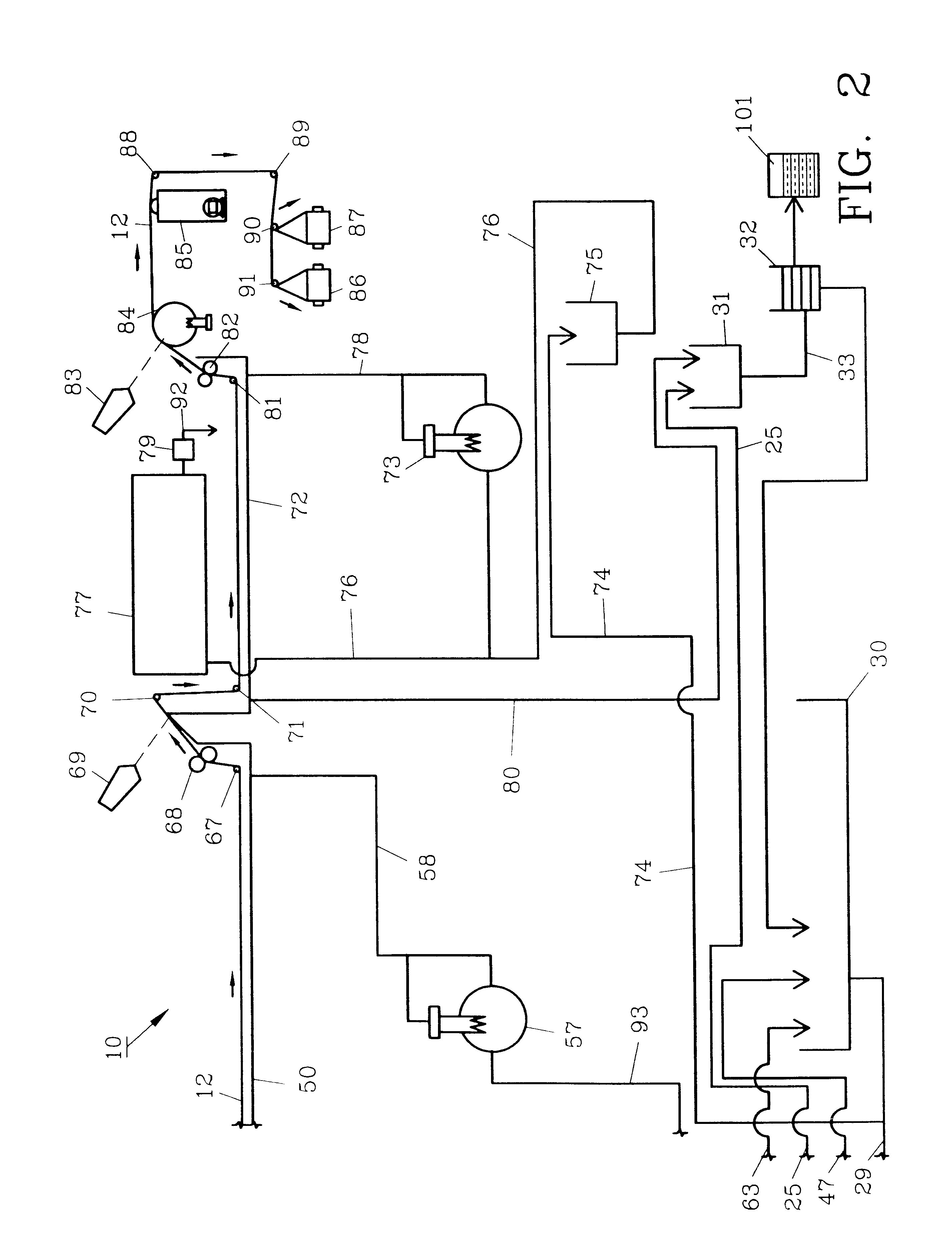
The post scour vessel removes any trace of dye composition that may inadvertently remain on the textile structure, and assures no crocking problems. The first half of the post scour vessel thoroughly cleans the textile structure by counter current flow through a mixture of purified water and a scouring agent such as Henkel Chemical CS-605 at a temperature of 90.degree. to 95.degree. C. and ultrasonic agitation as is desired or required. The second half contains purified water to rinse the textile structure.
Problems solved by technology
Each of these procedures encompasses limitations however.
Some are slow and inefficient; some require special pressure vessel equipment; some require volatile and possibly flammable solvents; some cause air or liquid pollution; some are hard to control sufficiently to assure consistent and uniform product quality; and some are expensive to operate.
Problems arise however, because traces of TEG are left in the textile structure.
Likewise, experiments with "pure" dye in press cake form were also unsatisfactory.
Both odor and discoloration are undesirable as they affect the ultimate salability of the textile structure.
Method used
the structure of the environmentally friendly knitted fabric provided by the present invention; figure 2 Flow chart of the yarn wrapping machine for environmentally friendly knitted fabrics and storage devices; image 3 Is the parameter map of the yarn covering machine
View more
Image
Smart Image Click on the blue labels to locate them in the text.
Viewing Examples
Smart Image
Click on the blue label to locate the original text in one second.
Reading with bidirectional positioning of images and text.
Smart Image
Examples
Experimental program
Comparison scheme
Effect test
Embodiment Construction
The preferred dyeing composition of the present invention comprises a volume of synthetic glycerin which is at least 99.5% pure, 99.7% or higher being preferred. Added to the glycerin is a conventional pure (undiluted) dye powder commonly called "press cake." Acceptable dyes include disperse orange 30, and disperse blue 27 as sold by Crompton & Knowles under the names Intrasil Brown 2RFL and Intrasil Blue GLF respectively and disperse yellow 86 as sold by Ciby Geigy under the name Terasil Yellow 2R. At least 0.1 gram of dye is added per liter of glycerin. No more than about 4.0 grams of dye per liter of glycerin should be needed for most dyeing jobs, although greater concentrations of dye are certainly possible, but not preferred. For a light colored dye, the preferred amount is 0.25 grams of dye per liter of glycerin. For a medium colored dye, the preferred amount is 1.1 grams of dye per liter of glycerin. For a dark dye, 2.0 grams of dye per liter of glycerin are preferred.
Since 9...
the structure of the environmentally friendly knitted fabric provided by the present invention; figure 2 Flow chart of the yarn wrapping machine for environmentally friendly knitted fabrics and storage devices; image 3 Is the parameter map of the yarn covering machine
Login to View More
PUM
Property
Measurement
Unit
temperature
aaaaa
aaaaa
temperature
aaaaa
aaaaa
temperatures
aaaaa
aaaaa
Login to View More
Abstract
A dye composition of 99.7% pure glycerin and press cake dye is provided along with an apparatus and method of use for the same. The apparatus sets the dye composition into polyester yarns by heating the composition to 160-190° C. and then cooling the composition to 100-140° C. Prescour, dye scour and post scour vessels are provided to facilitate the dyeing process. The fluids used in the apparatus and process are recycled by recycling units.
Description
1. Field of the InventionThis invention pertains to a dye composition, an apparatus, and a method of using the same.2. Description of the Prior Art and Objectives of the InventionMany solvent and aqueous compositions and procedures for dyeing yarns, fabrics and other textile structures composed of polyesters, polyamides, polyacrylics and the like have been described over the years as evidenced by U.S. Pat. Nos. Re. 27,773; 3,467,474; 3,518,734; 3,530,214; 3,558,260; 3,770,528; 3,771,949; 3,943,105; 4,047,889; 4,055,971; and 4,115,054. Each of these procedures encompasses limitations however. Some are slow and inefficient; some require special pressure vessel equipment; some require volatile and possibly flammable solvents; some cause air or liquid pollution; some are hard to control sufficiently to assure consistent and uniform product quality; and some are expensive to operate.One of the hardest fibers or fabric to dye is polyester, even though it is widely used in the industry. Ex...
Claims
the structure of the environmentally friendly knitted fabric provided by the present invention; figure 2 Flow chart of the yarn wrapping machine for environmentally friendly knitted fabrics and storage devices; image 3 Is the parameter map of the yarn covering machine
Login to View More
Application Information
Patent Timeline
Application Date:The date an application was filed.
Publication Date:The date a patent or application was officially published.
First Publication Date:The earliest publication date of a patent with the same application number.
Issue Date:Publication date of the patent grant document.
PCT Entry Date:The Entry date of PCT National Phase.
Estimated Expiry Date:The statutory expiry date of a patent right according to the Patent Law, and it is the longest term of protection that the patent right can achieve without the termination of the patent right due to other reasons(Term extension factor has been taken into account ).
Invalid Date:Actual expiry date is based on effective date or publication date of legal transaction data of invalid patent.


 Login to View More