
High contrast, low distortion optical acquisition system for image capturing
- Summary
- Abstract
- Description
- Claims
- Application Information
AI Technical Summary
Benefits of technology
Problems solved by technology
Method used
Image

Examples
Embodiment Construction
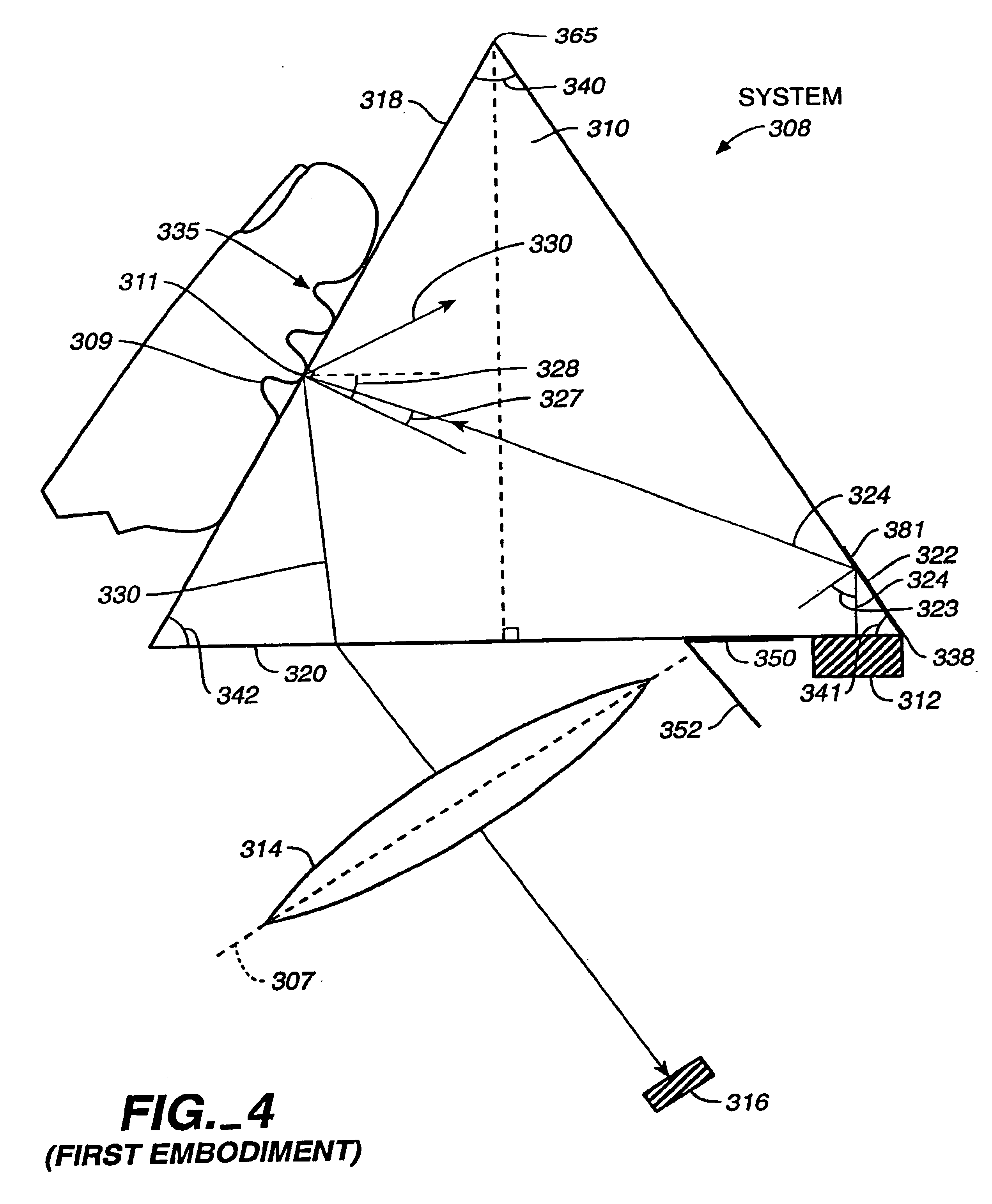
[0053]FIGS. 4 and 5 show a patterned object image acquisition system 308 in accordance with the present invention. Acquisition system 308 preferably includes a triangular prism 310, a light source 312, a lens assembly 314, and an image sensor 316. Prism 310 is a five faced isosceles triangular prism the length of which extends into the plane of FIG. 4. Prism 310 includes a rectangular imaging surface 318 against which an object to be imaged, such as a fingerprint 335, is placed. Prism 310 also includes a rectangular viewing surface 320 through which an image of a fingerprint 335 placed against imaging surface 318 passes out of prism 310. In the embodiment of FIGS. 4 and 5, viewing surface 320 also serves as a light receiving surface for allowing light to pass into prism 310. A light scattering surface 322 of prism comprises a third rectangular surface of prism 310. For reasons detailed below, light scattering surface 322 is preferably a diffusive.
[0054]Light source 312 is preferably...
PUM
 Login to View More
 Abstract
Description
Claims
Application Information
 Login to View More