
Data broadcast network for congestion-free internet access
a data broadcast network and internet access technology, applied in the field of information technology for reducing internet traffic and latency, can solve problems such as deadlock for attackers
- Summary
- Abstract
- Description
- Claims
- Application Information
AI Technical Summary
Benefits of technology
Problems solved by technology
Method used
Image

Examples
Embodiment Construction
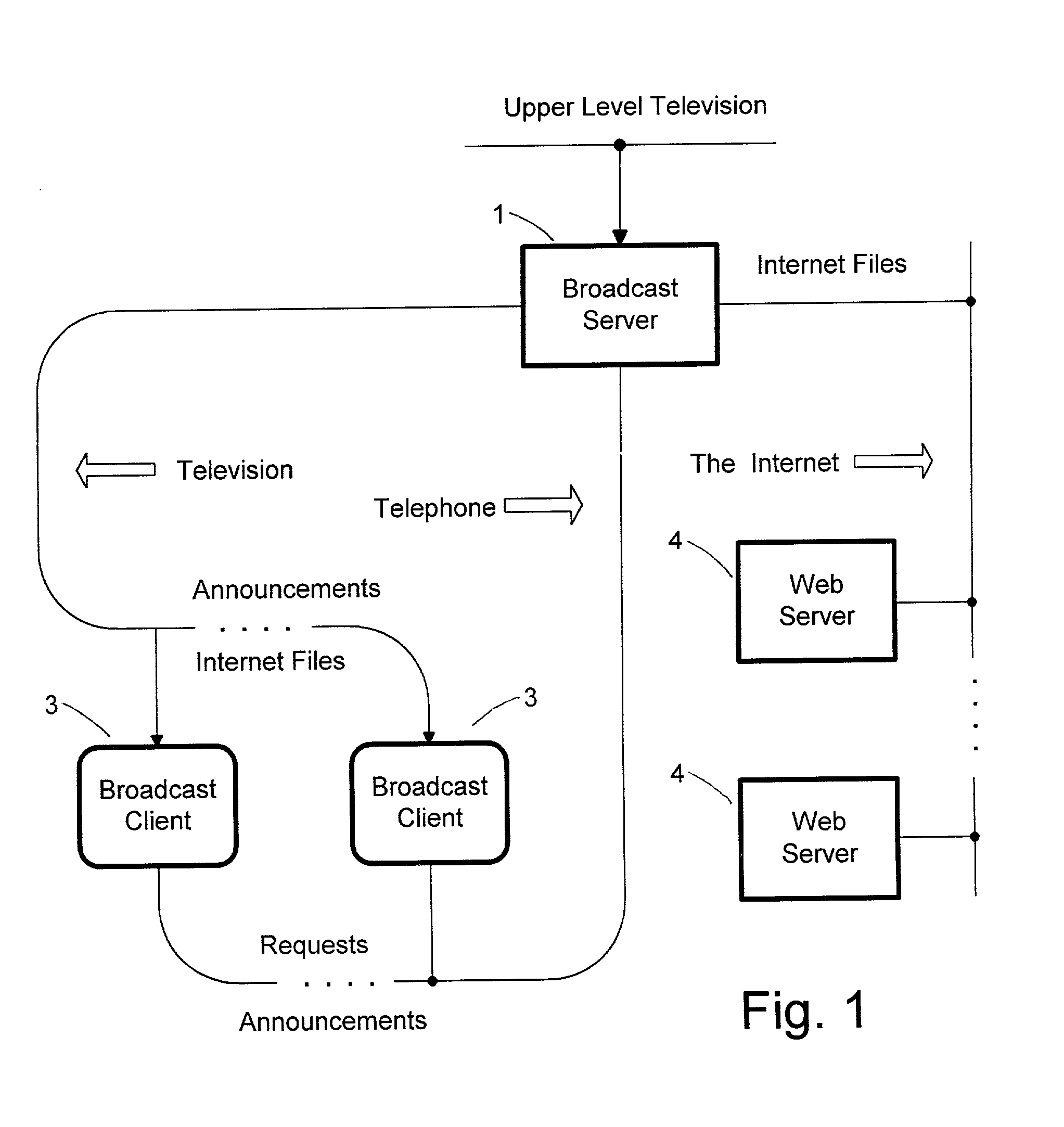
[0024]FIG. 1 shows a block diagram of a data broadcast system providing Internet access. It comprises a broadcast server 1, which is an Internet server located at a television transmission center, and broadcast clients 3 located in the area serviced by the broadcast center. The broadcast server receives requests for Internet content from client computers via telephone and composes a selection list of Internet files that contains everything requested by clients and in addition, some other frequently requested files. The server downloads the files of the selection list from Web servers 4 via the Internet and retransmits them in a broadcast manner via a television medium such as cable, satellite or over-the-air terrestrial broadcast system. The server produces in advance an announcement of each file to be transmitted so that broadcast clients could automatically control channel selectors (tuner cards) connecting them to the television medium for downloading those files that are request...
PUM
 Login to View More
 Abstract
Description
Claims
Application Information
 Login to View More