
Nonaqueous electrolytic solution with improved safety and lithium battery employing the same
- Summary
- Abstract
- Description
- Claims
- Application Information
AI Technical Summary
Benefits of technology
Problems solved by technology
Method used
Image

Examples
synthesis example 1
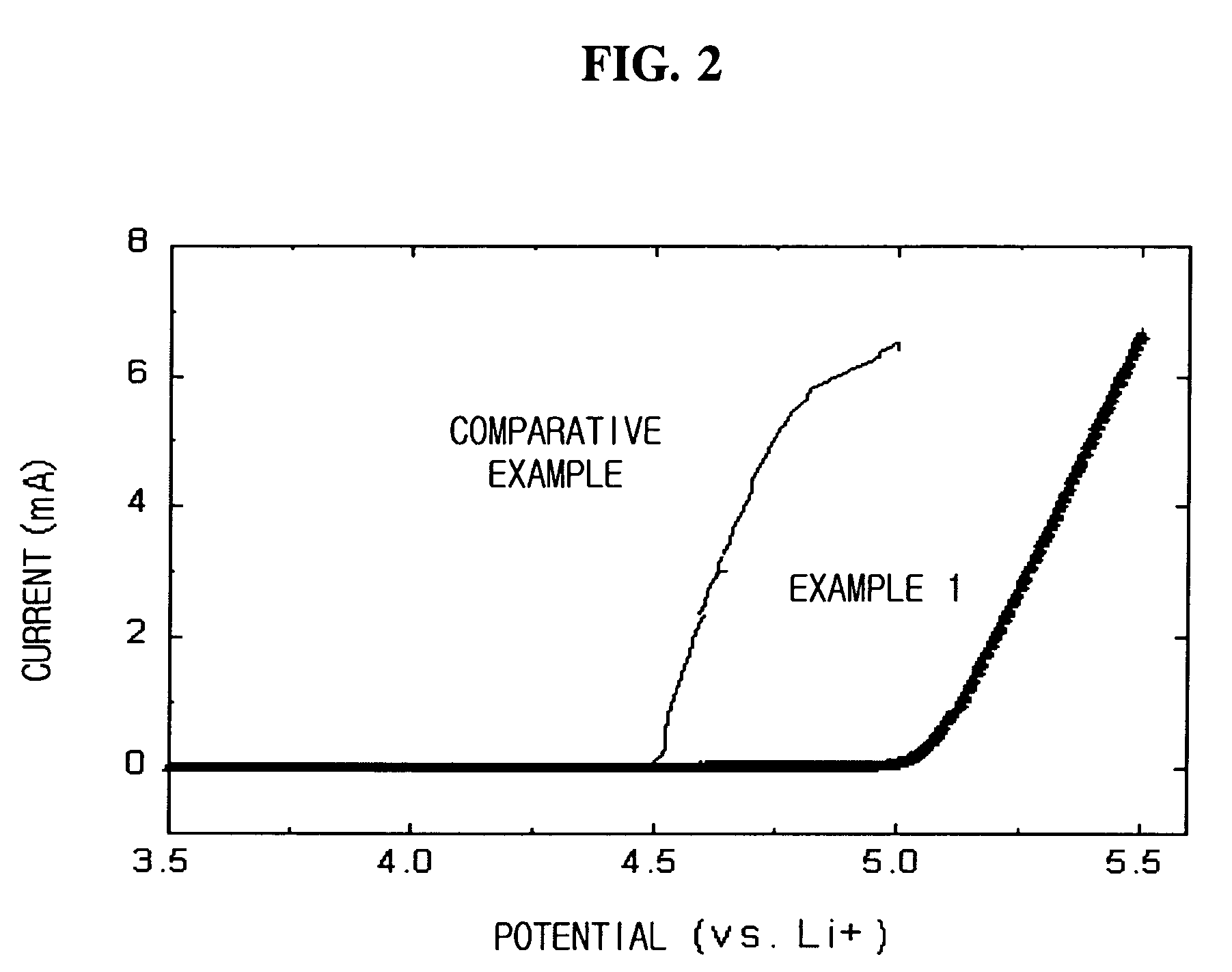
[0075]2.755 g of an EC / EMC / PC / FB mixed solvent mixed in a weight ratio of 30:55:5:10 containing 1.15 M LiPF6, and 0.145 g of trifluoromethoxybenzene represented by Formula 2 were mixed to prepare a nonaqueous electrolytic solution.
synthesis example 2
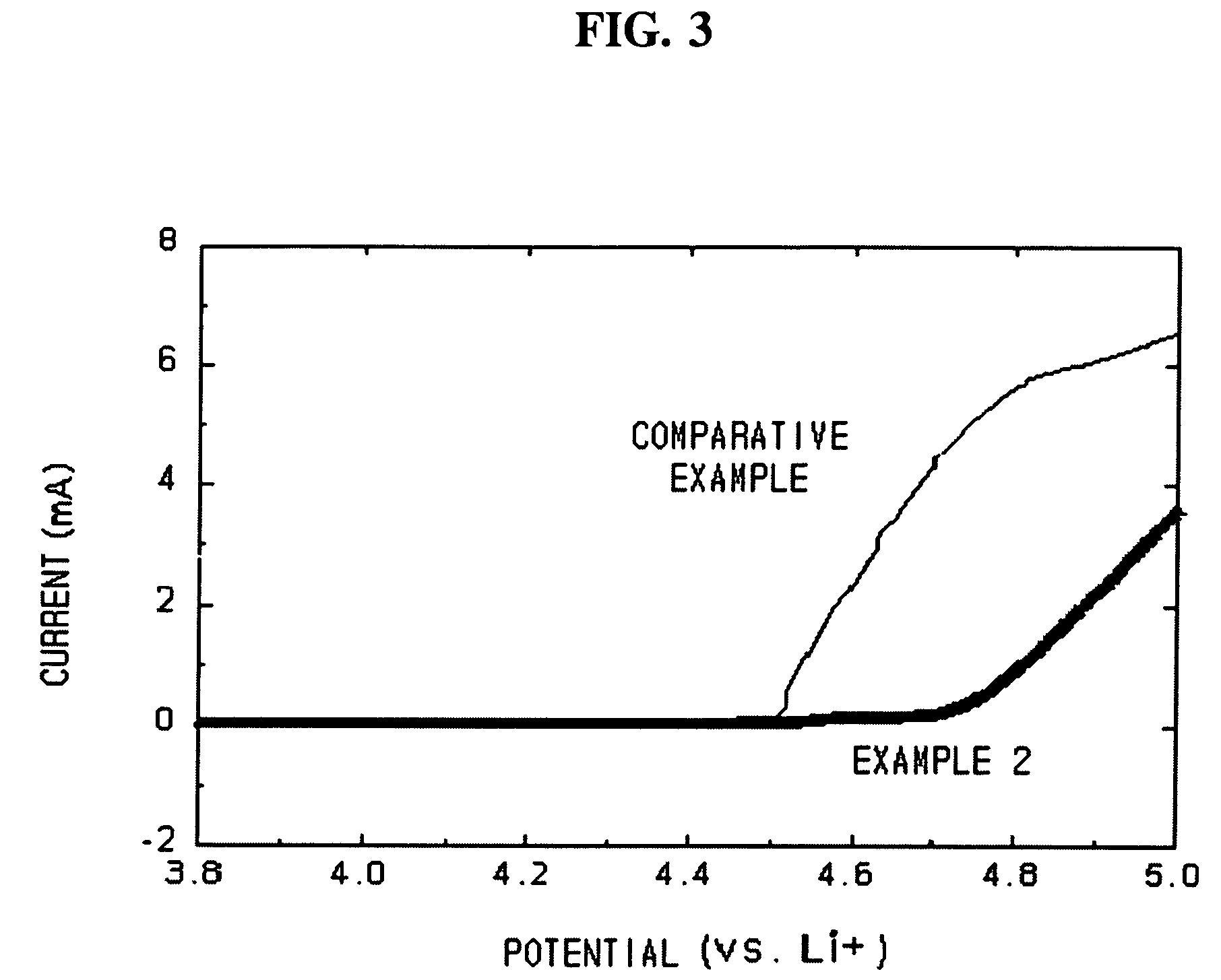
[0076]A nonaqueous electrolytic solution was prepared in the same manner as in Synthesis Example 1 except that α,4-dichloranisole represented by Formula 3 was used instead of trifluoromethoxybenzene represented by Formula 2.
synthesis example 3
[0077]To a mixture of 1 mole of dipentaerythritol, 2 moles of ε-caprolactone and a toluene solvent were added to 100 mg of tetrapropyltitanate as a catalyst, and reacted at 50° C. to synthesize a dipentaerythritol derivative having some hydroxy terminals substituted with pentylalcohols.
[0078]Subsequently, 4 moles of acrylic acid and 2 moles of butyl carboxylic acid were reacted with 1 mole of the dipentaerythritol derivative, giving a polyester hexaacrylate compound having two hydroxy groups present at the terminals of the pentaerythritol derivative substituted by —OC(═O)(CH2)5OC(═O)CH═CH2 and the remaining four hydroxy groups substituted by —OC(═O)(CH2)3CH3.
[0079]1 g of the polyester hexaacrylate compound and 30 g of an EC / EMC / PC / FB mixed solvent mixed in a weight ratio of 30:55:5:10 containing 1.15 M LiPF6, to prepare a nonaqueous electrolytic solution.
PUM
| Property | Measurement | Unit |
|---|---|---|
| Percent by mass | aaaaa | aaaaa |
| Percent by mass | aaaaa | aaaaa |
| Percent by mass | aaaaa | aaaaa |
Abstract
Description
Claims
Application Information
 Login to View More