Transmission of MIDI using TCP and UDP

a technology of midi and transmission, applied in the field of communication terminals, can solve problems such as inability to faithfully reproduce performances, and achieve the effect of effective transmission/receiving

US7396993B2Active Publication Date: 2008-07-08YAMAHA CORP
10 Cites 13 Cited by

Patent Information

Authority / Receiving Office
US · United States
Patent Type
Patents(United States)
Current Assignee / Owner
Publication Date
2008-07-08

Smart Images

  • Figure 1
    Figure 1
  • Figure 2
    Figure 2
  • Figure 3
    Figure 3
Patent Text Reader

Abstract

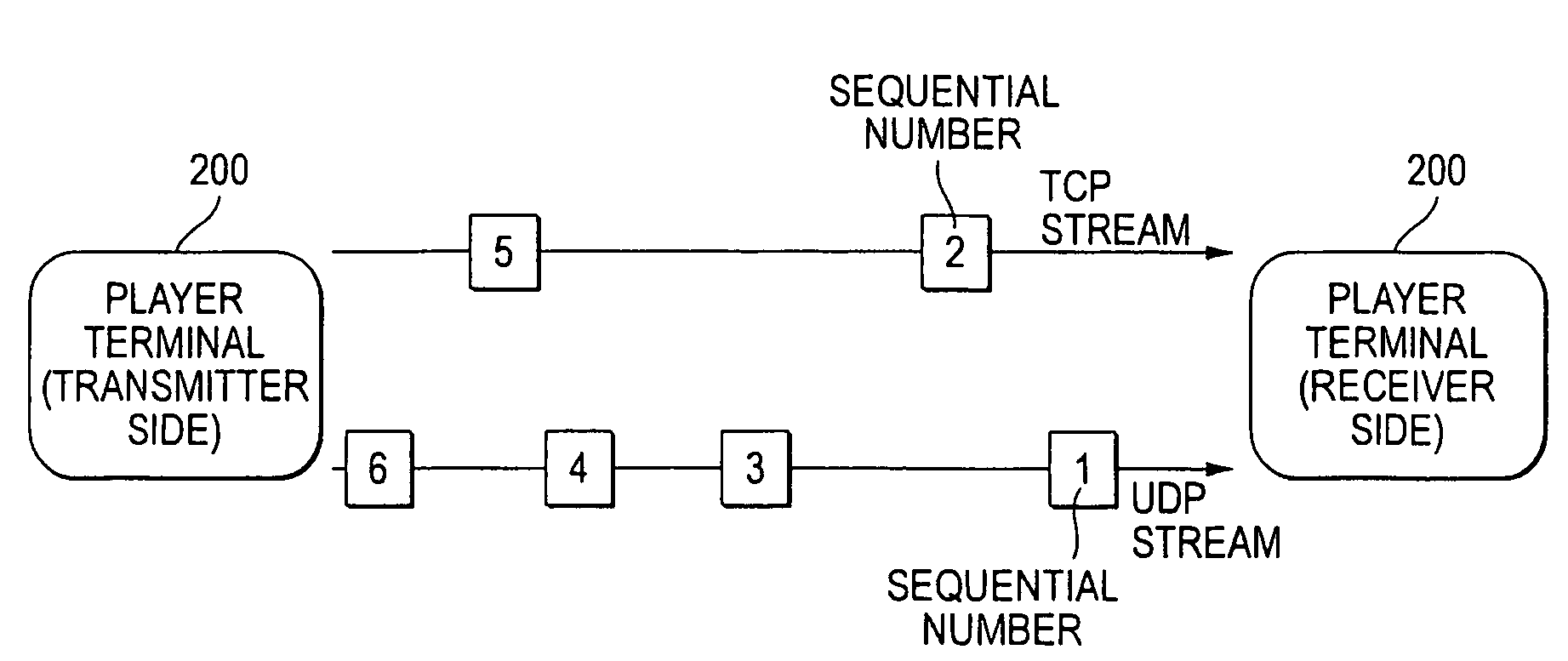
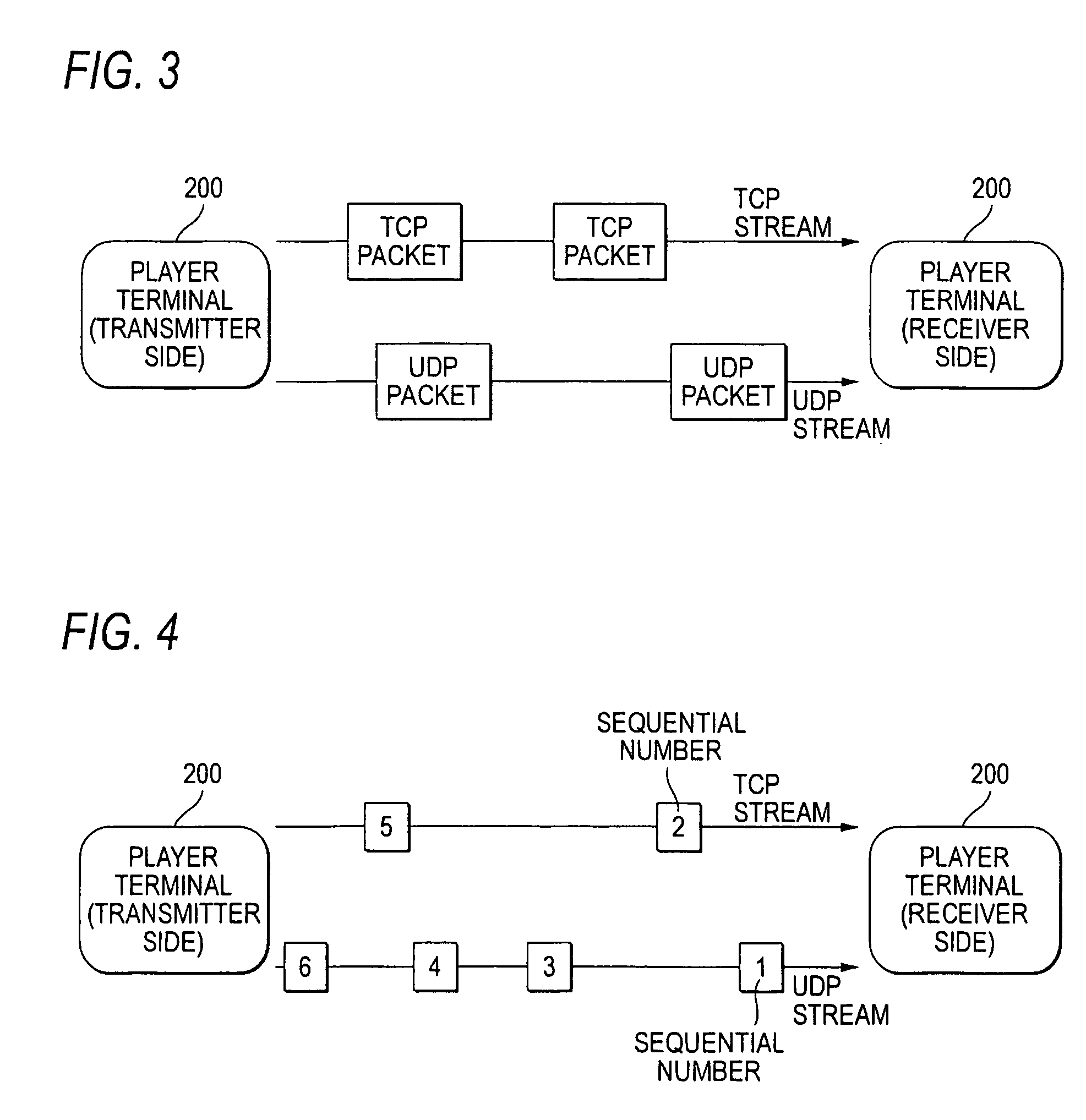
As the protocol used to transmit the MIDI message, TCP and UDP used widely as the transmission protocol are employed. A player terminal on the transmitter side classifies the transmitted MIDI message into the system exclusive message that should never be lost absolutely and other MIDI message. The player terminal on the transmitter side transmits the system exclusive message by using TCP with high reliability and transmits other MIDI message by using UDP with low reliability.
Need to check novelty before this filing date? Find Prior Art

Description

BACKGROUND OF THE INVENTION

[0001] The present invention relates to a communication terminal and, more particularly, a communication terminal for transmitting / receiving musical sound control data via a communication network such as the Internet, or the like.

[0002] FIG. 15 is a view exemplifying a connection state between electronic musical instruments, devices, etc. conforming to the MIDI (Musical Instrument Digital Interface) standard (referred to as “MIDI devices” hereinafter). Respective MIDI devices are connected via a MIDI cable, and a MIDI message (musical sound control data) generated in one MIDI device is transmitted to the other MIDI device via the MIDI cable.

[0003] In this manner, it is normal that the MIDI message is transmitted / received via the MIDI cable. In recent years in which the communication networks have been developed, a demand for implementation of duet performance or ensemble (session) by transmitting / receiving the MIDI message via the Internet is growing.

[0004] Ho...

Examples

Embodiment Construction

[0045]A system that permits a plurality of users, who are situated at various locations, to hold a session in real time by transmitting / receiving the MIDI message via the Internet (referred to as an “i-Session system” hereinafter) will be explained hereinafter.

A. Present Embodiment

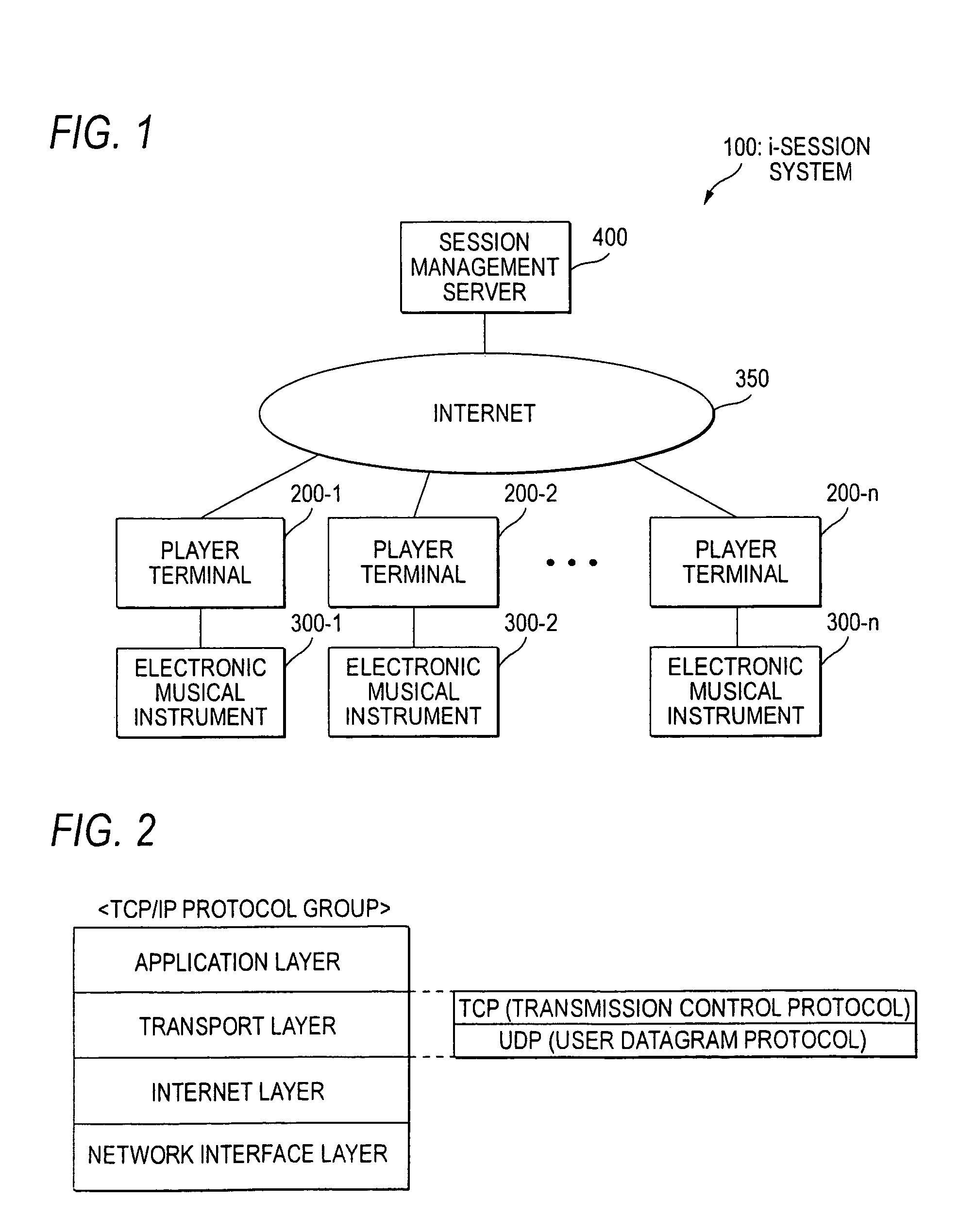
[0046]FIG. 1 is a view showing a configuration of an i-Session system 100 according to a present embodiment.

[0047]The i-Session system 100 is constructed by a plurality of player terminals 200-k (1≦k≦n) connected via the Internet 350, electronic musical instruments 300-k connected to respective player terminals 200-k, and a session management server 400. In this case, the player terminals 200-k and the electronic musical instruments 300-k are called simply the player terminals 200 and the electronic musical instruments 300 respectively if there is no necessity to discriminate them particularly.

[0048]The session management server 400 fulfills a role to manage pivotally the session that is implemented by the...