Low noise inter-symbol and inter-carrier interference cancellation for multi-carrier modulation receivers

a multi-carrier modulation and receiver technology, applied in the direction of amplitude demodulation, line-faulst/interference reduction, baseband system details, etc., can solve the problem of prohibitively high data throughput sacrifice, inability to match the sample at the receiver, and long impulsive response of the communication channel. problem, to achieve the effect of enhancing cancellation and minimizing cross-coupling

US7711059B2Active Publication Date: 2010-05-04REALTEK SEMICON CORP
10 Cites 8 Cited by

Patent Information

Authority / Receiving Office
US · United States
Patent Type
Patents(United States)
Current Assignee / Owner
Publication Date
2010-05-04

Smart Images

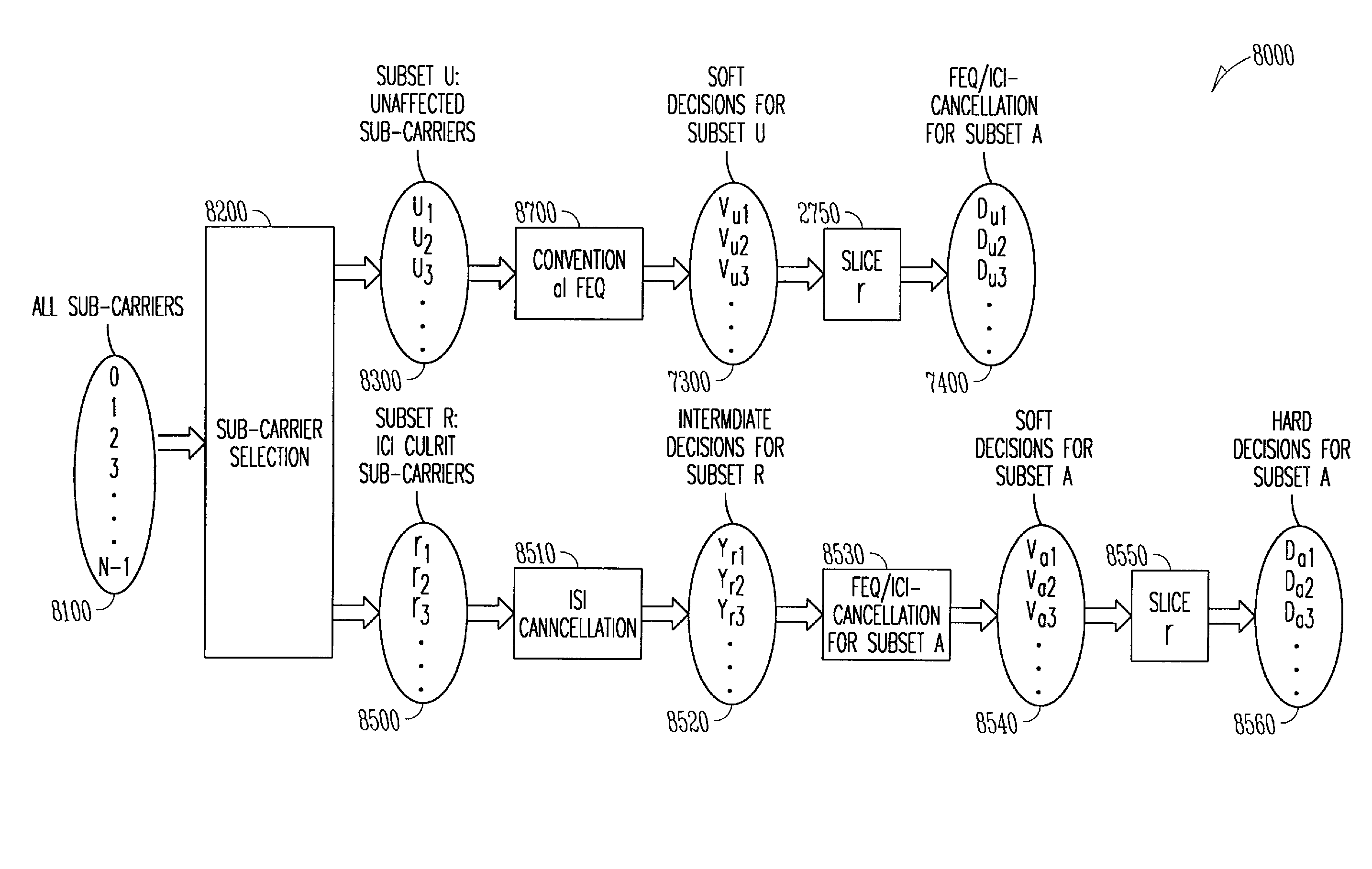
  • Figure 1
    Figure 1
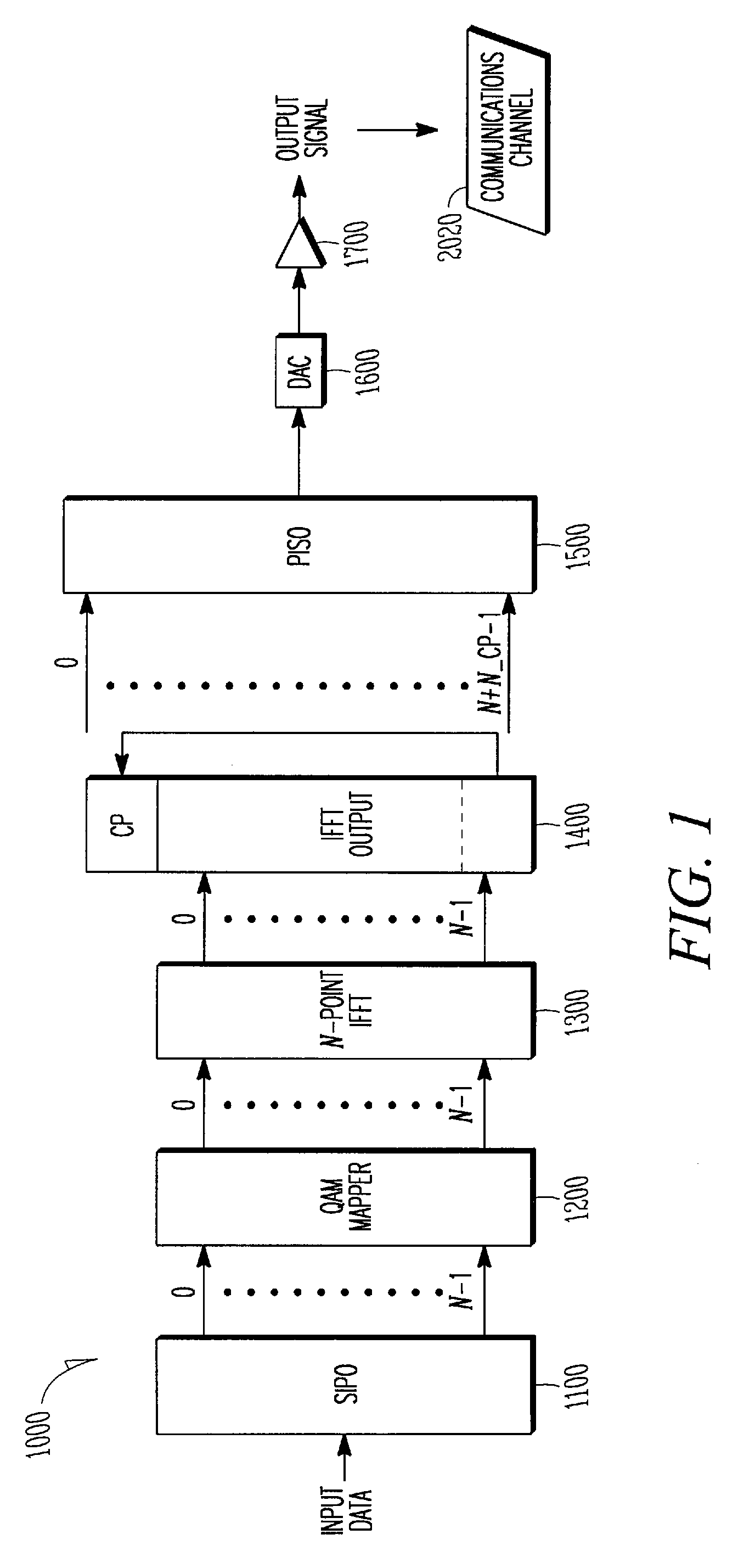
  • Figure 2
    Figure 2
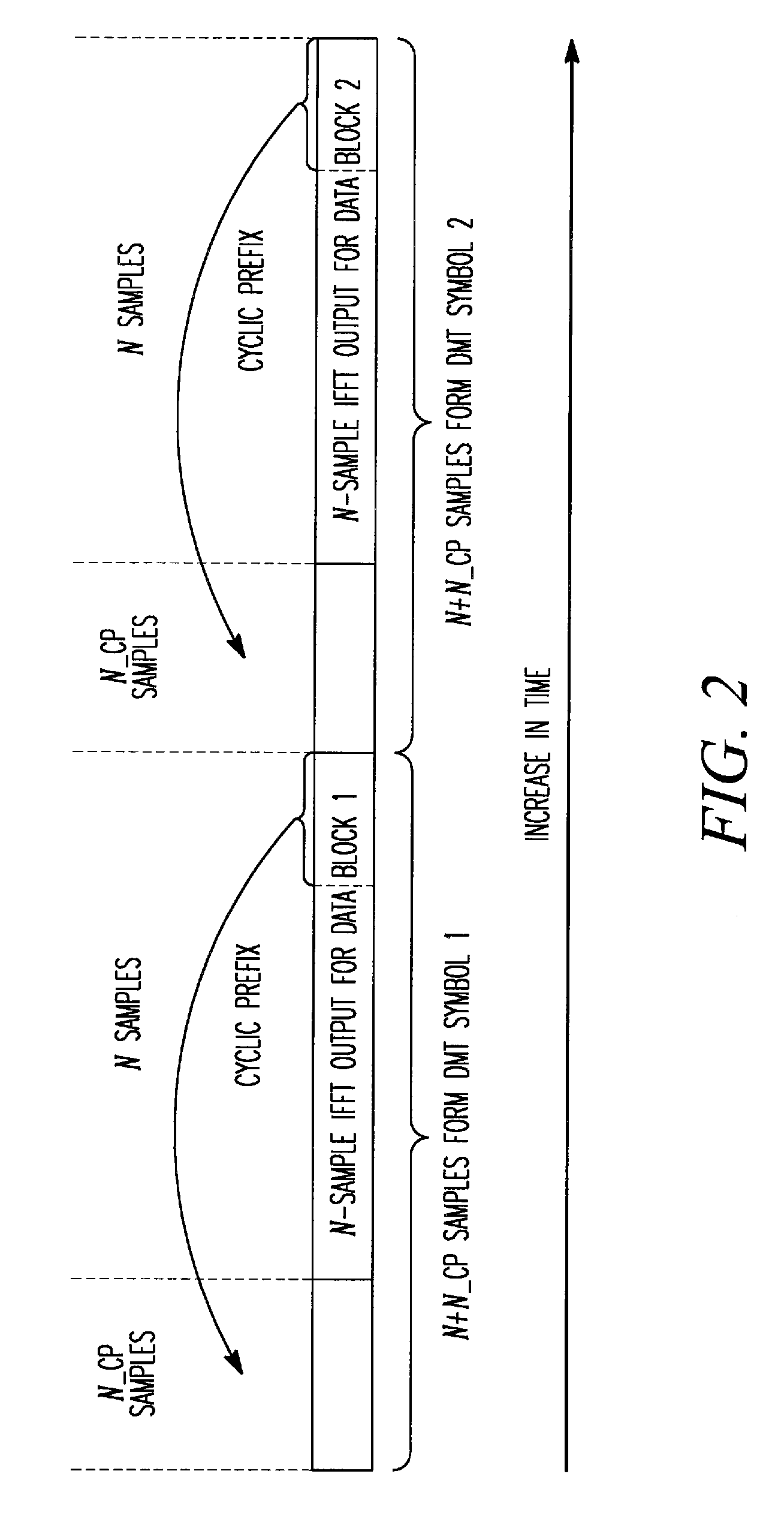
  • Figure 3
    Figure 3
Patent Text Reader

Abstract

A MCM (multi-carrier modulation) receiver that utilizes a plurality sub-carriers (e.g., tones) to transmit information in a frame-by-frame manner. Identify a first subset of sub-carriers that have negligible ISI (inter-symbol interference) and ICI (inter-carrier interference), and a second subset of sub-carriers that ISI / ICI cancellation is needed to improve the performance. For sub-carriers in the first subset, conventional equalization is performed to obtained soft decisions. For those sub-carriers in the second subset, perform ISI cancellation then ICI cancellation along with equalization. For sub-carriers in the second subset, identify a series of third subsets (one for each of the sub-carriers in the second subset) that cause interference to the sub-carriers in the second set. For sub-carriers in the third subset, identify a series of fourth subsets from a previous frame that cause interference to the sub-carriers in the third set. For each element in the third subset, perform ISI cancellation to eliminate the interference from the elements in the fourth subset from the previous frame to obtain a plurality of intermediate decisions. For each element in the second subset, perform a combined equalization and ICI cancellation using said intermediate decisions. The selection of the first subset, the second subset, the third subset, and the fourth subset are based on examining the frequency response of the communication channel.
Need to check novelty before this filing date? Find Prior Art

Description

CROSS-REFERENCE TO RELATED PATENT APPLICATION

[0001] This patent application claims the priority benefits of U.S. provisional application titled “Low noise inter-symbol and inter-carrier interference cancellation for multi-carrier modulation receivers” filed on Sep. 8, 2005, Ser. No. 60 / 596,200, the entire disclosure of which is incorporated herein by reference. This patent application is also related to U.S. patent application Ser. No. 11 / 256,707 filed Oct. 24, 2005, titled “Inter-Symbol and Inter-Carrier Interference Canceller for Multi-Carrier Modulation Receiver,” by inventors Chia-Liang Lin, Heng-Cheng Yeh and Cheng-Hsian Li, the entire subject matter of which is incorporated herein by reference.COPYRIGHT NOTICE

[0002] This patent document contains copyrightable subject matter that may include (by way of example and not by way of limitation) computer software elements, source code, flow charts, screen displays, and other copyrightable subject matter. The following notice shall appl...

Examples

Embodiment Construction

[0035]In the following detailed description, reference is made to the accompanying drawings that show, by way of illustration, specific embodiments in which the invention may be practiced. These embodiments are described in sufficient detail to enable those skilled in the art to practice the invention. It is to be understood that the various embodiments of the invention, although different, are not necessarily mutually exclusive. For example, a particular feature, structure, or characteristic described herein in connection with one embodiment may be implemented within other embodiments without departing from the scope of the invention. In addition, it is to be understood that the location or arrangement of individual elements within each disclosed embodiment may be modified without departing from the scope of the invention. The following detailed description is, therefore, not to be taken in a limiting sense, and the scope of the present invention is defined only by the appended cla...