Dynamic bandwidth allocation and service differentiation for broadband passive optical networks

a passive optical network and bandwidth allocation technology, applied in data switching networks, frequency-division multiplexes, instruments, etc., can solve the problems of additional data delay, existing bandwidth allocation schemes pose critical limitations, and serious bottlenecks in access networks, and achieve efficient allocation of upstream channel bandwidth and low time and space complexity.

a passive optical network and bandwidth allocation technology, applied in data switching networks, frequency-division multiplexes, instruments, etc., can solve the problems of additional data delay, existing bandwidth allocation schemes pose critical limitations, and serious bottlenecks in access networks, and achieve efficient allocation of upstream channel bandwidth and low time and space complexity.

US7808913B2Inactive Publication Date: 2010-10-05NEW JERSEY INSTITUTE OF TECHNOLOGY

Image

Smart Image Click on the blue labels to locate them in the text.
Viewing Examples
Smart Image
  • Dynamic bandwidth allocation and service differentiation for broadband passive optical networks
  • Dynamic bandwidth allocation and service differentiation for broadband passive optical networks
  • Dynamic bandwidth allocation and service differentiation for broadband passive optical networks

Examples

Experimental program
Comparison scheme
Effect test

Embodiment Construction

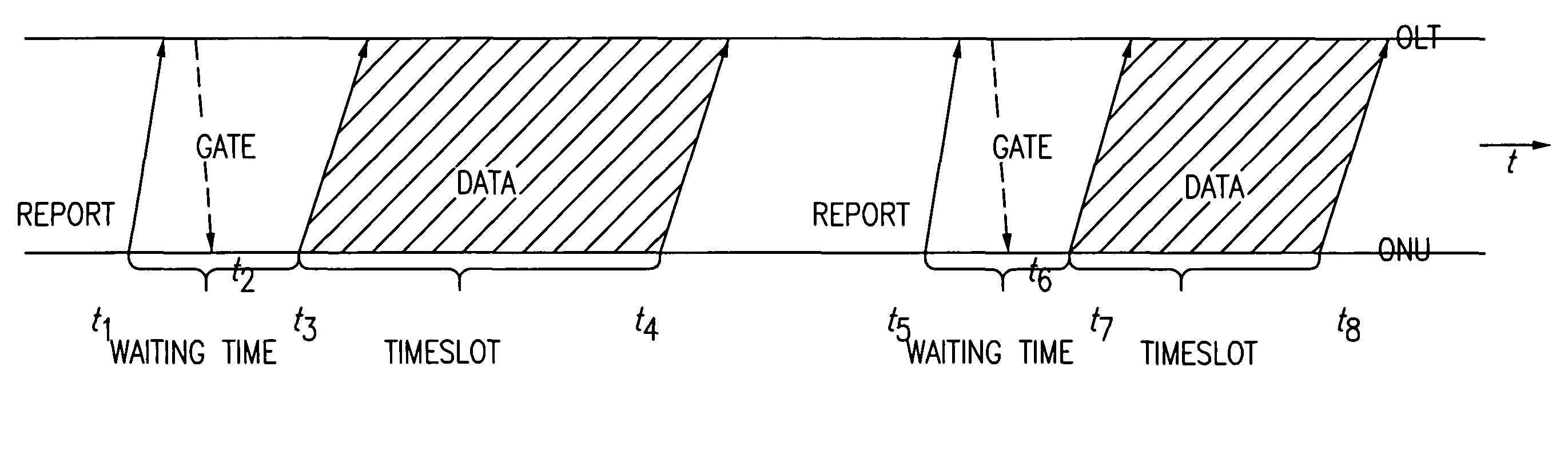
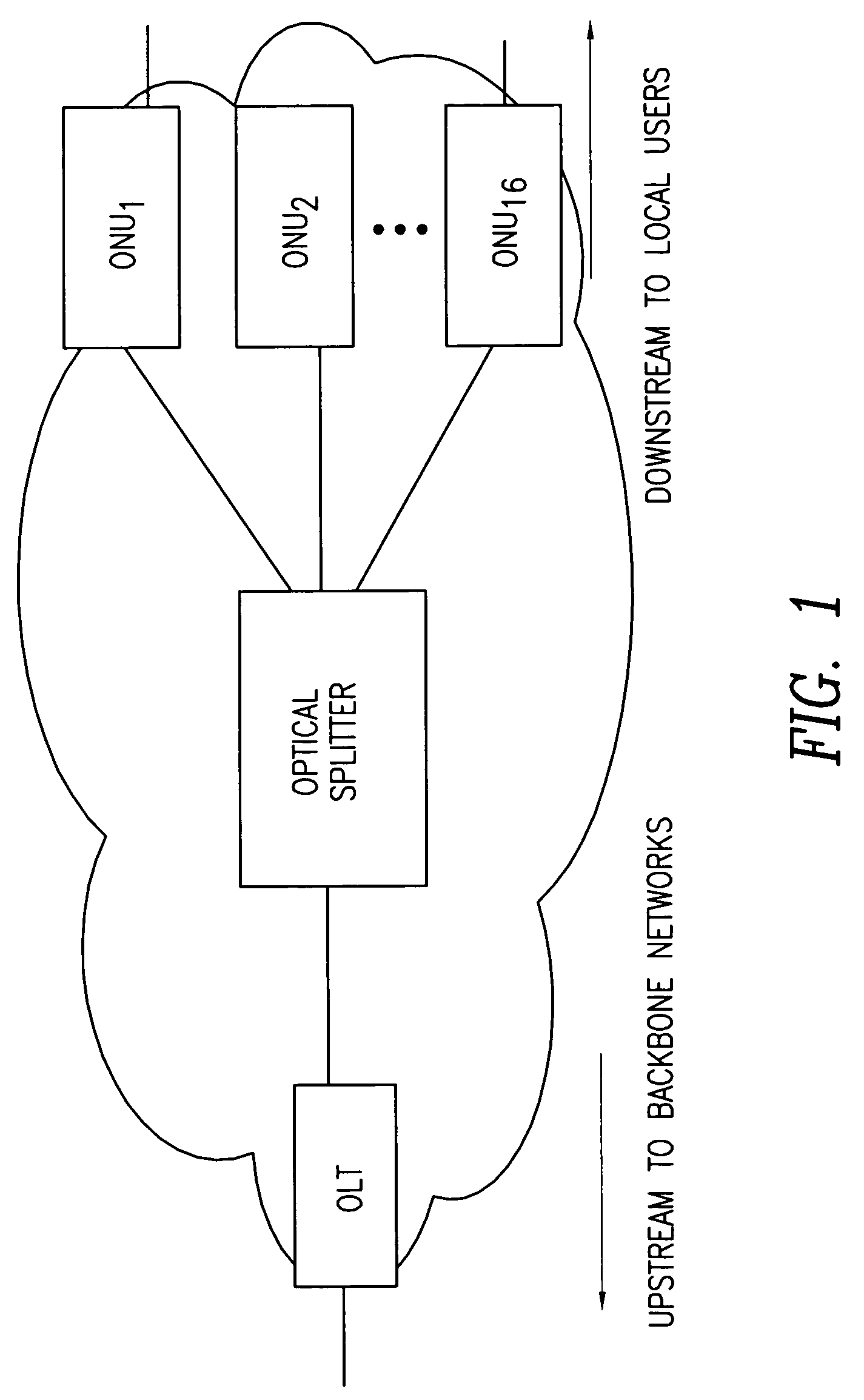
[0022]The major challenges of PONs include the MAC protocol design and the multi-service provisioning. Because of the directional property of the passive optical splitter, it is difficult for an ONU to detect data collisions by the conventional CSMA / CD MAC protocol which was designed for Ethernet. Therefore, an efficient MAC protocol is crucial to ensure high bandwidth utilization. Since PONs do not support QoS (quality of service) directly while the access network is required to accommodate various kinds of traffic, multi-service access is a distinguished feature that PONs are expected to provide. Owing to the differences in subscriber's service level agreements (SLAs), different ONUs may have different bandwidth requirements. A pragmatic approach is to employ the timeslot-based bandwidth allocation by providing various lengths of timeslots to different ONUs.

[0023]Fixed bandwidth allocation (FBA) grants each ONU a fixed timeslot length in every service cycle. A service cycle is def...

the structure of the environmentally friendly knitted fabric provided by the present invention; figure 2 Flow chart of the yarn wrapping machine for environmentally friendly knitted fabrics and storage devices; image 3 Is the parameter map of the yarn covering machine
Login to View More

PUM

No PUM Login to View More

Abstract

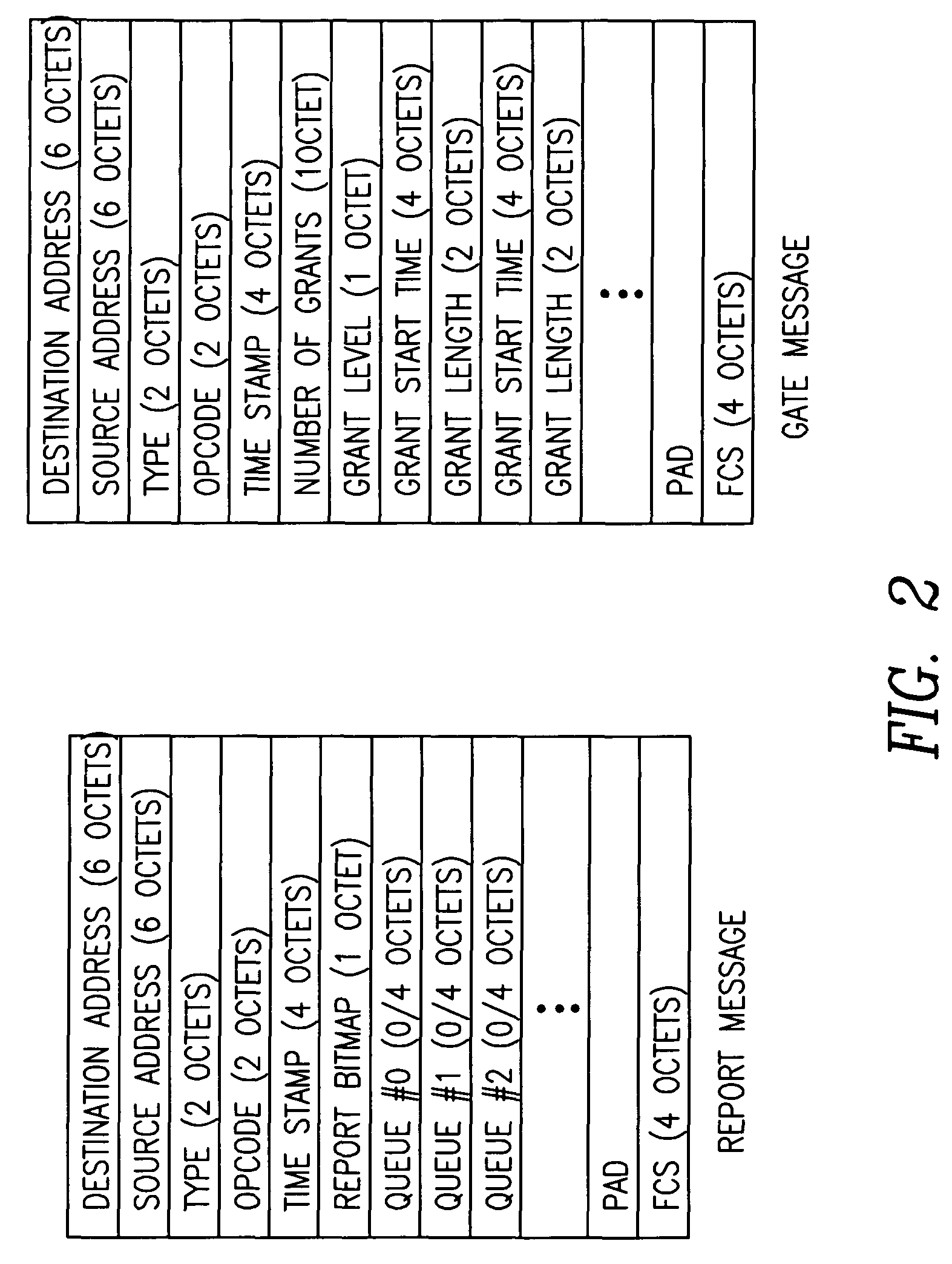
A dynamic upstream bandwidth allocation scheme is disclosed, i.e., limited sharing with traffic prediction (LSTP), to improve the bandwidth efficiency of upstream transmission over PONs. LSTP adopts the PON MAC control messages, and dynamically allocates bandwidth according to the on-line traffic load. The ONU bandwidth requirement includes the already buffered data and a prediction of the incoming data, thus reducing the frame delay and alleviating the data loss. ONUs are served by the OLT in a fixed order in LSTP to facilitate the traffic prediction. Each optical network unit (ONU) classifies its local traffic into three classes with descending priorities: expedited forwarding (EF), assured forwarding (AF), and best effort (BE). Data with higher priority replace data with lower priority when the buffer is full. In order to alleviate uncontrolled delay and unfair drop of the lower priority data, the priority-based scheduling is employed to deliver the buffered data in a particular transmission timeslot. The bandwidth allocation incorporates the service level agreements (SLAs) and the on-line traffic dynamics. The basic limited sharing with traffic prediction (LSTP) scheme is extended to serve the classified network traffic.

Description

CROSS REFERENCE TO RELATED APPLICATIONS[0001]This application claims the benefit of priority to U.S. Provisional Application No. 60 / 671,973, filed Apr. 15, 2005, entitled LIMITED SHARING WITH TRAFFIC PREDICTION FOR DYNAMIC BANDWIDTH ALLOCATION OVER BROADBAND PASSIVE OPTICAL NETWORKS AND SERVICE DIFFERENTIATION ENHANCEMENT THEREFOR.BACKGROUND OF THE INVENTION[0002]This invention relates to the problem of dynamic bandwidth allocation over passive optical networks. It arbitrates the upstream channel bandwidth among multiple optical network units (ONUs). In addition, this invention relates to the problem of service differentiation over passive optical networks (PONs). It integrates queuing, scheduling, and class-based bandwidth allocation to serve diverse end users. Specifically, the basic limited sharing with traffic prediction (LSTP) scheme is extended to serve the classified network traffic over broadband PONs (EPONs, BPONs, GPONs).[0003]Passive optical networks (PONs) address the fi...

Claims

the structure of the environmentally friendly knitted fabric provided by the present invention; figure 2 Flow chart of the yarn wrapping machine for environmentally friendly knitted fabrics and storage devices; image 3 Is the parameter map of the yarn covering machine
Login to View More

Application Information

Patent Timeline
05 Oct 2010
Publication
US7808913B2
IPC
H04L12/43; H04B10/2581
CPC
H04J3/1694; H04J14/0226; H04J14/0227; H04J14/0282; H04L12/5693; H04L12/5695; H04L47/15; H04L47/2433
Inventors
ANSARI, NIRWAN; LUO, YUANQIU