
Stable composition comprising a PTHrP analogue
a technology of parathyroid hormone and stable composition, which is applied in the direction of parathyroid hormone, peptide/protein ingredients, inorganic non-active ingredients, etc., can solve the problems of reducing the beneficial effect which can be achieved, and the current availability of osteoporosis drugs have limitations on suitable dosage ranges, so as to reduce the length of treatment time, reduce unwanted side effects, and increase beneficial physiological effects
- Summary
- Abstract
- Description
- Claims
- Application Information
AI Technical Summary
Benefits of technology
Problems solved by technology
Method used
Image

Examples
example 1
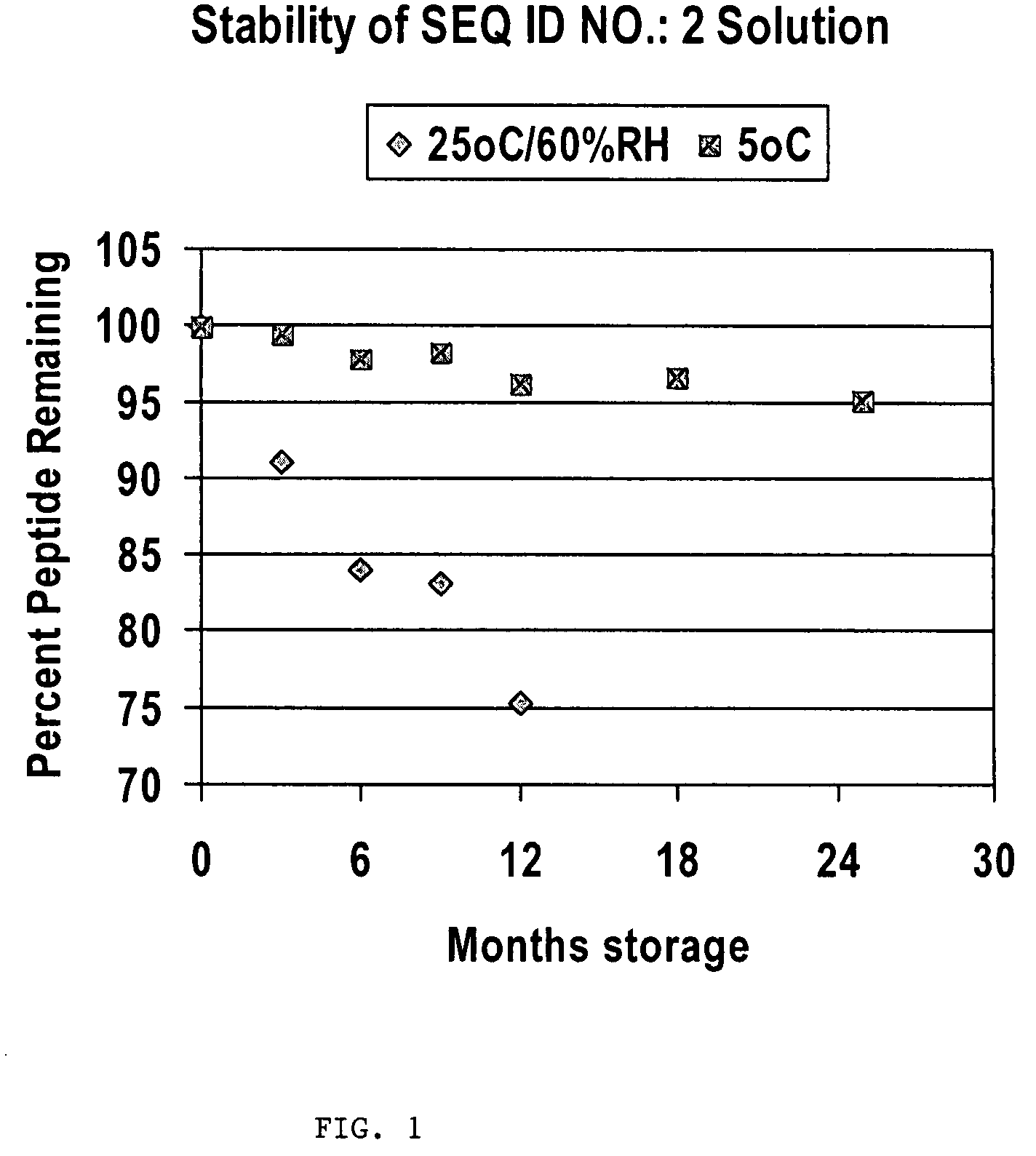
Demonstrates [Glu22,25, Leu23,28,31, Aib29, Lys26,30]hPTHrP(1-34)NH2 (SEQ ID NO.: 2) Stability at Low Acetate Concentration (1 mM), Without Stabilizer
[0046]
TABLE 1Unitary FormulaMaterialSupplier(per cartridge)(SEQ ID NO.: 2)Ipsen Ireland0.140 mg (free base)Tri-hydrate sodium acetate 0.1 NProlabo14.6 mgAcetic acid 0.1 NProlabo1.9 mg qs pH 5.1Water for InjectionMeramqs 1.4 gType I clear glass CartridgeBünderglass via11.5 ml, washed, siliconisedVetterand sterilisedGrey PTFE bromobutyl cartridgeDaïkyo1rubber stopperChlorobutyl rubber-metalWest1cartridge crimpPharmaceuticalqs = quantity sufficient to achieve
[0047]The formulation delivered 100 mcg of (SEQ ID NO.: 2) per 0.1 ml. (SEQ ID NO.: 2) was dissolved in Water for Injection containing dilute acetate buffer to give pH 5.1 was used.
[0048]Results confirm excellent chemical stability over 24 months, at 5° C. as shown in FIG. 1. This solution contains no stabilizer or preservative and only 6 mM acetate buffer.
[0049]In summation for (SEQ ...
example 2
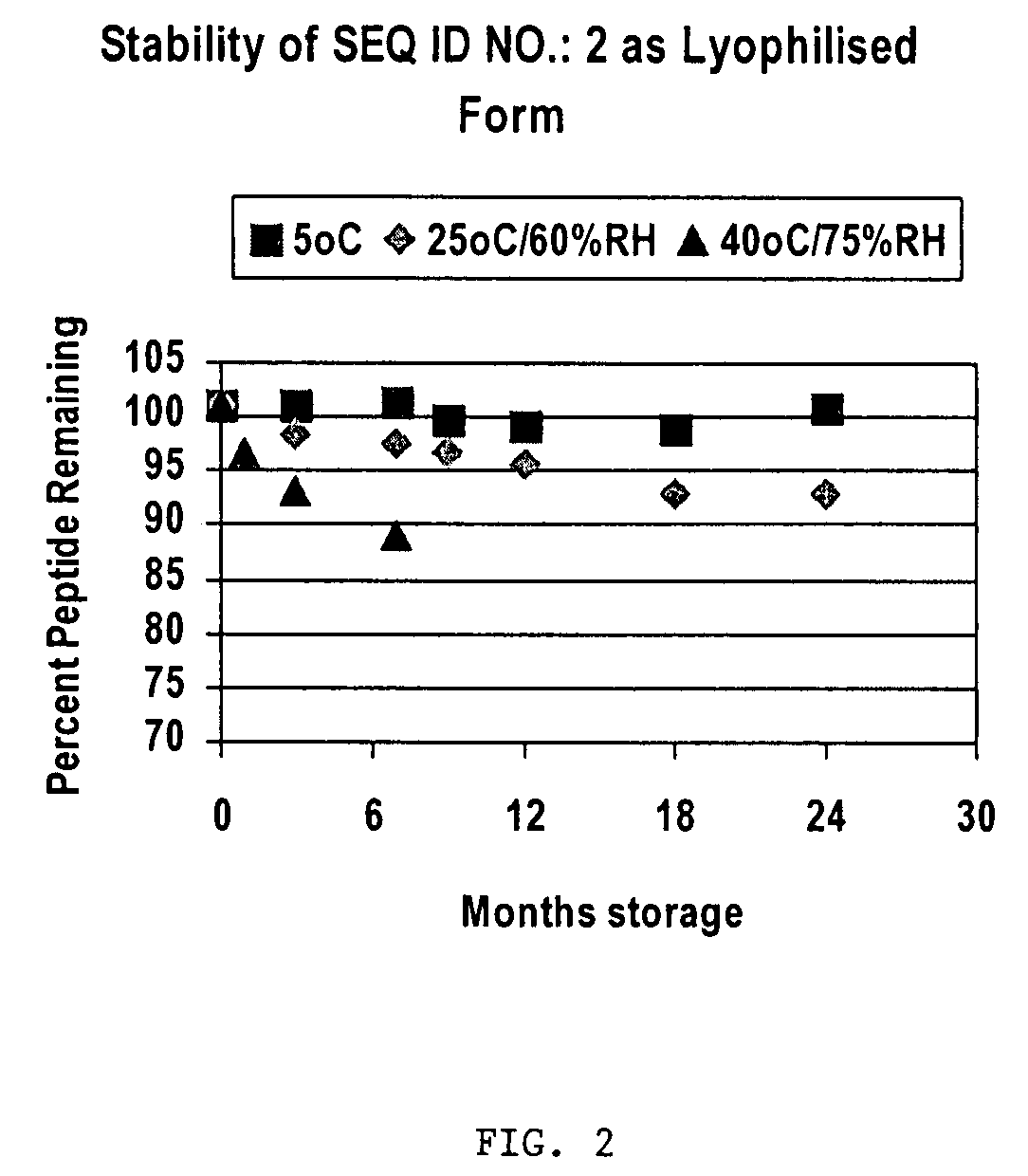
Use of Citric Acid Buffer in Lyophilized Form of (SEQ. ID NO.: 2)
[0050]
TABLE 2Unitary FormulaMaterialSupplier(per vial)(SEQ ID NO.: 2)Ipsen Ireland0.1 mg (free base)Dextran 70Interchemical50 mgCitric acid 0.25% (w / v)Prolaboqs pH 4.5*Water for injections**Meramqs 1 gType I clear glass vial, 11-13 mlVerretubex1Grey chlorobutyl PTFE stopper,Daïkyo120 mmFlip-off metal crimpWest Pharma1**to get pH 5-5.5 after lyophilisation removed after freeze-drying step.
[0051]The solutions in TABLE 2 were reconstituted with NaCl 0.9%, to give:
[0052]ONE vial of 2 ml (=50 μg / ml) providing 10 to 80 μg / d doses (with injections of 200 μl to 1.6 ml), or
[0053]ONE vial of 5 ml (=20 μg / ml solution) providing 5 to 40 μg / d doses (with injections of 250 μl-2 ml).
[0054]Citric acid was used to adjust pH and Dextran was used to provide a bulking agent to aid cake formation during lyophilization.
[0055]The solutions described were lyophilized in glass vials, and stored at various temperatures for up to 24 months. The ...
example 3
Screening of Formulations for [Glu22,25, Leu23,28,31, Aib29, Lys26,30]hPTHrP(1-34)NH2 (SEQ ID NO.: 2) to Compare Different Preservatives
[0056]TABLE 3 below shows Methyparaben and Benzyl Alcohol are not suitable preservatives for use with [Glu22,25, Leu23,28,31, Aib29, Lys26,30]hPTHrP(1-34)NH2 (SEQ ID NO.: 2), as precipitation and / or inactivity in preservative activity was seen.
[0057]
TABLE 3Example 3aExample 3bExample 3cExample 3dExample 3eMethylparaben1.5 mg / mL1.35 mg / mL———Propylparaben—0.15 mg / mL———Phenol——5 mg / mL——Chlorocresol———3 mg / mL—Benzyl alcohol————10 mg / mLPreservativeFailedPassPassPassPasseffectiveness testObservationo orPrecipitation————IssuesobservedPreservativeNot TestedPassPassPassFaileffectivenessastest after storageprecipitated4.5 months at 5° C.initially
[0058]Solutions were prepared containing [Glu22,25, Leu23,28,31, Aib29, Lys26,31]hPTHrP(1-34)NH2 (SEQ ID NO.: 2) 2 mg / ml, acetate buffer 6 mM and water for injection, with various different preservatives added at conc...
PUM
| Property | Measurement | Unit |
|---|---|---|
| concentration | aaaaa | aaaaa |
| concentration | aaaaa | aaaaa |
| concentration | aaaaa | aaaaa |
Abstract
Description
Claims
Application Information
 Login to View More