
Self-authentication communication device and device authentication system
a communication device and self-authentication technology, applied in public key infrastructure trust models, instruments, digital transmission, etc., can solve problems such as data interception/tampering or identity fraud, access target devices may be frauds, and browsers cannot discriminate if the devices
- Summary
- Abstract
- Description
- Claims
- Application Information
AI Technical Summary
Benefits of technology
Problems solved by technology
Method used
Image

Examples
embodiment 1
[0069]An embodiment will be described wherein each device generates an ID-based encryption private key at the time of manufacture, and generates a self-signed certificates including the signature of an RSA public key using the ID-based encryption private key (to be referred to as a registered trademark “RSA” hereinafter) at the time of system construction. The respective devices authenticate each other at the time of operation by using the self-signed certificates.
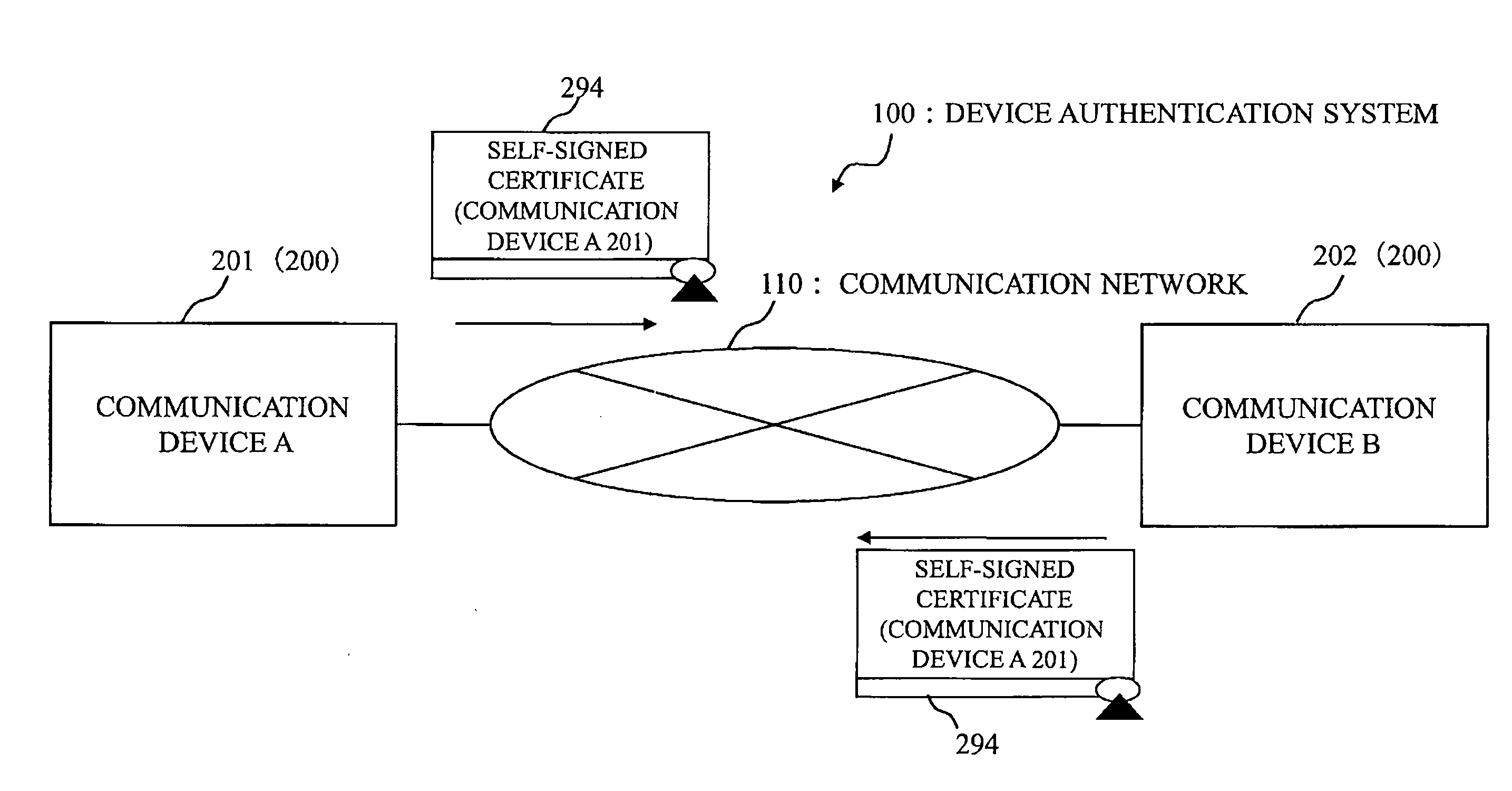
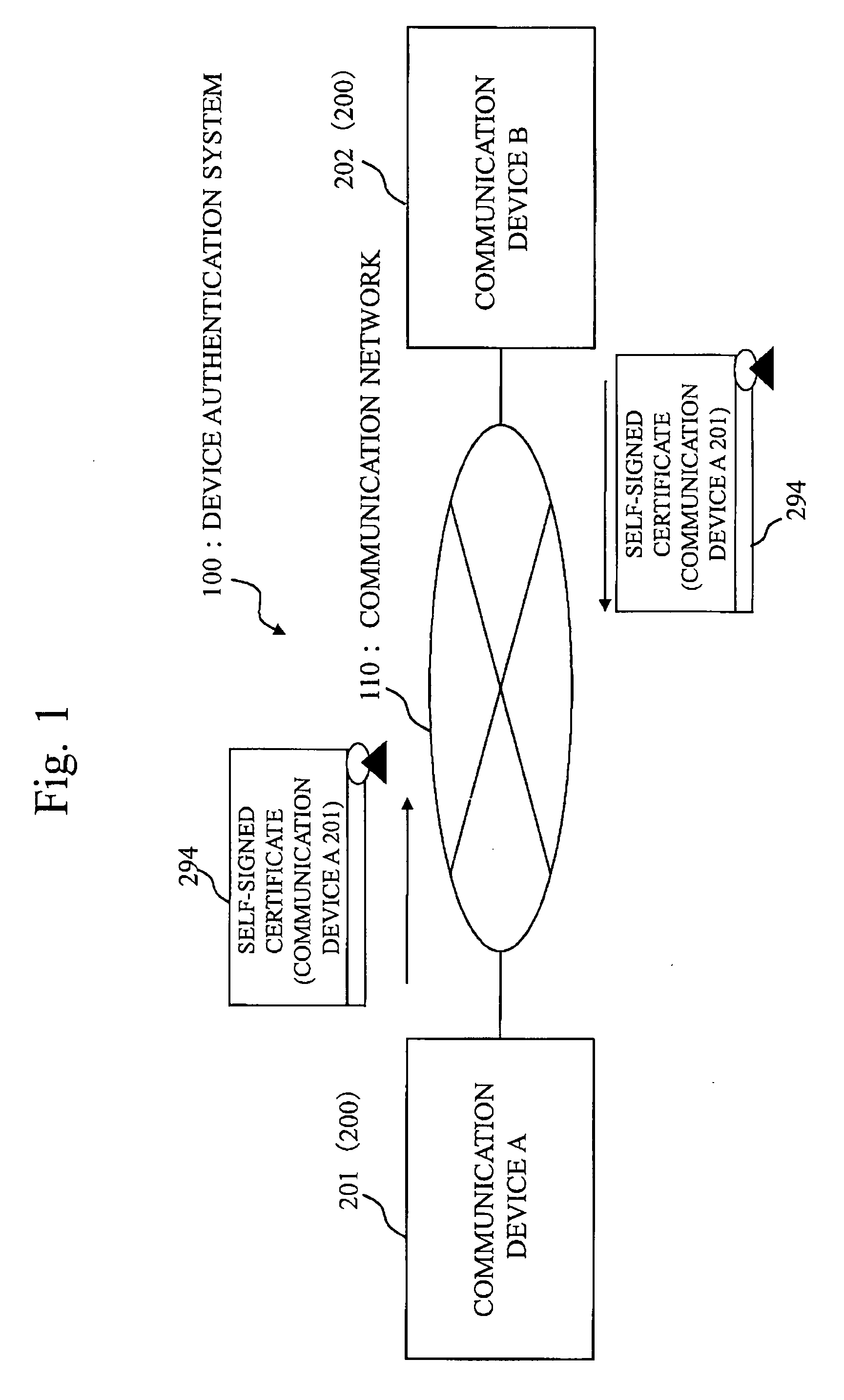
[0070]FIG. 1 is an architectural diagram of a device authentication system 100 of the first embodiment.
[0071]The architecture of the device authentication system 100 of the first embodiment will be described hereinafter with reference to FIG. 1.
[0072]In the device authentication system 100, a plurality of communication devices 200 (a communication device A 201 and communication device B 202) (examples of a self-authentication communication device) (examples of a self-authentication verification communication device) commun...
embodiment 2
[0259]An embodiment will be described wherein the communication device 200 generates the self-signed certificate 294 not at the time of system construction but at the time of manufacture.
[0260]An explanation will be made mainly on matters that are different from the first embodiment. An explanation on matters that are identical to those of the first embodiment will be omitted.
[0261]FIG. 11 is a flowchart showing the manufacturing process of the communication device 200 of the second embodiment.
[0262]The manufacturing process of the communication device 200 of the second embodiment will be described with reference to FIG. 11.
[0263]The flowchart shown in FIG. 11 is obtained by adding S130 to S160 to the manufacturing process (see FIG. 5) of the communication device 200 of the first embodiment.
[0264]Note that S130 to S150 are identical to S220 to S240 of the system construction process (see FIG. 7) of the communication device 200 of the first embodiment.
[0265]In S160, the self-signed c...
embodiment 3
[0274]An embodiment will be described wherein the communication device 200 updates the self-signed certificate 294.
[0275]An explanation will be made mainly on matters that are different from the first embodiment. An explanation on matters that are identical to those of the first embodiment will be omitted.
[0276]FIG. 12 is a function block diagram of the communication device 200 of the third embodiment.
[0277]The function blocks of the communication device 200 of the third embodiment will be described with reference to FIG. 12.
[0278]The communication device 200 comprises a certificate update opportunity detection part 224 in addition to the structure (see FIG. 3) described in the first embodiment.
[0279]The certificate update opportunity detection part 224 detects, by using the CPU, the opportunity (a predetermined timing) to update the self-signed certificate 294.
[0280]For example, the certificate update opportunity detection part 224 verifies the expiration date set in the self-signe...
PUM
 Login to View More
 Abstract
Description
Claims
Application Information
 Login to View More