
Quinoline compound, and agricultural and horticultural fungicide
Patent Information
- Authority / Receiving Office
- US · United States
- Current Assignee / Owner
- Publication Date
- 2020-09-03
- Estimated Expiration
- Not applicable · inactive patent
Smart Images
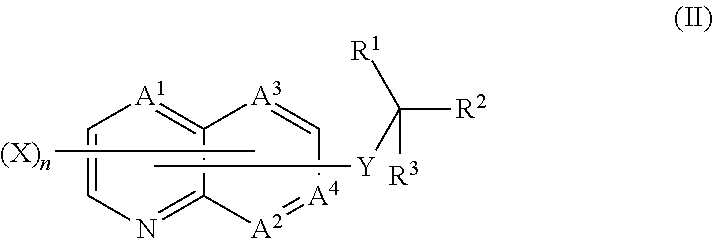
Figure 1 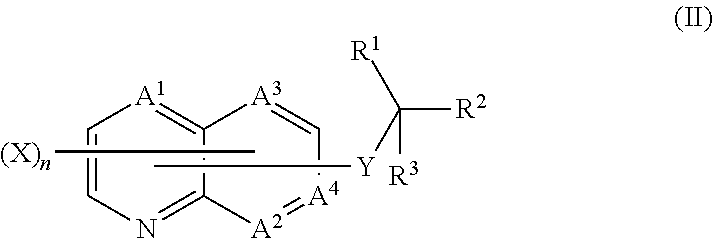
Figure 2 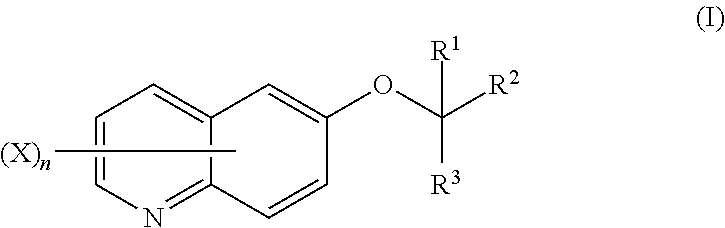
Figure 3
Abstract
Description
TECHNICAL FIELD
[0001] The present invention relates to a quinoline compound and an agricultural and horticultural fungicide. More specifically, the present invention relates to a quinoline compound having excellent fungicidal activity, excellent in safety, and can be synthesized in an industrially favorable manner; and an agricultural and horticultural fungicide containing this compound as an active ingredient.
[0002] Priority is claimed on Japanese Patent Application No. 2017-184719, filed Sep. 26, 2017, the content of which is incorporated herein by reference.BACKGROUND ART
[0003] In the cultivation of agricultural and horticultural crops, a large number of control agents against crop diseases have been proposed. Most of the proposed control agents are not sufficiently satisfactory because of insufficient control efficacy, restrictions on their use due to the emergence of drug-resistant pathogens, occurrence of phytotoxicity or contamination in plant bodies, high toxicity to humans, an...
Examples
example 1
2-(((8-bromoquinolin-6-yl)oxy)(5-fluoropyridin-2-yl)methyl)-1,3,4-oxadiazole
Synthesis of [2-(((8-bromoquinolin-6-yl)oxy)(5-fluoropyridin-2-yl)methyl)-1,3,4-oxadiazole] (Compound No. a-115)
(Step 1) Ethyl 2-(5-fluoropyridin-2-yl) acetate
Synthesis of [ethyl 2-(5-fluoropyridin-2-yl) acetate]
[0302]
[0303]Copper iodide (10.8 g, 56.7 mmol), picolinic acid (14.0 g, 114 mmol), and cesium carbonate (185.2 g, 568 mmol) were suspended in 1,4-dioxane (850 mL). Under a nitrogen atmosphere, 2-bromo-5-fluoropyridine (50.2 g, 285 mmol) and diethyl malonate (91.2 g, 569 mmol) were added to the obtained suspension, and the resulting mixture was stirred at 100° C. for 25 hours. Thereafter, a saturated aqueous ammonium chloride solution was added thereto, and the resulting mixture was extracted with ethyl acetate. The organic layer was dried over anhydrous magnesium sulfate, and then inorganic substances were removed by filtration. The resulting filtrate was concentrated under reduced pressure. Ethanol (...
example 2
2-((5-fluoropyridin-2-yl)((8-(pyridin-3-yl)quinolin-6-yl)oxy)methyl)-1,3,4-oxadiazole
Synthesis of [2-((5-fluoropyridin-2-yl)((8-(pyridin-3-yl)quinolin-6-yl)oxy)methyl)-1,3,4-oxadiazole] (Compound No. a-134)
(Step 1) 2-((5-fluoropyridin-2-yl)((8-(pyridin-3-yl)quinolin-6-yl)oxy)methyl)-1,3,4-oxadiazole
Synthesis of [2-((5-fluoropyridin-2-yl)((8-(pyridin-3-yl)quinolin-6-yl)oxy)methyl)-1,3,4-oxadiazole]
[0314]
[0315]2-(((8-bromoquinolin-6-yl)oxy)(5-fluoropyridin-2-yl)methyl)-1,3,4-oxadiazole (0.15 g, 0.37 mmol) and 3-pyridylboronic acid (0.07 g, 0.56 mmol) were dissolved in a mixed solvent of toluene (5 mL) and water (1 mL). Under a nitrogen atmosphere, tetrakis(triphenylphosphine)palladium(0) (0.04 g, 0.035 mmol) and sodium carbonate (0.16 g, 1.50 mmol) were added to the obtained solution, and the resulting mixture was stirred at 80° C. overnight and was then allowed to cool. The obtained liquid was filtered through celite, and the filtrate was concentrated under reduced pressure. The obta...
example 3
2-(((3-ethylquinolin-6-yl)oxy)(5-fluoropyridin-2-yl)methyl)-1,3,4-oxadiazole
Synthesis of [2-(((3-ethylquinolin-6-yl)oxy)(5-fluoropyridin-2-yl)methyl)-1,3,4-oxadiazole] (Compound No. a-106)
(Step 1) Ethyl 2-((3-bromoquinolin-6-yl)oxy)-2-(5-fluoropyridin-2-yl) acetate
Synthesis of [ethyl 2-((3-bromoquinolin-6-yl)oxy)-2-(5-fluoropyridin-2-yl) acetate]
[0318]
[0319]Ethyl 2-(5-fluoropyridin-2-yl) acetate (1.96 g, 10.76 mmol) was dissolved in carbon tetrachloride (36 mL). N-bromosuccinimide (1.90 g, 10.76 mmol) and benzoyl peroxide (0.17 g, 0.53 mmol) were added to the obtained solution, and the resulting mixture was stirred with heating under reflux for 4.5 hours and was then allowed to cool. The obtained liquid was filtered through celite, and the filtrate was concentrated under reduced pressure. The obtained concentrate was dissolved in N,N-dimethylformamide (27 mL). 3-bromo-6-quinolinol (1.84 g, 8.23 mmol) and potassium carbonate (2.27 g, 16.4 mmol) were added to the obtained solution, an...