
Process for producing n-acetylneuraminic acid
a technology of n-acetylneuraminic acid and process, which is applied in the direction of microorganisms, organic chemistry, bacteria-based processes, etc., can solve the problems of insufficient conversion efficiency, the production of n-acetylneuraminic acid requires complicated operations or expensive materials, etc., to achieve economic and more efficient effects
Patent Information
- Authority / Receiving Office
- US · United States
- Patent Type
- Patents(United States)
- Current Assignee / Owner
- Publication Date
- 2008-02-12
Smart Images
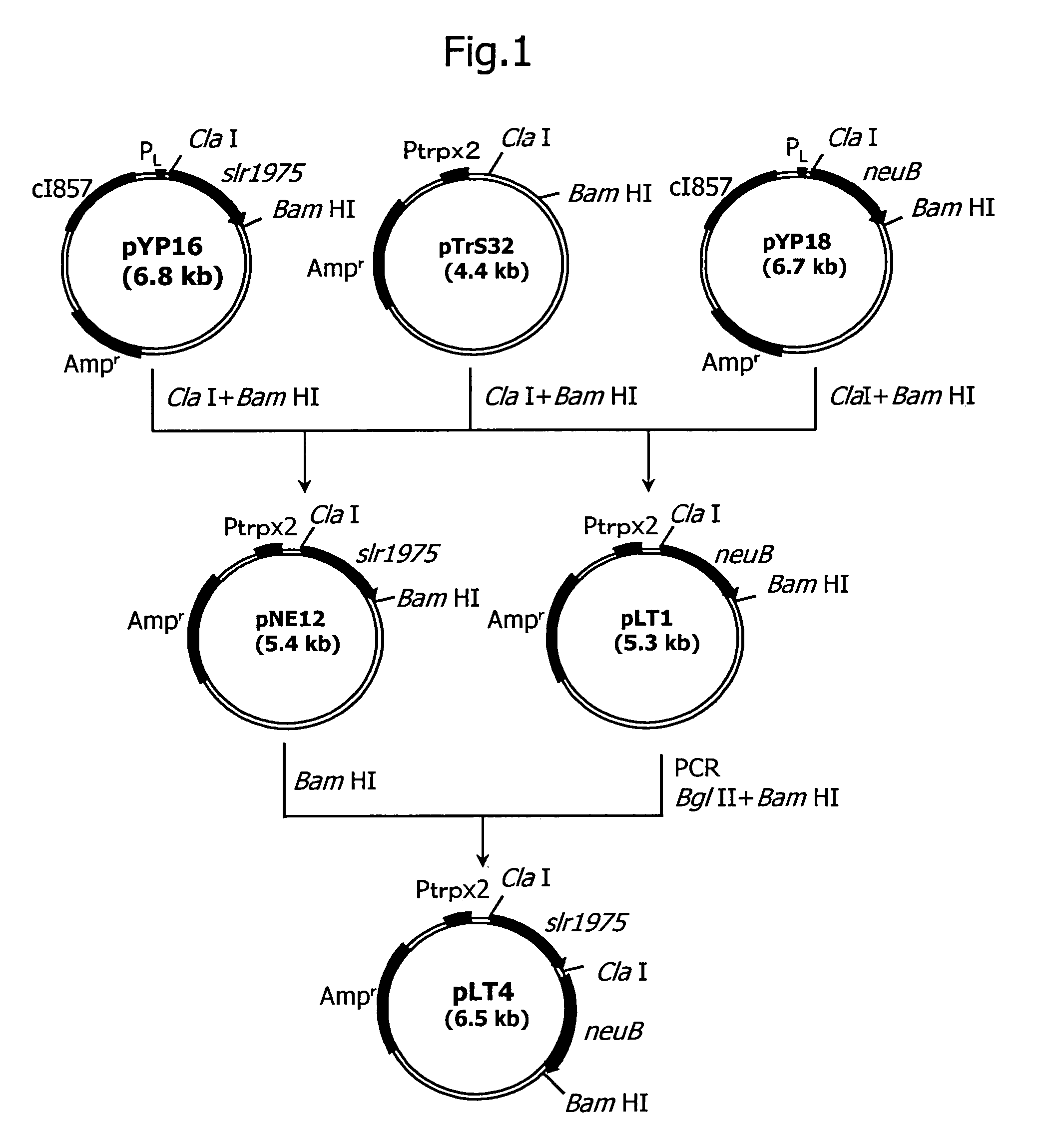
Figure 1
Abstract
Description
TECHNICAL FIELD
[0001] The present invention relates to a process for producing N-acetylneuraminic acid by using a microorganism in which the activity to decompose N-acetylneuraminic acid is lost or reduced compared with a wild-type strain.BACKGROUND ART
[0002] N-acetylneuraminic acid is known to be produced by extraction or decomposition, and by using enzymes or microorganisms.
[0003] An example of a known method by extraction is extraction from a nest of sea swallows, etc. [Carbohydr. Res., 56, 423 (1977)].
[0004] An example of a known method by decomposition is decomposition of colominic acid which is an N-acetylneuraminic acid polymer produced by Escherichia coli, etc. [J. Biochem., 82, 1425 (1977)].
[0005] Known methods utilizing enzymes include: methods using N-acetylneuraminic acid aldolase, pyruvic acid and N-acetylmannosamine [J. Am. Chem. Soc., 110, 6481 (1988); J. Am. Chem. Soc. 110, 7159 (1988)], methods using N-acetylneuraminic acid aldolase, pyruvic acid and N-acetylglucosamine ...
Examples
example 1
[0255]Construction of a Strain Expressing N-Acetylneuraminic Acid Synthase and N-Acetylglucosamine 2-Epimerase
[0256]After cleaving 0.2 μg of pYP18 (Japanese Published Unexamined Patent Application No. 136982 / 00) with restriction enzymes ClaI and BamHI, DNA fragments were separated by agarose gel electrophoresis, and a 1.1 kb DNA fragment comprising N-acetylneuraminic acid synthase gene derived from Escherichia coli was recovered using Gene Clean II Kit (Funakoshi). Then 0.1 μg of pTrS32 [prepared from Escherichia coli JM109 / pTrS32 (FERM BP-5408)] was cleaved with restriction enzymes ClaI and BamHI, DNA fragments were separated by agarose gel electrophoresis, and a 4.2 kb DNA fragment was recovered in the same manner.
[0257]The 1.1 kb and 4.2 kb fragments were subjected to ligation using a ligation kit (Takara Shuzo) at 16° C. for 16 hours.
[0258]Escherichia coli NM522 was transformed using the ligation mixture according to the known method described above, and the transformant was spr...
example 2
Acquisition of a Strain with Activity to Decompose N-Acetylneuraminic Acid Reduced
[0270]Escherichia coli HN0074 (FERM BP-4425) was inoculated into 30 ml of LB medium [10 g / l Bacto-trpton (Difco Laboratories Inc.), 10 g / l yeast extract, 5 g / l sodium chloride] in a 300-ml Erlenmeyer flask and cultured at 28° C. for 5 hours with shaking. The resulting culture was centrifuged at 3,000 r.p.m. at 4° C. for 10 minutes to recover the cells at the logarithmic growth phase. The cells were suspended in TM buffer [6.1 g / l Tris(hydroxymethyl)aminomethane, 5.8 g / l maleic acid, 0.1 g / l magnesium sulfate heptahydrate, 1 g / l ammonium sulfate, 0.5 g / l sodium citrate, pH6.0] containing 0.1 mg / ml N-methyl-N′-nitro-N-nitrosoguanidine, and mutagenesis was carried out at 37° C. for 30 minutes. The cells subjected to mutagenesis were collected by centrifugation, washed and then suspended in sterilized water. The suspension was spread on M9 minimal medium [3 g / l glucose, 6 g / l disodium hydrogenphosphate, 3 ...
example 3
Production of N-Acetylneuraminic Acid
[0273]Escherichia coli NAN8-71 was transformed using plasmid pLT4 obtained in Example 1, and the transformant obtained was spread on LB agar medium containing 50 μg / ml ampicillin and cultured overnight at 30° C. to obtain Escherichia coli NAN8-71 / pLT4.
[0274]Escherichia coli NAN8-71 / pLT4 was inoculated into 150 ml of LB medium containing 50 μg / ml ampicillin in a 1-1 Erlenmeyer flask with baffles and cultured at 30° C. with shaking at 220 rpm for 17 hours. Then, 150 ml of the culture was inoculated into 3 l of M9 medium [5 g / l glucose, 6 g / l disodium hydrogenphosphate, 3 g / l potassium dihydrogenphosphate, 5 g / l sodium chloride, 1 g / l ammonium chloride, 2.4 g / l magnesium sulfate heptahydrate, 10 mg / l manganese sulfate monohydrate, 200 mg / l ferrous sulfate heptahydrate, 8 mg / l vitamin B1, 5 g / l peptone (Kyokuto Pharmaceutical)] containing 50 μg / ml ampicillin in a 5-1 jar fermentor and cultured at 30° C. for 6.5 hours under the conditions of stirring ...