Unlock instant, AI-driven research and patent intelligence for your innovation.

Apparatus and method for depth image-based representation of 3-dimensional object

A technology for depth images and objects, applied in the field of devices and methods for representing three-dimensional objects based on depth images, which can solve problems such as expensive, difficult to handle, and unsatisfactory quality

Inactive Publication Date: 2009-09-30
SAMSUNG ELECTRONICS CO LTD
View PDF3 Cites 21 Cited by
  • Summary
  • Abstract
  • Description
  • Claims
  • Application Information

AI Technical Summary

Problems solved by technology

The main reasons for this include the difficulty of creating polygonal models of real objects and the complexity and unsatisfactory quality of coloring the actual scenery to produce a true picture
[0006] The desired application is polygon-heavy; for example, a detailed model of a human body contains millions of triangles, which is not easy to handle
Despite recent developments in range finding techniques, such as laser range scanners, which allow us to acquire dense range data with tolerable errors, it is still very expensive and difficult to get a seamless full polygonal model of the entire object
On the other hand, the rendering algorithm to achieve realistic image quality is computationally complex and thus far from real-time rendering

Method used

the structure of the environmentally friendly knitted fabric provided by the present invention; figure 2 Flow chart of the yarn wrapping machine for environmentally friendly knitted fabrics and storage devices; image 3 Is the parameter map of the yarn covering machine
View more

Image

Smart Image Click on the blue labels to locate them in the text.
Viewing Examples
Smart Image
  • Apparatus and method for depth image-based representation of 3-dimensional object
  • Apparatus and method for depth image-based representation of 3-dimensional object
  • Apparatus and method for depth image-based representation of 3-dimensional object

Examples

Experimental program
Comparison scheme
Effect test

Embodiment Construction

[0068] This application claims the benefit of the US provisional applications listed below, which are hereby incorporated by reference in their entirety.

[0069] I. ISO / IEC JTC 1 / SC 29 / WG 11 CODING OF MOVING PICTURES AND AUDIO

[0070] 1 Introduction

[0071] In this article, AFX A8.3 is reported based on the results of a central test of image colorization. The central implementation of image shader technology uses textures with depth information. Also, based on experiments following the 57th MPEG meeting and discussions at the AFX Special Members' Meeting in October, a small number of changes to node materialization were proposed.

[0072] 1. Test results

[0073] 1.1 Test model

[0074] ●Stationary objects

[0075] ● Depth image nodes with simple textures

[0076] ◆dog

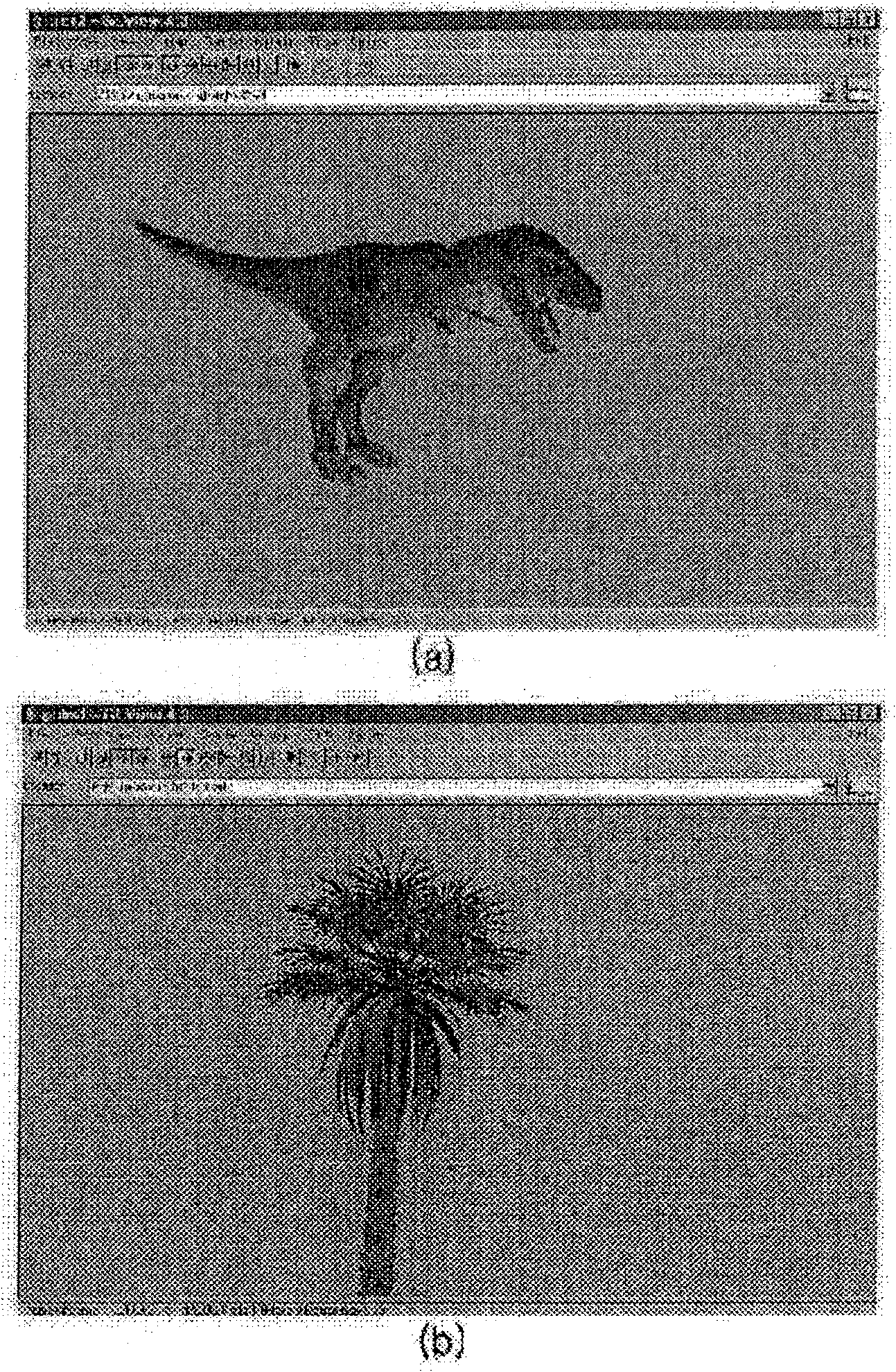
[0077] ◆Tirannosaurus Rex (depth image, utilizing about 20 cameras)

[0078] ◆Terrasque (a monster) (depth image, using about 20 cameras)

[0079] ◆ChumSungDae (depth image, scan data)

[0080] ◆ ...

the structure of the environmentally friendly knitted fabric provided by the present invention; figure 2 Flow chart of the yarn wrapping machine for environmentally friendly knitted fabrics and storage devices; image 3 Is the parameter map of the yarn covering machine
Login to View More

PUM

No PUM Login to View More

Abstract

Provides a family of node structures that use depth images to represent 3D image objects. These node structures are adopted in MPEG-4 of the regular polygonal 3D representation. The main formats of this family of node structures are depth images, point textures and octree images. A depth image represents an object through the combination of a reference image and a corresponding depth map. A point texture represents the object as a set of color point parameters determined by projecting onto a regular 2D grid. Octree images transform the same data into a hierarchical octree-structured 3D pixel model, a set of compressed reference images, and a 3D image corresponding directory tree. The depth image and octree have an animated version, the reference image is replaced by the video stream. The DIBR format is convenient for 3D model structures from 3D range scans and multi-source video data. The MPEG-4 framework allows the structure of a wide-range representation of the main DIBR format, providing flexible tools for efficient work with 3D models. The DIBR format is compressed by applying image (video) compression techniques to depth maps and reference images (video streams).

Description

[0001] This application is a divisional application of an invention application with a filing date of November 27, 2002, an application number of 02151900.5, and an invention title of "Apparatus and method for representing three-dimensional objects based on depth images". technical field [0002] The present invention relates to a device and method for representing a three-dimensional (3D) object based on a depth image, in particular, to a device and method for representing a three-dimensional (3D) object using a depth image, for computer graphics and animation In other words, it is called Depth Image Based Representation (DIBR), which has been adopted in MPEG-4 Animation Framework Extensions (AFX). Background technique [0003] Since the beginning of research on three-dimensional (3D) graphics, the fundamental purpose of researchers is to synthesize actual graphic scenes like actual images. Therefore, polygonal models have been exploited in the study of traditional shading ...

Claims

the structure of the environmentally friendly knitted fabric provided by the present invention; figure 2 Flow chart of the yarn wrapping machine for environmentally friendly knitted fabrics and storage devices; image 3 Is the parameter map of the yarn covering machine
Login to View More

Application Information

Patent Timeline
no application Login to View More
Patent Type & Authority Patents(China)
IPC IPC(8): G06T17/00G06T9/40G06T15/20
Inventor 朴仁圭亚历山大·O·齐尔科夫韩万镇
Owner SAMSUNG ELECTRONICS CO LTD