Turbot fluorescence labeling microsatellite sextuple PCR family tree recognizing method

A fluorescent labeling and identification method technology, applied in biochemical equipment and methods, microbial determination/inspection, chemiluminescence/bioluminescence, etc., can solve the problems of indistinguishable PCR products, limited triple PCR efficiency, etc., to save PCR experiments Consumables, improve product resolution, improve detection efficiency

CN101638692AInactive Publication Date: 2010-02-03YELLOW SEA FISHERIES RES INST CHINESE ACAD OF FISHERIES SCI
0 Cites 6 Cited by

Patent Information

Authority / Receiving Office
CN · China
Patent Type
Applications(China)
Current Assignee / Owner
Publication Date
2010-02-03
Estimated Expiration
Not applicable · inactive patent

Smart Images

  • Figure 1
    Figure 1
  • Figure 2
    Figure 2
Patent Text Reader

Abstract

The invention relates to a turbot fluorescence labeling microsatellite sextuple PCR family tree recognizing method which comprises the following steps: using three kinds of fluorescence (6FAM, HEX andNED) for pairwise labeling six pairs of primers according to the sizes of the PCR amplifying products of the primers; using primer design software for excluding the possibility that the six pairs ofprimers form dipolymer in the PCR reaction process, and combining the six pairs of primers in the same PCR reaction system which comprises ROX fluorescence molecule internal labels; adjusting the PCRreaction system, and establishing parameters which can enable the six pairs of primers to be simultaneously amplified in the same PCR reaction system and a proper PCR reaction procedure; and analyzingPCR products in six microsatellite positions of the turbot through ABI3130 or a similar gene analyzer according to the fluorescence labels. The sextuple PCR technology can improve the detection efficiency of the turbot microsatellite labeling, wherein the single parent excluding ratio is 99.63%, and the individual recognizing ratio is 99.99%; and the sextuple PCR technology can distinguish different family trees of the turbot or recognize and identify individuals and parent children.
Need to check novelty before this filing date? Find Prior Art

Description

Technical field:

[0001] The invention belongs to molecular marker auxiliary technology of genetic breeding of molecular biology, and relates to a method for identification of turbot fluorescent marker microsatellite six-fold PCR family. Background technique:

[0002] Turbot (Scophthalmus maximus L.), also known as turbot, is a high-quality mariculture species native to Europe. my country introduced aquaculture in 1992 and is an important marine aquaculture object in my country. The use of molecular marker-assisted breeding is one of the important ways of turbot breeding, and the most widely used molecular marker is microsatellite. Conventional microsatellite detection technology is PCR amplification of a single site with a single pair of primers, and its products are separated and detected by polyacrylamide gel electrophoresis, which is inefficient and takes a long time. Microsatellite multiplex PCR is based on conventional PCR technology. Multiple pairs of specific micros...

Examples

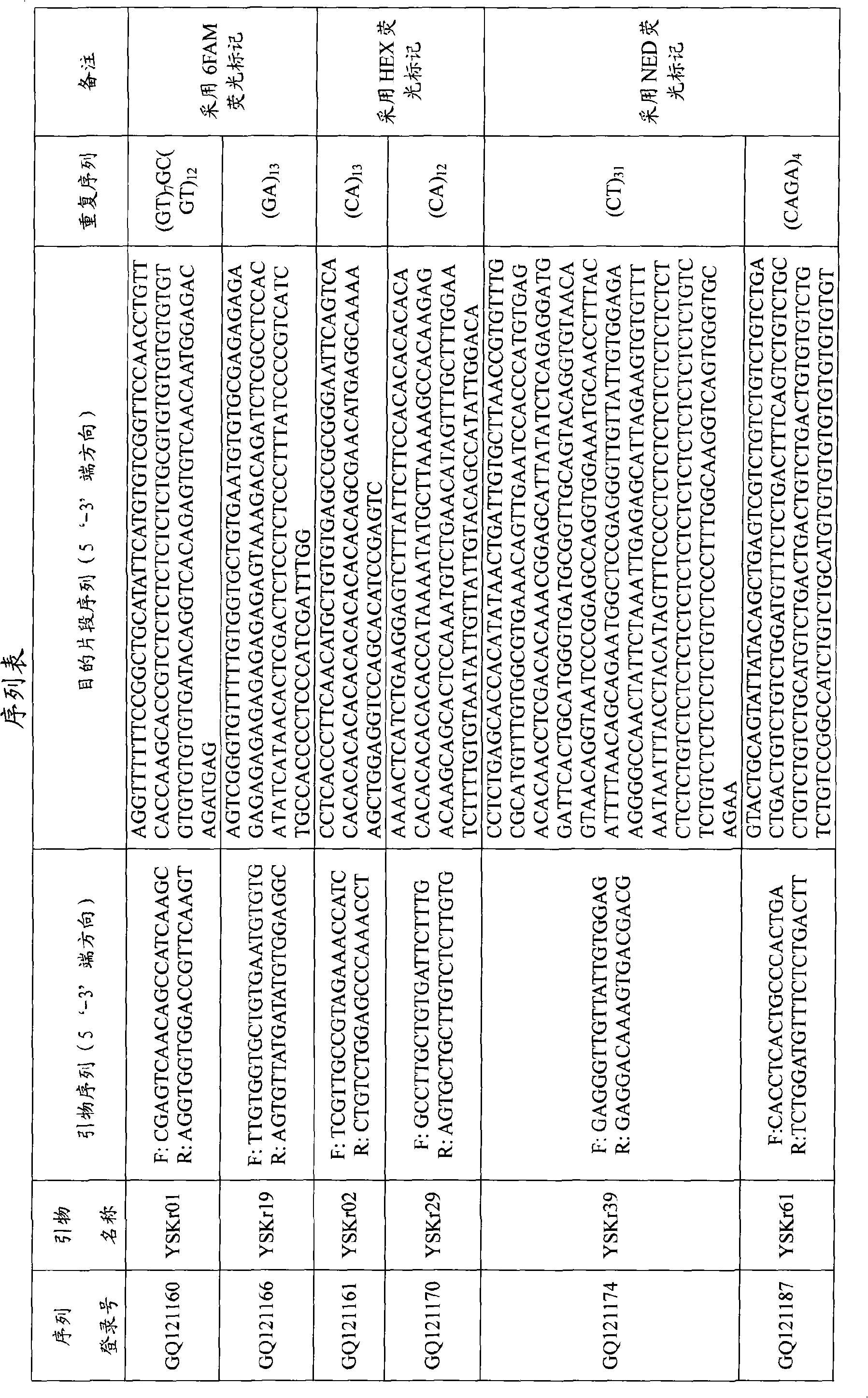
Embodiment Construction

[0012] The development of microsatellite markers in turbot was obtained by sequencing using the "colony enrichment-probe hybridization" strategy, and primers were designed for repetitive sequences to achieve PCR amplification of specific microsatellite loci in turbot. First, use the primer design software to analyze and exclude the possibility that the six pairs of primers form primer dimers and pod structures with each other, and modify the detected primers that seriously affect the dimer and pod structures of the compound PCR reaction to make them completely Suitable for complex PCR reaction system. For any two pairs of primers with significant difference in the size of the amplification product (≥50bp), the same single primer fluorescent labeling is carried out, specifically, the two primers YSKr01 and YSKr19 are fluorescently labeled with 6FAM; the two primers YSKr02 and YSKr29 are fluorescently labeled with HEX; YSKr39 and Two primers of YSKr61 were fluorescently labeled ...