
Culture method of early-breeding seedlings of Charybdis japonica
A cultivation method and seedling propagation technology, which is applied in the field of early propagation of seedlings, to achieve the effects of long growth period, improvement of economic benefits, and promotion of income increase and prosperity
- Summary
- Abstract
- Description
- Claims
- Application Information
AI Technical Summary
Problems solved by technology
Method used
Image

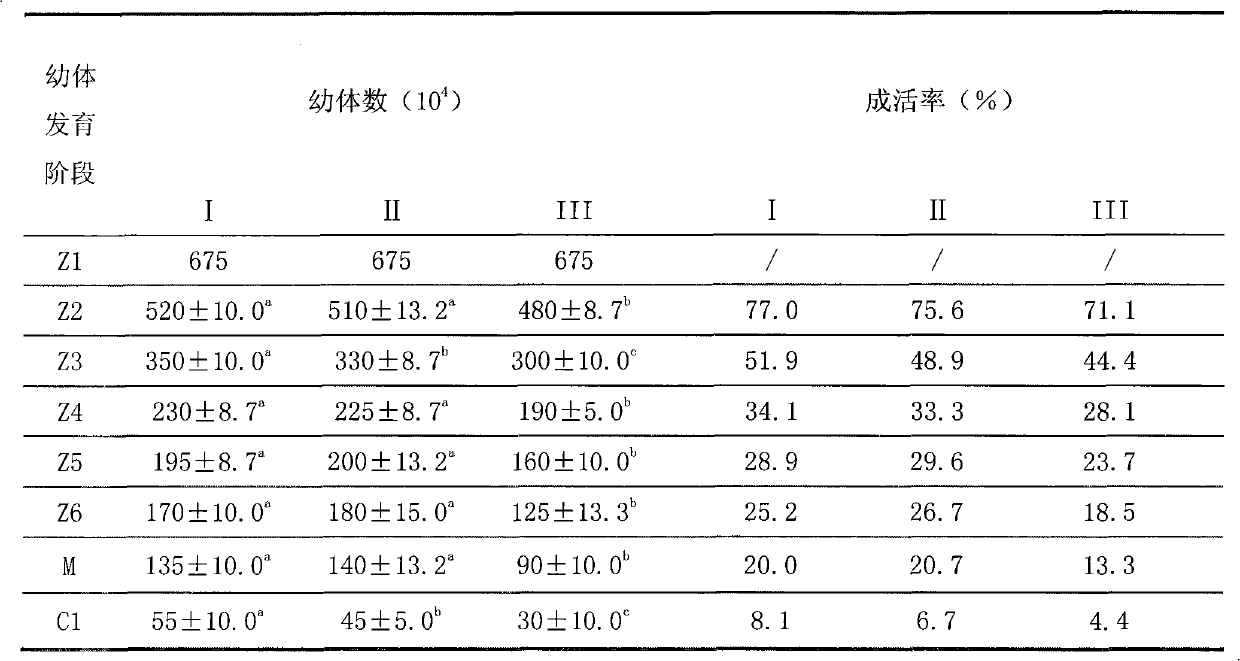
Examples
Embodiment 1
[0016] Example 1. A kind of cultivating method of early multiplication seedling of Japanese catfish, its step is as follows:
[0017] (1) Cultivation pond preparation: use potassium permanganate to disinfect the cultivation pond, rinse the cultivation pond with seawater after disinfection to remove potassium permanganate; then pave the sand with a thickness of 8cm on the 1 / 2 area at the bottom of the cultivation pond. There is a drainage outlet on the cultivation pond at the sand spreading place; use sterilized tiles, hollow bricks or bamboo rafts to build shelters at the bottom of the sand cultivation pond for parent crabs to inhabit; inject deep 60cm, salinity 26, pH into the cultivation pond 8.1 seawater;
[0018] (2) Cultivation of brood crabs: Take Japanese crab brood crabs with strong physique, complete appendages, and a shell length of more than 5cm. The ratio of male to female is 3:1. Enter the breeding pond for parent crab cultivation, the cultivation density is 2 / m...
Embodiment 2
[0023] Example 2. A kind of cultivating method of early multiplication seedling of Japanese catfish, its step is as follows:
[0024] (1) Cultivate pond preparation: use potassium permanganate to disinfect the cultivation pond, wash and remove potassium permanganate with seawater after the disinfection; then lay 15cm sand with a thickness on the 3 / 4 area at the bottom of the cultivation pond. There is a drainage port on the cultivation pond at the sand spreading place; use sterilized tiles, hollow bricks or bamboo rafts to build a shelter at the bottom of the sand cultivation pond for the parent crabs to inhabit; inject deep 80cm, salinity 30, pH into the cultivation pond 8.5 seawater;
[0025] (2) Cultivation of brood crabs: Take Japanese crab brood crabs with strong physique, complete appendages, and shell length of more than 5cm. The ratio of male to female is 3:1. Enter the breeding pool for brood crab cultivation, and the cultivation density is 3 / m 2;During the cultiva...
Embodiment 3
[0030] Example 3. In the step (5) of the method for cultivating early breeding seedlings of Nippon japonica described in embodiment 1 or 2, the concentration of the nystatin seawater solution used for disinfection bathing is 30~40g / m 3 , the concentration of potassium permanganate seawater solution is 8 ~ 12g / m 3 .
PUM
 Login to View More
 Abstract
Description
Claims
Application Information
 Login to View More