System and method for pseudorandom permutation for interleaving in wireless communications
What is AI technical title?
AI technical title is built by Patsnap AI team. It summarizes the technical point description of the patent document.
A pseudo-random, communication symbol technology, which is applied in the field of pseudo-random sorting and interleaving of bits, symbols or sequences, and can solve problems such as not easy to generate, not easy to reconstruct, etc.
Inactive Publication Date: 2014-04-23
SAMSUNG ELECTRONICS CO LTD
View PDF2 Cites 0 Cited by
Summary
Abstract
Description
Claims
Application Information
AI Technical Summary
This helps you quickly interpret patents by identifying the three key elements:
Problems solved by technology
Method used
Benefits of technology
Problems solved by technology
Sometimes true random interleaving is not desirable because it may not be easy to generate, and / or it may not be easy to reconstruct
Method used
the structure of the environmentally friendly knitted fabric provided by the present invention; figure 2 Flow chart of the yarn wrapping machine for environmentally friendly knitted fabrics and storage devices; image 3 Is the parameter map of the yarn covering machine
View more
Image
Smart Image Click on the blue labels to locate them in the text.
Viewing Examples
Smart Image
Click on the blue label to locate the original text in one second.
Reading with bidirectional positioning of images and text.
the structure of the environmentally friendly knitted fabric provided by the present invention; figure 2 Flow chart of the yarn wrapping machine for environmentally friendly knitted fabrics and storage devices; image 3 Is the parameter map of the yarn covering machine
Login to View More
PUM
Login to View More
Abstract
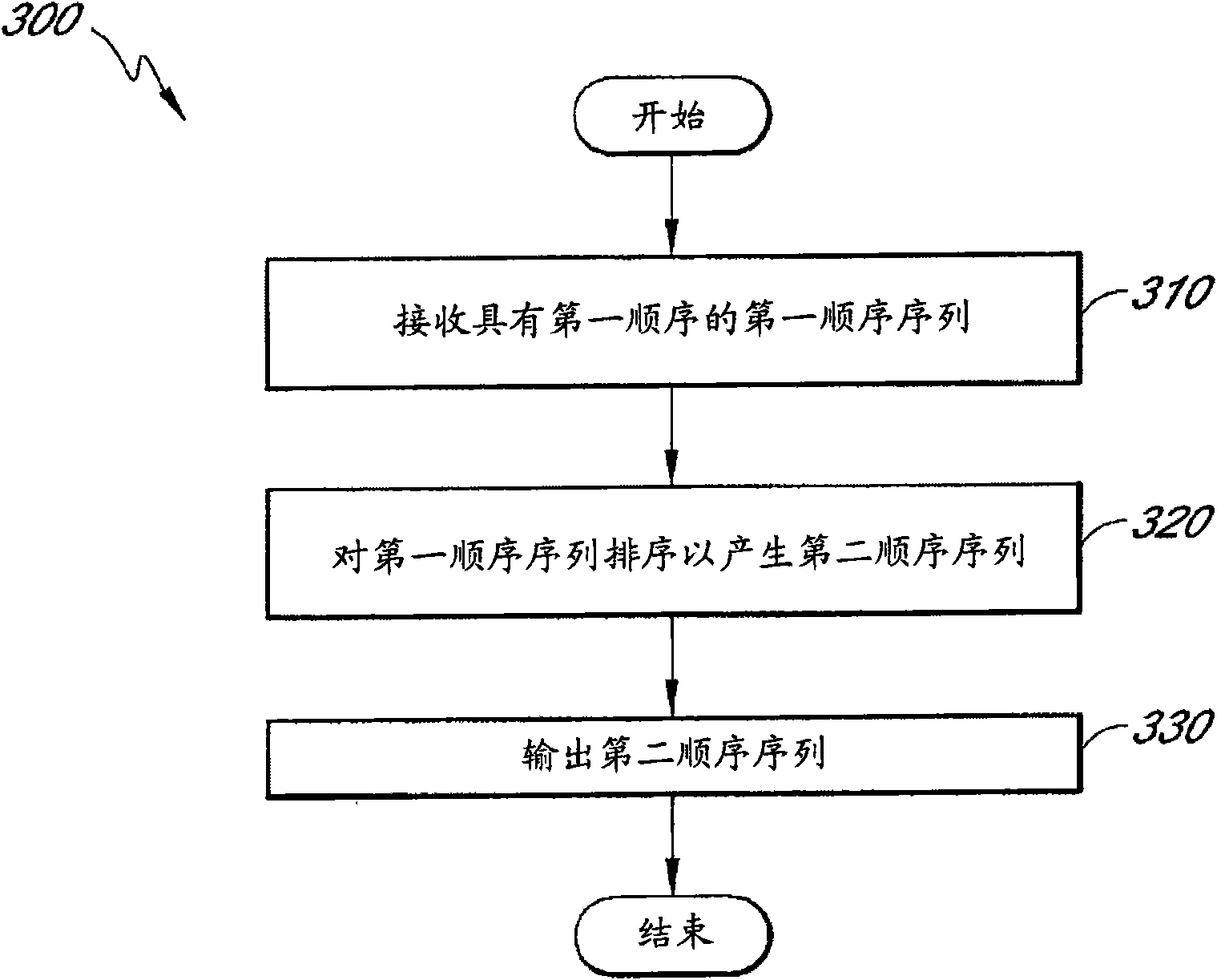
A system and method for pseudorandom permutation for interleaving in wireless communication is disclosed. In one embodiment, the method comprises receiving a first ordered sequence of communication symbols having a first order, permuting the first ordered sequence of communication symbols to generate a second ordered sequence of communication symbols having a second order, and outputting the second ordered sequence of communication symbols, wherein the second order is based, at least in part, on a third order having a greater size than the second order, the third order being a pseudorandom permutation defined by the input-output relationship Y = mod ( m * S * ( S + 1 ) 2 , P ) , wherein P is the smallest power of two not less than the number of elements in the first ordered sequence, S is an input order represented by a sequence of consecutive integers from zero to P−1 in increasing order, Y is an output order represented as a sequence of integers, and m is an integer.
Description
technical field [0001] The present invention relates to error reduction in communication systems, and more particularly to performing interleaving of bits, symbols or sequences using pseudo-random ordering. Background technique [0002] A wireless communication network is a telecommunications network that interconnects communication devices without the use of wires. Wireless telecommunications networks are typically implemented with some type of telematics system using electromagnetic waves (eg, radio waves) for a carrier wave, and this implementation often occurs at the physical layer of the network. [0003] A wireless personal area network (WPAN) is a type of wireless network used for communication between multiple devices (eg, computers, mobile phones, personal digital assistants, printers, digital cameras, televisions, media players, etc.). Typically, WPANs cover short ranges up to 10 or 20 meters. Several standards have recently been developed for such network commun...
Claims
the structure of the environmentally friendly knitted fabric provided by the present invention; figure 2 Flow chart of the yarn wrapping machine for environmentally friendly knitted fabrics and storage devices; image 3 Is the parameter map of the yarn covering machine
Login to View More
Application Information
Patent Timeline
Application Date:The date an application was filed.
Publication Date:The date a patent or application was officially published.
First Publication Date:The earliest publication date of a patent with the same application number.
Issue Date:Publication date of the patent grant document.
PCT Entry Date:The Entry date of PCT National Phase.
Estimated Expiry Date:The statutory expiry date of a patent right according to the Patent Law, and it is the longest term of protection that the patent right can achieve without the termination of the patent right due to other reasons(Term extension factor has been taken into account ).
Invalid Date:Actual expiry date is based on effective date or publication date of legal transaction data of invalid patent.



 Login to View More
  Login to View More