Load balancing realization method and device for DHT (distributed Hash table) network
A distributed hash table and load balancing technology, applied in the field of communication, can solve problems such as load imbalance and achieve the effect of ensuring load balancing
- Summary
- Abstract
- Description
- Claims
- Application Information
AI Technical Summary
Problems solved by technology
Method used
Image



Examples
Embodiment 1
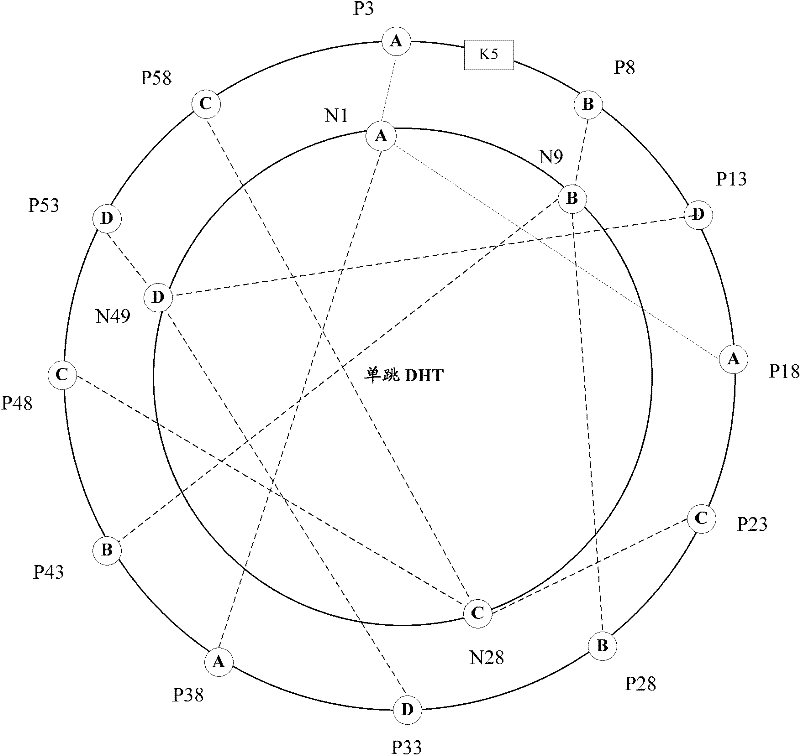
[0035] image 3 It is a schematic structural diagram of a device for implementing load balancing of a DHT network according to an embodiment of the present invention, the device can split the virtual identifiers allocated by each node in the DHT network when the DHT network is expanded.
[0036] like image 3As shown, the device mainly includes: a splitting module 10 and a distribution module 20 . The splitting module 10 is configured to equally divide the load space corresponding to each of the first virtual identities in the Z first virtual identities that have been allocated to each node in the DHT network into M shares, and use M×N second virtual identities. The identifier identifies each load space after the even distribution, wherein M and N are natural numbers, and M≥2; the allocation module 20 is used for allocating M×N of the second virtual identifiers to the current DHT network Each node is responsible for the load space corresponding to the second virtual identifi...
Embodiment 2
[0044] Image 6 This is a flowchart of a method for implementing load balancing of a DHT network according to an embodiment of the present invention, and the method can be implemented by the apparatus described in the first embodiment. like Image 6 As shown, the method mainly includes the following steps:
[0045] Step S602: Divide the load space corresponding to each of the first virtual identities in the Z first virtual identities that have been allocated to each node in the DHT network into M shares, and use M×Z second virtual identities to equally divide the load space. Each subsequent load space is identified, where M and Z are natural numbers, and M≥2;
[0046] Among them, Z is the number of virtual identifiers in the current DHT network, that is, the number of virtual spaces evenly divided into the entire load space in the DHT network. For example, when the DHT network is initially built, Z can be determined according to the node planning of the DHT network and the ...
Embodiment 3
[0067] The embodiment of the present invention takes a centralized topology network as an example to describe the splitting process of a virtual identity. In the embodiment of the present invention, splitting is performed when the load unbalance degree of some nodes in the DHT network exceeds the load unbalance degree threshold, and after splitting, the number of responsible virtual identifiers of each node is adjusted, so that the DHT The load imbalance of nodes in the network decreases.
[0068] Figure 7 is a flowchart of virtual identification splitting in the embodiment of the present invention, such as Figure 7 It mainly includes the following steps:
[0069] Step 701: As new nodes continue to join the overlay network, the network scale continues to expand, and the load unbalance degree continues to increase. When the unbalance degree threshold is reached, the management service node generates an alarm;
[0070] Step 702: The management service node sends an alarm noti...
PUM
 Login to View More
 Abstract
Description
Claims
Application Information
 Login to View More