
Portable method for detecting content of adenosine triphosphate (ATP)
An adenosine triphosphate, portable detection technology, applied in the field of portable detection of adenosine triphosphate content, can solve the problems of inconvenience to carry, complicated operation of instruments and equipment, inability to realize on-site detection, etc., and achieves the effects of good activity and stability, non-toxic cost, and low cost.
- Summary
- Abstract
- Description
- Claims
- Application Information
AI Technical Summary
Problems solved by technology
Method used
Image

Examples
Embodiment 1
[0031] The following examples illustrate the operation process of applying the method of the present invention to the detection of ATP concentration in human serum samples in conjunction with the accompanying drawings:
[0032] 1. Synthesis of DNA compounds modified with sucrose invertase. References (Hermanson, G. T. Bioconjugate Techniques; Elsevier: London, 2008). Specific steps are as follows:
[0033] A. Mix 30 μM sulfhydryl-modified DNA with 60 μM TCEP in PBS buffer solution and incubate at room temperature for 1 hour;
[0034] B. Mix 10.0 mg / mL sucrose invertase and 1 mg Sulfo-SMCC in a buffer solution (0.01 M PBS, pH=7.3, 0.1 M NaCl) for 5 min, place on a shaker at room temperature for 1 hour, and shake the mixture Centrifuge and take the supernatant;
[0035] C. Mix the substances prepared in A and B, and react at room temperature for 48 hours.
[0036] 2. The preparation of magnetic beads modified with sucrose invertase and the detection of ATP, the specific step...
Embodiment 2
[0042] 1. The detection of ATP concentration in human serum, the specific steps are as follows: add 10 dilutions to the 4.0 uM two modified DNA mixtures 3 Double human serum sample, incubated at room temperature for (1.5±0.05) hours, then separated the mixture with a magnet, washed the magnetic beads with 50 uL buffer solution three times and added 10 uL buffer solution, then added 20 uL 1 M sucrose solution, and reacted at 45°C After 20 minutes, pipette 2.5 μL to measure with a blood glucose meter and record the data. The test results show that the ATP concentration in the human serum sample is about 1.81×10 -10 M.
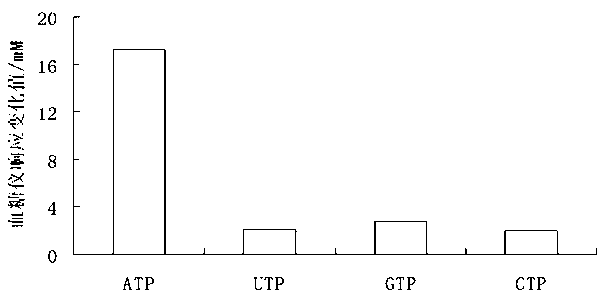
[0043] 2. The specificity of the method of the present invention to the detection of ATP, the specific steps are as follows: in order to detect the specificity of the method of the present invention, the ATP used in the embodiment 1-2 is replaced with other interfering substances, respectively UTP , GTP and CTP, the concentration of ATP is 1×10 -12 M, and th...
PUM
 Login to View More
 Abstract
Description
Claims
Application Information
 Login to View More