
A spacer bar self-locking clamp
A self-locking, spacer bar technology, applied in the direction of the device to maintain the distance between parallel conductors, can solve the problems of easy accidents, cumbersome installation, easy drop of the latch and R pin, etc., and achieve the effect of novel structure and quick installation
- Summary
- Abstract
- Description
- Claims
- Application Information
AI Technical Summary
Problems solved by technology
Method used
Image

Examples
Embodiment Construction
[0013] In order to deepen the understanding of the present invention, the present invention will be further described below in conjunction with the embodiments and accompanying drawings. The embodiments are only used to explain the present invention and do not constitute a limitation to the protection scope of the present invention.
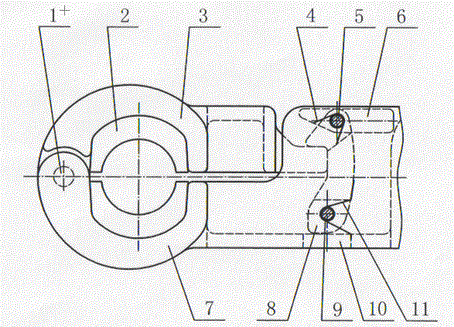
[0014] Such as figure 1 As shown, the spacer bar self-locking clamp includes a clamp body 7 and a gland 3. The front end of the clamp body 7 is hinged to the front end of the gland 3 through a hinge pin 1, and the clamp body 7 and the gland 3 are respectively A rubber tile 2 is installed, and the rubber tile 2 in the clamp body 7 cooperates with the rubber tile 2 in the gland 3 . A self-locking mechanism is also provided in the clamp body 7, which is arranged at the tail of the gland 3. The self-locking mechanism includes a locking block 8 and a base 10, and the bottom of the locking block 8 is connected by a locking shaft 9 in rotation. Inside ...
PUM
 Login to View More
 Abstract
Description
Claims
Application Information
 Login to View More