Quantitative detection method of transgenosis protein CP4EPSPS
What is AI technical title?
AI technical title is built by Patsnap AI team. It summarizes the technical point description of the patent document.
A quantitative detection and protein technology, applied in the direction of measuring devices, biological testing, material inspection products, etc., to achieve the effect of low cost, accurate quantitative detection method, and short operation time
Inactive Publication Date: 2014-09-03
WUXI FUYANG BIOTECH
View PDF5 Cites 4 Cited by
Summary
Abstract
Description
Claims
Application Information
AI Technical Summary
This helps you quickly interpret patents by identifying the three key elements:
Problems solved by technology
Method used
Benefits of technology
Problems solved by technology
This method has certain limitations due to the relative fragility of DNA, which may degrade under heat, nuclease presence, and low pH, and the reliability of the PCR methodology depends on the integrity of the DNA
Method used
the structure of the environmentally friendly knitted fabric provided by the present invention; figure 2 Flow chart of the yarn wrapping machine for environmentally friendly knitted fabrics and storage devices; image 3 Is the parameter map of the yarn covering machine
View more
Image
Smart Image Click on the blue labels to locate them in the text.
Viewing Examples
Smart Image
Click on the blue label to locate the original text in one second.
Reading with bidirectional positioning of images and text.
Smart Image
Examples
Experimental program
Comparison scheme
Effect test
Embodiment 1
[0041] Embodiment 1, the assembly of kit of the present invention:
[0042] 1. Preparation of buffer
[0043] (1) Coating buffer, 0.1M carbonate buffer CB, pH value is 9.6;
[0050] Pipette a certain amount of CP4EPSPS antibody into the required volume of coating solution to make the concentration about 2 μg / mL, and configure it as a coating working solution. Add 100 μL of the coating working solution to the microwells of the microtiter plate, and let it stand overnight at 4°C (note that water evaporation should be prevented).
[0051] (2) closed
[0052] Add a certain amount of calf serum, sodium salicylate, and sucrose in the CB buffer solution (pH9.6), so that the concentrations o...
Embodiment 2
[0062] Embodiment 2, using the kit of the present invention to detect transgenic protein CP4EPSPS in plants
[0063] (1) Prepare standards and samples of unknown concentration
[0064] 1) Preparation of standard products:
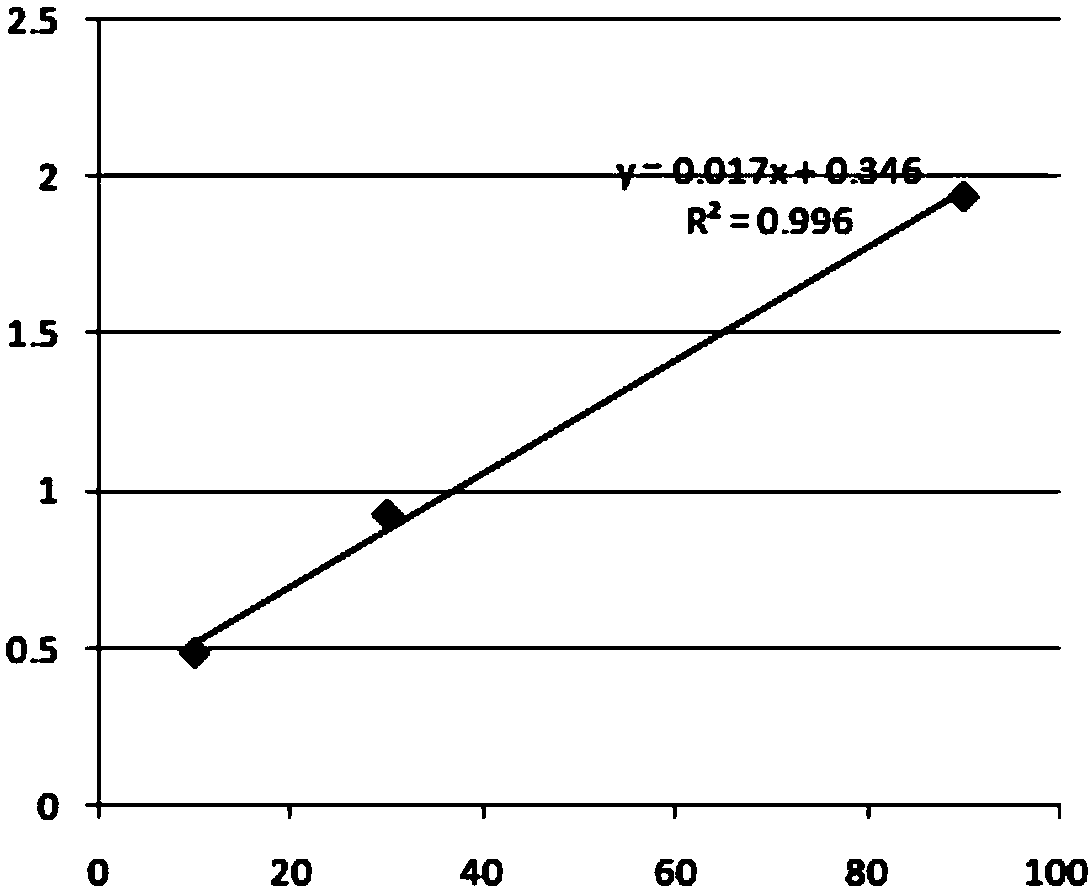
[0065] Dissolve the freeze-dried powder of CP4EPSPS standard with 1mL diluent, the concentration of this solution is 90ppb; take 300μL of 90ppb CP4EPSPS standard, add 600μL of sample extract, the concentration of this solution is 30ppb; take 300μL of 30ppb CP4EPSPS standard, add 600μL of sample extract, The concentration of this solution is 10ppb;
[0066] 2) Processing of unknown concentration samples:
[0067] Leaf pretreatment method: take 5-10mm 2 Put the leaf sample into a 1.5mL centrifuge tube and mash it, add 250μL of diluent, shake and mix for 5 minutes, centrifuge at 4000rpm for 3 minutes, and take 100μL of the supernatant for analysis.
the structure of the environmentally friendly knitted fabric provided by the present invention; figure 2 Flow chart of the yarn wrapping machine for environmentally friendly knitted fabrics and storage devices; image 3 Is the parameter map of the yarn covering machine
Login to View More
PUM
Property
Measurement
Unit
Coating concentration
aaaaa
aaaaa
Concentration
aaaaa
aaaaa
Login to View More
Abstract
The invention discloses a method for quantitatively detecting transgenosis protein CP4EPSPS in plant. The method comprises the following steps: extracting protein from plant to be detected to obtain a protein extraction solution; covering an elisa plate with a monoclonalantibody capable of resisting the CP4EPSPS protein, sealing the elisa plate by using a sealing solution, adding the plant protein extraction solution to incubate and wash; adding an HRP (Horse Reddish Peroxidase)-labeled polyclonal antibody capable of resisting the CP4EPSPS protein for incubating and washing; adding a substrate TMB (tetramethylbenzidine) solution for carrying out chromogenic reaction; ending reaction by using sulfuric acid after developing color and detecting absorbancy value in a part being 450nm; calculating concentration of the CP4EPSPS protein in a sample to be detected by using a concentration-absorbancy standard curve manufactured by using CP4EPSPS protein standard products. The quantitative detection method of transgenos protein CP4EPSPS is accurate and reliable; compared with the prior art, the quantitative detection method of transgenos is short in operation time and low in cost.
Description
technical field [0001] The invention relates to the technical field of transgenic plant detection, in particular to a quantitative detection method for transgenic protein CP4EPSPS. Background technique [0002] Since Monsanto (Monsato) listed the first case of glyphosate-resistant soybeans in 1996, the promotion and application of genetically modified crops has gone through 18 years, and herbicide resistance is still the primary trait of genetically modified plants. CP4EPSPS has been applied in the transgenic research of various crops, including corn, soybean, cotton, rapeseed, sugar beet and alfalfa. [0003] With a large number of various genetically modified foods entering the international market through trade, the safety of genetically modified foods has attracted increasing attention. Countries around the world have great disputes over the safety of genetically modified foods. The European Union, Japan and other regions have formulated Relevant laws and regulations ha...
Claims
the structure of the environmentally friendly knitted fabric provided by the present invention; figure 2 Flow chart of the yarn wrapping machine for environmentally friendly knitted fabrics and storage devices; image 3 Is the parameter map of the yarn covering machine
Login to View More
Application Information
Patent Timeline
Application Date:The date an application was filed.
Publication Date:The date a patent or application was officially published.
First Publication Date:The earliest publication date of a patent with the same application number.
Issue Date:Publication date of the patent grant document.
PCT Entry Date:The Entry date of PCT National Phase.
Estimated Expiry Date:The statutory expiry date of a patent right according to the Patent Law, and it is the longest term of protection that the patent right can achieve without the termination of the patent right due to other reasons(Term extension factor has been taken into account ).
Invalid Date:Actual expiry date is based on effective date or publication date of legal transaction data of invalid patent.



 Login to View More