
Fourier conversion spectrum instrument based on Michelson interferometer of equivalent intersecting mirror
A Fourier transform and interferometer technology, applied in the field of Fourier transform spectrometers, can solve problems such as unsuitability and complex components
- Summary
- Abstract
- Description
- Claims
- Application Information
AI Technical Summary
Problems solved by technology
Method used
Image

Examples
example
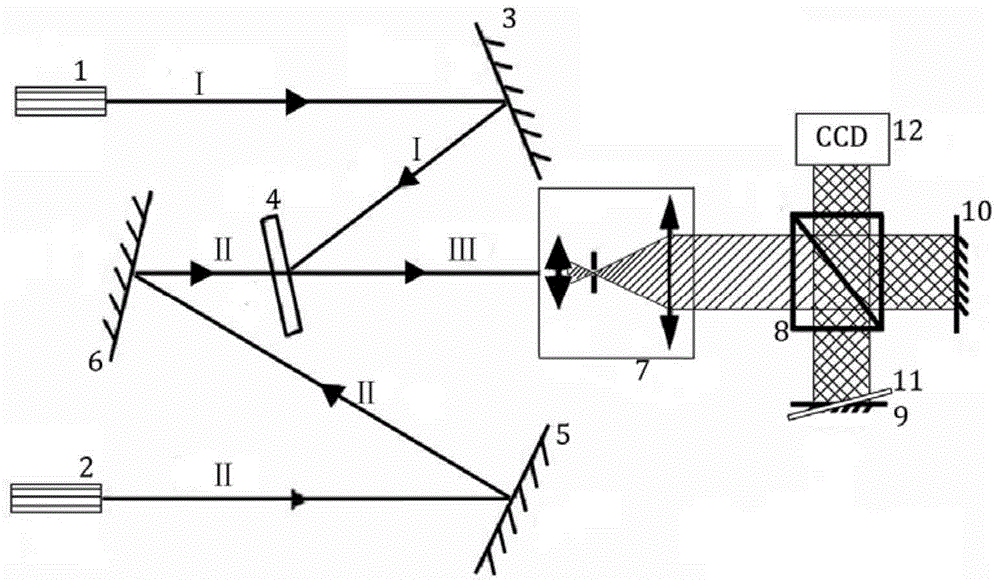
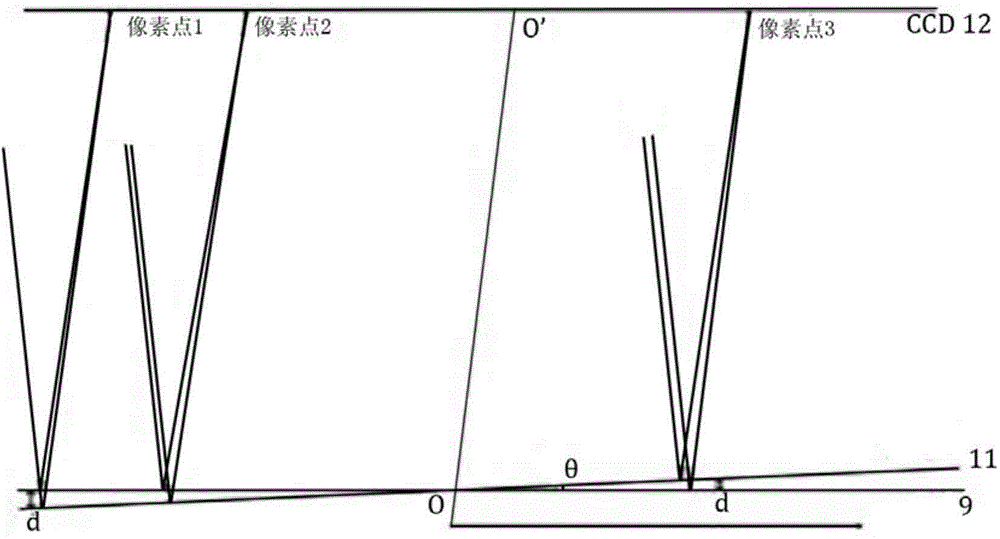
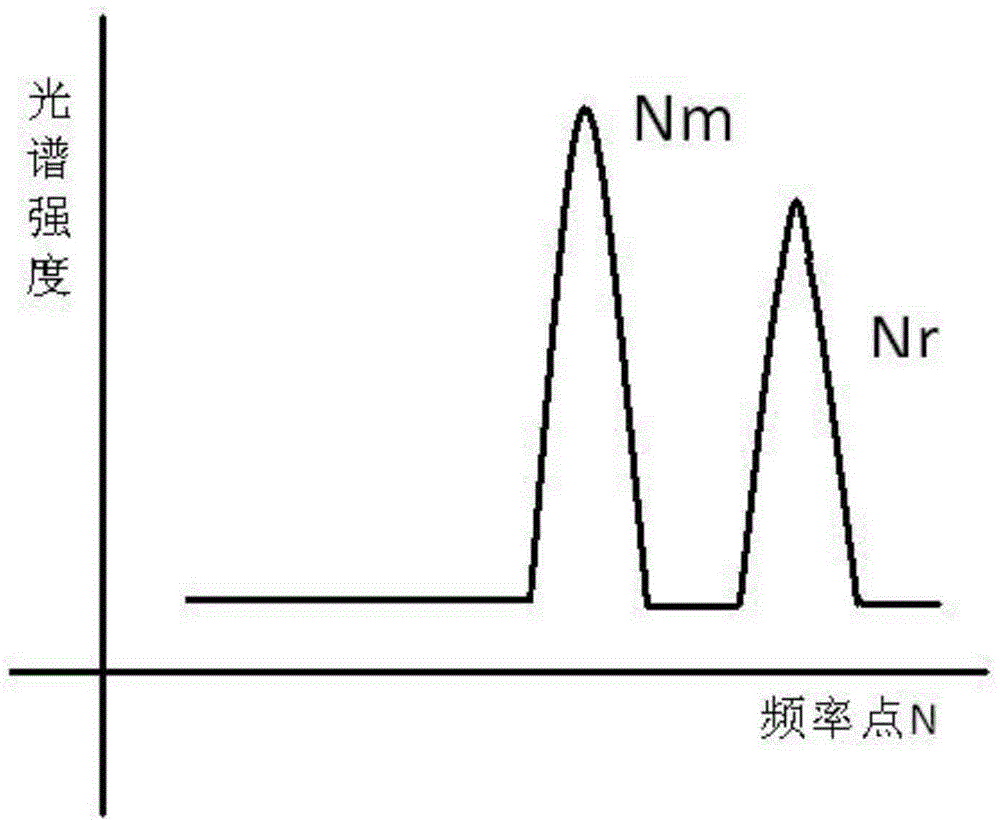
[0054] Embedded processor 15 selects FPGA in the circuit part, and CCD signal collector 12 sampling pixels are 2 11 point, select the AD converter 14 with a resolution of 12 bits. A 531.5nm solid-state laser is used as the reference light source I1, and a 632.8nm solid-state laser is used as the measured light source II2. where the angle θ is 1.90°. After using the present invention to measure, the display shows the Fourier transform spectrum of interference fringes, as attached Figure 5 shown. The peak frequency points corresponding to the reference light and the measured light are 917 and 769, respectively. The measured light wavelength λ can be calculated by formula 12 m = 633.79nm.
[0055] At the same time, a 471.5nm solid-state laser is selected as the light source to be measured, the θ angle is 1.71°, and the measured result is 470.41nm. A 648.7nm solid-state laser is selected as the light source to be measured, the θ angle is 1.90°, and the measured result is 64...
PUM
 Login to View More
 Abstract
Description
Claims
Application Information
 Login to View More