Method for predicting exposure level of chemicals of anaerobic-anoxia-aerobic treatment system

A technology of aerobic treatment and prediction method, applied in chemical instruments and methods, aerobic and anaerobic process treatment, multi-stage water treatment, etc., can solve problems that cannot be simulated with organic chemical exposure

CN104649413AActive Publication Date: 2015-05-27NANJING INST OF ENVIRONMENTAL SCI MINIST OF ECOLOGY & ENVIRONMENT OF THE PEOPLES REPUBLIC OF CHINA
3 Cites 2 Cited by

Patent Information

Authority / Receiving Office
CN · China
Current Assignee / Owner
Publication Date
2015-05-27

Smart Images

  • Figure 1
    Figure 1
  • Figure 2
    Figure 2
  • Figure 3
    Figure 3
Patent Text Reader

Abstract

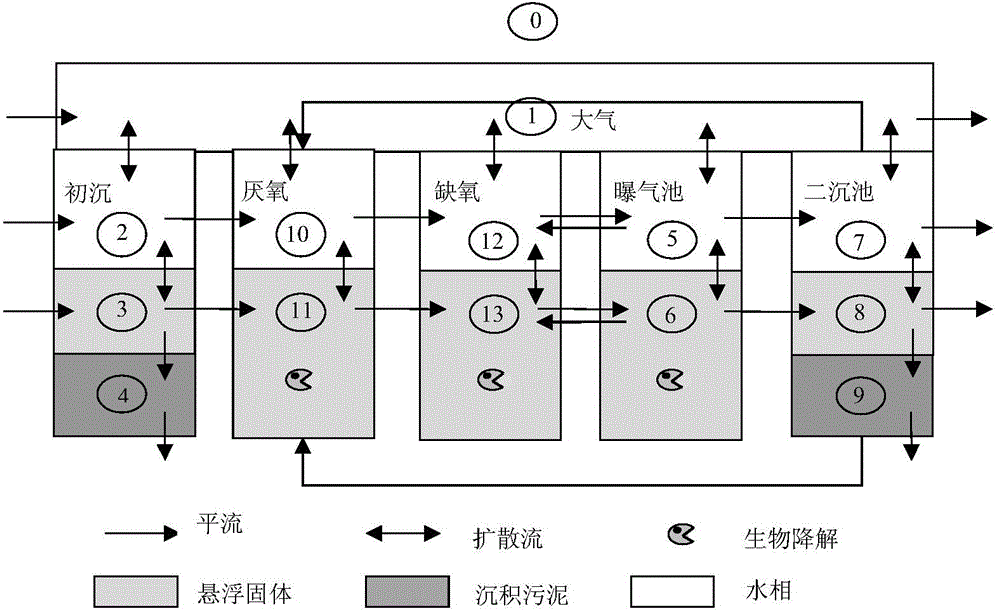
The invention discloses a method for predicting the exposure level of chemicals of an anaerobic-anoxia-aerobic wastewater treatment system (shortened as STP(A2 / O)). An STP(A2 / O) concept model is built according to co-existence relationship of environmental mediums such as air, water, suspended solids and sludge and mass flow process of the chemicals by taking the anaerobic-anoxia-aerobic wastewater treatment system as a basic technique; by defaulting environmental exposure scene parameters, the exposure level can be predicted by just inputting the molecular weight of the chemicals, the steam pressure (P), the water solubility (S), the anaerobic organism degradation rate (k10), the anoxia organism degradation rate (k12), the aerobic organism degradation rate (k5), the adsorption coefficient (Koc) and the emission load (ERC). The prediction method is simple, feasible, few in actually-measured parameters and high in prediction accuracy and has a great signification for evaluating exposure risk of the chemicals.
Need to check novelty before this filing date? Find Prior Art

Description

technical field

[0001] The invention relates to the field of chemical environmental risk assessment, and relates to an exposure prediction method for an anaerobic-anoxic-aerobic treatment system of organic chemical wastewater. Background technique

[0002] my country is a big country in the research and development, production and use of chemicals. In addition to more than 45,000 existing chemical substances, thousands of new chemical substances are put into use every year. Sewage treatment plant (STP) is the key link for chemicals to enter the environment. Easily degradable chemicals can basically be completely removed in STP, but refractory chemicals are difficult to degrade after STP treatment, and some of them volatilize into the atmosphere and are Sludge adsorption and residual chemicals are discharged into the receiving water body with the secondary effluent, which has potential ecotoxic effects on the ecological environment, especially the aquatic ecosystem.

[0003] ...

Examples

Embodiment 1

[0114] Select biphenyl as the chemical to be evaluated, and collect data on 8 basic physical and chemical properties of biphenyl, respectively molecular weight MW=154.21g.mol -1 , vapor pressure P=1261Pa, water-soluble S=7.5mg.L -1 , adsorption coefficient lgK oc =3.27, anaerobic biodegradation rate k 10 =0.3h -1 , anoxic biodegradation rate k 12 = 0h -1 , aerobic biodegradation rate k 5 = 1h -1 , daily discharge of chemicals ERC = 10kg.d -1 .

[0115] Collect or calculate the exposure scene data of the wastewater anaerobic-anoxic-aerobic biochemical treatment system, see Table 1. The exposure scene parameters of the sewage treatment plant can be obtained by referring to the design parameters and relevant process technical specifications. The volume of each box can be calculated according to the hydraulic retention time, suspended solid concentration, suspended solid density, deposited sludge thickness, and total STP area. The exposure scenario parameters given in thi...