
Method of realizing bidirectional optical diode and device of realizing bidirectional optical diode
An optical diode and laser technology, applied in the direction of the device for controlling the output parameters of the laser, can solve the problems of difficult continuous tuning and all-optical tuning control, etc., and achieve the effect of easy miniaturization and integration, avoiding polarization rotation, and simple and compact structure
- Summary
- Abstract
- Description
- Claims
- Application Information
AI Technical Summary
Problems solved by technology
Method used
Image

Examples
Embodiment Construction
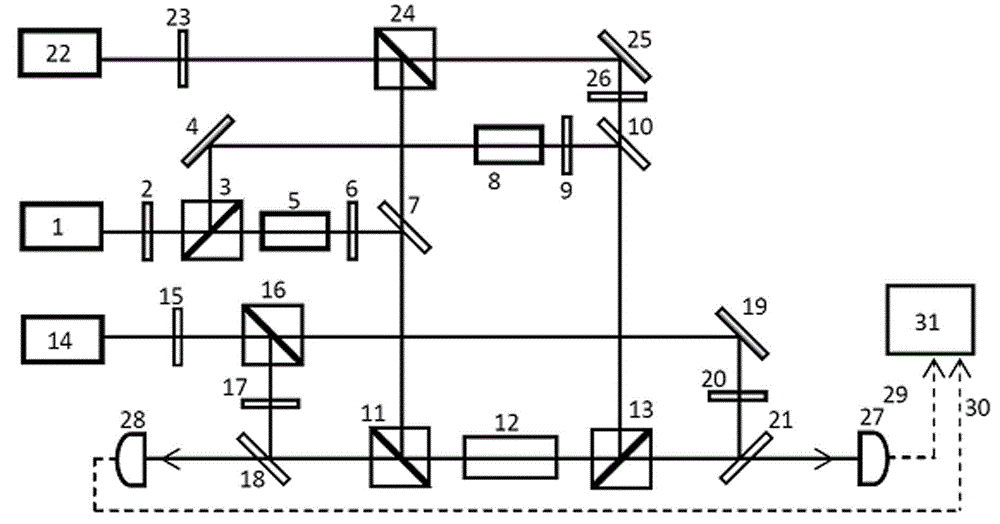
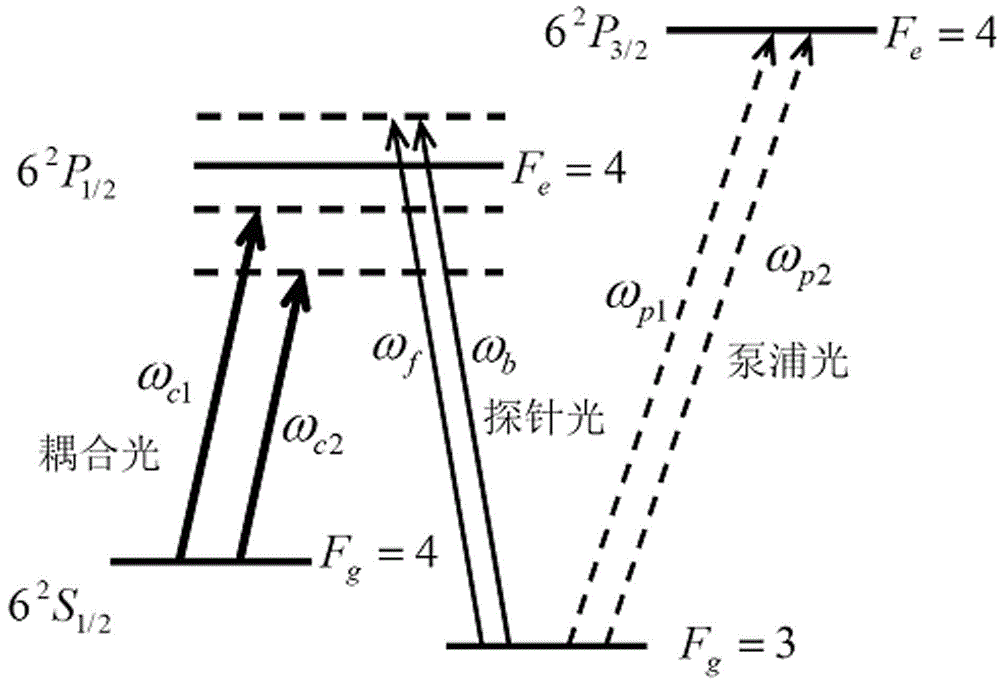
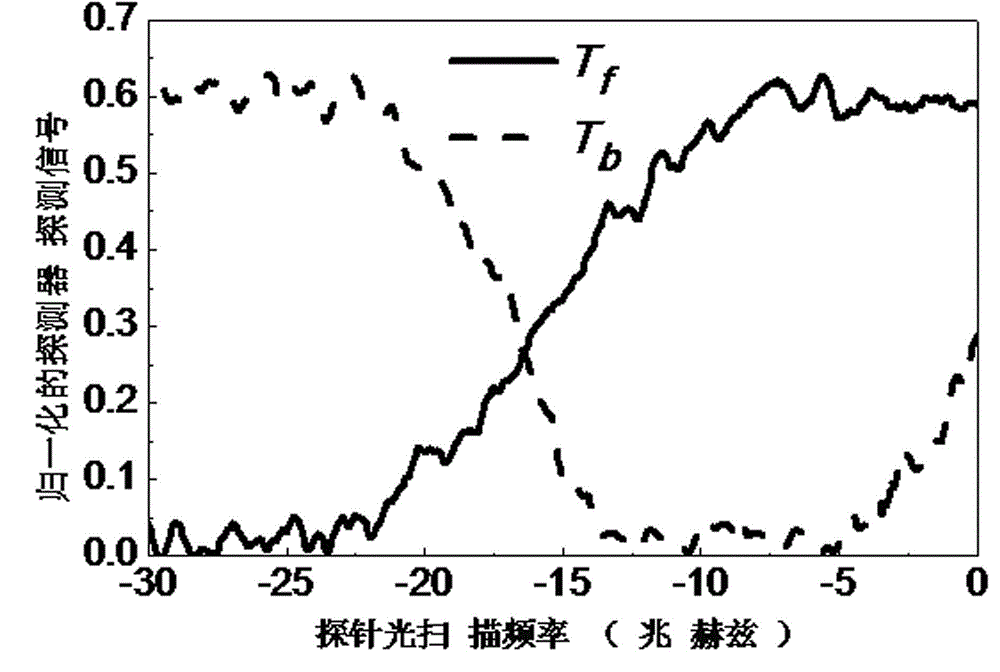
[0025] A method for realizing a bidirectional optical diode, comprising the following steps: (a), acting on two beams of oppositely incident coupling fields with a certain frequency detuning in a hot alkali metal atomic medium, so that the atomic medium is opposite to the The refractive index of light is periodically modulated, forming a detuned standing wave model; (b), two probe fields with the same frequency are passed through the thermal atomic medium, and the frequency of the probe field is near the two-photon resonance center. When the forward incident probe field can pass through the hot atomic medium, the backward incident probe field is just completely absorbed by the hot atomic medium, and vice versa, so that the transmission characteristics of the bidirectionally incident probe light can be effectively controlled, and a unique Bidirectional optical diode functions with a certain frequency interval and frequency width; the frequency interval depends on the difference ...
PUM
 Login to View More
 Abstract
Description
Claims
Application Information
 Login to View More