
Acid-resistant dry-mixed mortar
A dry powder mortar, acid resistance technology, applied in the direction of climate sustainability, sustainable waste treatment, solid waste management, etc., can solve the problems of insufficient material source and poor acid resistance, and achieve the effect of reducing production cost and enhancing acid resistance.
- Summary
- Abstract
- Description
- Claims
- Application Information
AI Technical Summary
Problems solved by technology
Method used
Image

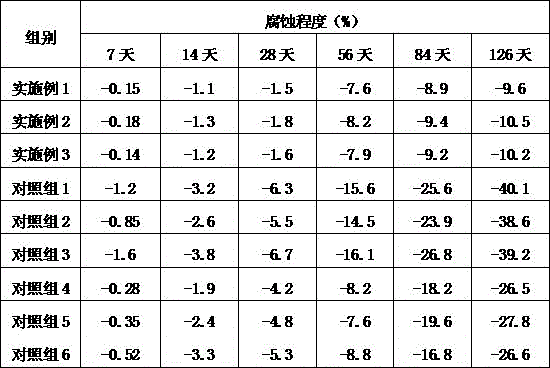
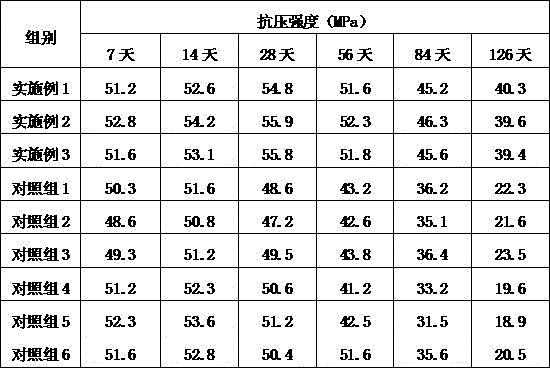
Examples
Embodiment 1
[0013] An acid-resistant dry powder mortar, including the following components, and the mass percentage of each component is: combined cement 25%, foundry waste 10%, yellow sand 34%, fly ash 3%, slag powder 12%, lithium slag 15%, 0.6% wood fiber, 0.3% cellulose ether, 0.03% redispersible polymer, 0.07% polysiloxane powder;
[0014] Wherein, the combined cement is a combination of crystalline cement, high-resistance sulfuric acid Portland cement and fast hardening sulphoaluminate cement, and the combination ratio is 1:1.2:2.
Embodiment 2
[0016] An acid-resistant dry powder mortar, including the following components, and the mass percentage of each component is: combined cement 28%, foundry waste sand 6%, yellow sand 36%, fly ash 5%, slag powder 10%, lithium slag 12%, 0.7% wood fiber, 0.2% cellulose ether, 0.04% redispersible polymer, 0.06% polysiloxane powder;
[0017] Wherein, the combined cement is a combination of crystallized cement, high-resistant sulfuric acid Portland cement and fast hardening sulphoaluminate cement, and the combination ratio is 1:1.3:1.9.
Embodiment 3
[0019] An acid-resistant dry powder mortar, including the following components, and the mass percentage of each component is: combined cement 30%, foundry waste sand 5%, yellow sand 38%, fly ash 2%, slag powder 14%, lithium slag 10%, 0.7% wood fiber, 0.2% cellulose ether, 0.02% redispersible polymer, 0.08% polysiloxane powder;
[0020] Wherein, the combined cement is a combination of crystalline cement, high-resistant sulfuric acid Portland cement and fast hardening sulphoaluminate cement, and the combination ratio is 1:1.5:1.8.
[0021] Replace 25% of the combined cement with a single type of sand, which is the control group 1-3, and replace it with two types of sand, which are 4-6 respectively. The specific correspondence is as follows:
[0022] Group cement Ratio Control group 1 Crystallized cement / Control group 2 High resistance to sulfuric acid Portland cement / Control group 3 Fast hardening sulphoaluminate cement / Control group 4 Crystallized cement and high resistance...
PUM
| Property | Measurement | Unit |
|---|---|---|
| particle diameter | aaaaa | aaaaa |
| length | aaaaa | aaaaa |
Abstract
Description
Claims
Application Information
 Login to View More