An energy-dissipating shock-absorbing tie-beam for double-limb bridge piers

A technology for bridge piers and tie beams is applied in the field of energy dissipation and shock absorption tie beams for double-limb bridge piers, to achieve the effects of improving static and dynamic stability, reducing the degree of vibration loss and quick installation.

CN105839518BInactive Publication Date: 2017-10-24SHIJIAZHUANG TIEDAO UNIV
6 Cites 0 Cited by

Patent Information

Authority / Receiving Office
CN · China
Patent Type
Patents(China)
Current Assignee / Owner
Publication Date
2017-10-24
Estimated Expiration
Not applicable · inactive patent

Smart Images

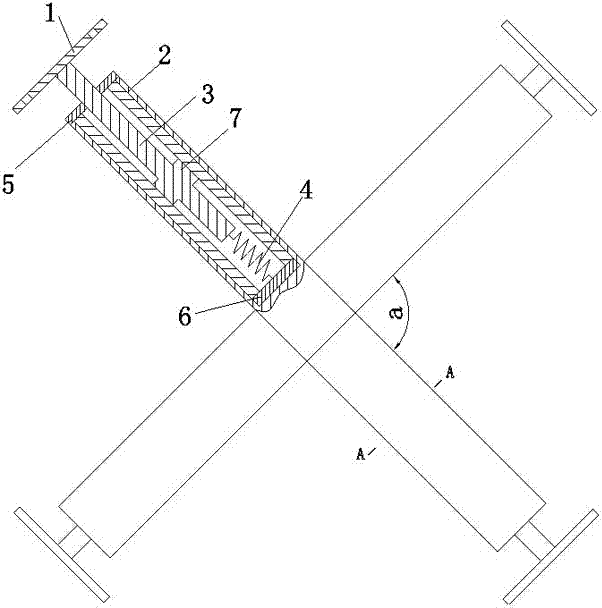
  • Figure 1
    Figure 1
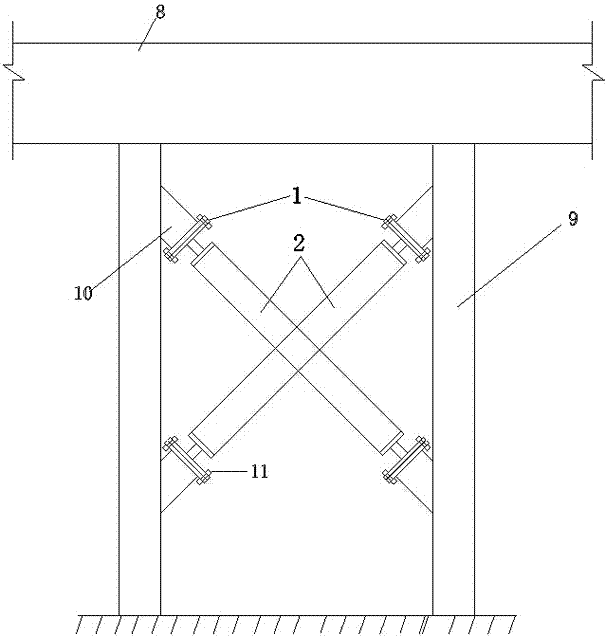
  • Figure 2
    Figure 2
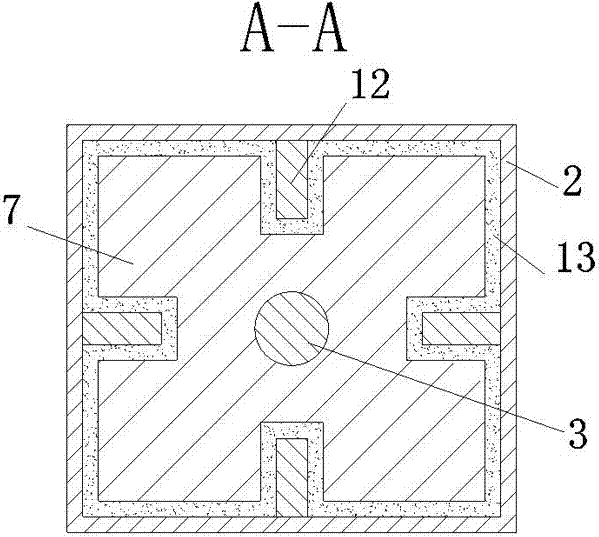
  • Figure 3
    Figure 3
Patent Text Reader

Abstract

The invention discloses an energy-dissipating and shock-absorbing tie beam for double-leg bridge piers, which relates to the technical field of bridge construction and includes four sleeves fixed in an X-shaped cross in the same vertical plane, and the included angle between two adjacent sleeves is up and down. is α; there is a sliding telescopic rod inside the sleeve, a spring is set between the sliding telescopic rod and the bottom of the sleeve, and the outer end of the sliding telescopic rod is fixed on the pier of both limbs; a sliding friction surface is set between the sliding telescopic rod and the sleeve, and through the sliding friction Heat generated by surface sliding friction realizes energy consumption and shock absorption. The pier body is horizontally restrained by using the X-shaped cross sleeve to improve the static and dynamic stability of the pier; the friction between the sliding telescopic rod and the sleeve is used to reduce the load on the pier The seismic energy is converted into thermal energy through frictional heat and dissipated, which will reduce the seismic dynamic response of bridge piers and the development degree of plastic hinges, etc., and effectively protect the main structures such as bridge piers and main girders from occurring or reduce earthquake damage under seismic loads.
Need to check novelty before this filing date? Find Prior Art

Description

technical field

[0001] The invention relates to the technical field of bridge construction, in particular to an energy-dissipating and shock-absorbing tie beam for double-leg bridge piers. Background technique

[0002] At present, the design and construction of bridges are not only developing towards long-span or even super-long-span, but also towards high-pier or even super-high-pier bridges. In order to reduce the construction cost and ensure the safety of the bridge structure, high-pier bridges often use double-leg piers, the most common of which are double-leg piers and high-pier rigid-frame bridges or double-leg bridges. Continuous girder bridges with column-high piers. The pier height of these bridges is usually set to more than 40 meters. At present, the highest pier in China is about 200 meters, which belongs to super-high pier bridges.

[0003] As the height of bridge piers continues to increase, not only the static stability under operational loads needs to be con...

Examples

Embodiment Construction

[0020] The present invention will be further described in detail below in conjunction with the accompanying drawings and specific embodiments.

[0021] Such as figure 1 , 2 , a kind of double-leg pier shown in 3 is used for frictional energy dissipation shock-absorbing tie beams, including four sleeves 2, and the four sleeves 2 are fixed in the same vertical plane in an X-shaped cross, and the two adjacent sleeves up and down 2 The included angle is α; the sleeve 2 is provided with a sliding telescopic rod 3, a spring 4 is provided between the inner end of the sliding telescopic rod 3 and the bottom of the sleeve 2, and the outer end of the sliding telescopic rod 3 is fixed on the pier 9 of both limbs ; There is a sliding friction surface between the sliding telescopic rod 3 and the sleeve 2, and the synthetic anti-skid coating 13 is coated on the sliding friction surface, and the energy consumption and shock absorption are realized through the sliding friction of the sliding...