
Insole with function of treating tinea pedis
A technology for insole and function, applied in the field of insole, can solve the problems of long treatment time, inability to recover from tinea pedis, residual fungus, etc., and achieve the effects of solving the inconvenience of applying medicine, reducing itching and discomfort, and lasting drug effect release.
- Summary
- Abstract
- Description
- Claims
- Application Information
AI Technical Summary
Problems solved by technology
Method used
Image

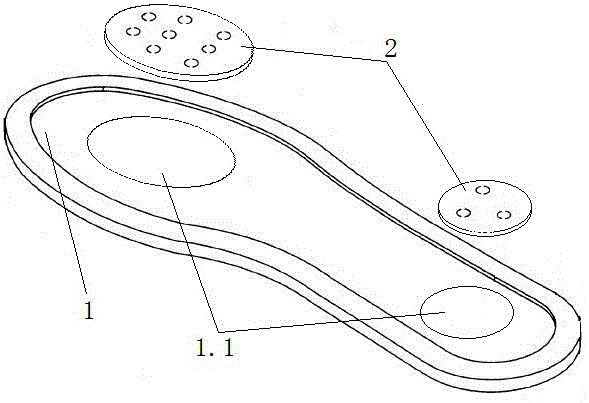
Examples
Embodiment Construction
[0011] The insole with the function of treating tinea pedis is ground into powder and compressed into insole gasket by mass parts of the following eight components: Cnidium 6-12, Cocklebur 9-12, Sophora flavescens 7-9, hibiscus Skin 4-8, Kochia chinensis 3-9, Aconitum 9-15, green tea 1-5, borneol 12-18.
[0012] Several preferred embodiments of this medicine are given below.
[0013] Cnidium 6, Cocklebur 9, Sophora flavescens 7, Hibiscus bark 4, Kochia chinensis 3, Raw grass black 9, Green tea 1, Borneol 12.
[0014] Cnidium 9, Cocklebur 10, Sophora flavescens 8, Hibiscus bark 6, Kochia scoparia 6, Raw grass 13, Green tea 3, Borneol 15.
[0015] Cnidium 12, Cocklebur 12, Sophora flavescens 9, Hibiscus bark 8, Kochia scoparia 9, Raw grass 15, Green tea 5, Borneol 18.
[0016] The above-mentioned parts by mass are also the proportional relationship of each component.
PUM
 Login to View More
 Abstract
Description
Claims
Application Information
 Login to View More