Liquid chromatography-tandem mass spectrometry method for measuring 18 semi-volatile organic pollutants in water

A technology of organic pollutants and liquid chromatography, applied in the field of environmental monitoring, can solve the problems of low analysis efficiency, easy loss of concentration, cumbersome treatment process, etc., and achieve the effects of improving quantitative accuracy, reducing sample loss, and high quantitative sensitivity

CN106053622AInactive Publication Date: 2016-10-26广西壮族自治区环境监测中心站
0 Cites 9 Cited by

Patent Information

Authority / Receiving Office
CN · China
Patent Type
Applications(China)
Current Assignee / Owner
Publication Date
2016-10-26
Estimated Expiration
Not applicable · inactive patent

Smart Images

  • Figure 1
    Figure 1
  • Figure 2
    Figure 2
  • Figure 3
    Figure 3
Patent Text Reader

Abstract

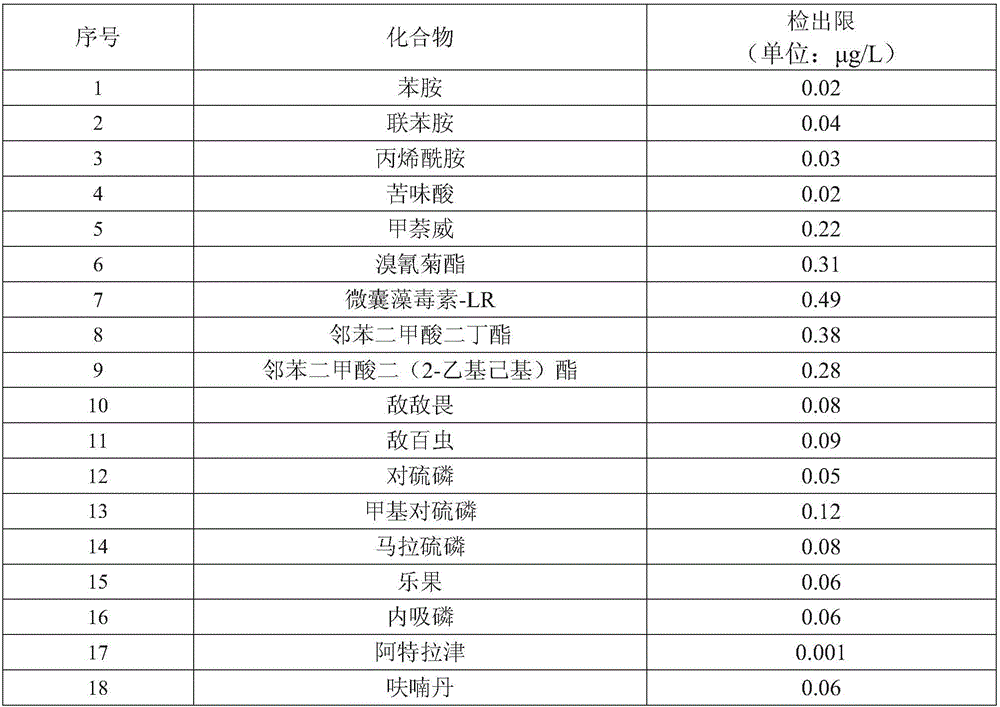
The invention discloses a liquid chromatography-tandem mass spectrometry method for measuring 18 semi-volatile organic pollutants in water. According to the method, a clean water sample such as surface water, drinking water, and the like is simply filtered by a 0.22 [mu]m micro-porous filter membrane, and then a liquid chromatography-mass spectrometry instrument is used to separate and detect the following 18 compounds in water: aniline, benzidine, acrylamide, picric acid, carbaryl, deltamethrin, microcystic toxin-LR, dibutyl phthalate, bis(2-ethylhexyl) phthalate, dichlorvos, trichlorphon, parathion, methyl parathion, malathion, dimethoate, demeton, atrazine, and carbofuran. The provided method can detect many target substances. The detection range of the method is 0.001 to 0.49 [mu]g / L, the relative standard deviation is 0.7 to 15.4%; and the analysis method has the advantages of high sensitivity, quick analysis speed, little pollution, and simple and efficient pretreatment, is especially suitable for standard analysis of drinking water source monitoring, and solves the problems of bad conformability, large labor strength, and low analysis efficiency of the conventional standard method.
Need to check novelty before this filing date? Find Prior Art

Description

technical field

[0001] The invention relates to the monitoring of organic pollutants in the field of environmental monitoring, in particular to a liquid chromatography-tandem mass spectrometry method for measuring 18 kinds of semi-volatile organic pollutants in water. Background technique

[0002] For aniline, benzidine, acrylamide, picric acid, carbaryl, deltamethrin, microcystin-LR, dibutyl phthalate, bis(2-ethylhexyl) phthalate, 18 kinds of dichlorvos, trichlorfon, parathion, methyl parathion, malathion, dimethoate, demeton, atrazine and carbofuran "Environmental Quality Standard for Surface Water" (GB 3838-2002) and the specific monitoring items stipulated in the "Drinking Water Sanitation Standard" (GB 5749-2006), there is no integrated liquid chromatography-tandem mass spectrometry method for the determination of these 18 semi-volatile organic compounds in water in China. Some standard analysis methods are gas chromatography or liquid chromatography, which require cum...

Examples

Embodiment Construction

[0031] The process flow of the pretreatment and analysis method of the present invention is to pass the water sample through a 0.22 μm polyethersulfone filter membrane, and use a liquid chromatography-mass spectrometer to detect and analyze the above-mentioned sample solution to be tested, using a ZORBAX C18 chromatographic column, Eighteen kinds of semi-volatile organic compounds were separated and detected by triple quadrupole mass spectrometry.

[0032] 1. Preparation of sample solution to be tested

[0033] Weigh 10 mg of the standard substance, dissolve it in methanol and dilute to 10 mL, and prepare a 1 g / L single standard stock solution. Take an appropriate amount of each single standard stock solution, and use methanol to prepare a mixed standard solution of the required concentration (10 μg / mL). After filtering through a 0.22 μm polyethersulfone filter membrane, the sample solution to be tested was obtained.

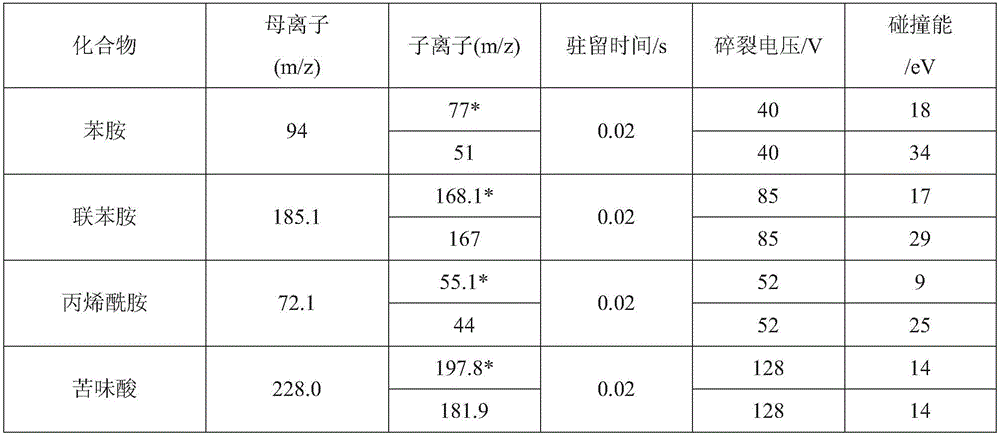
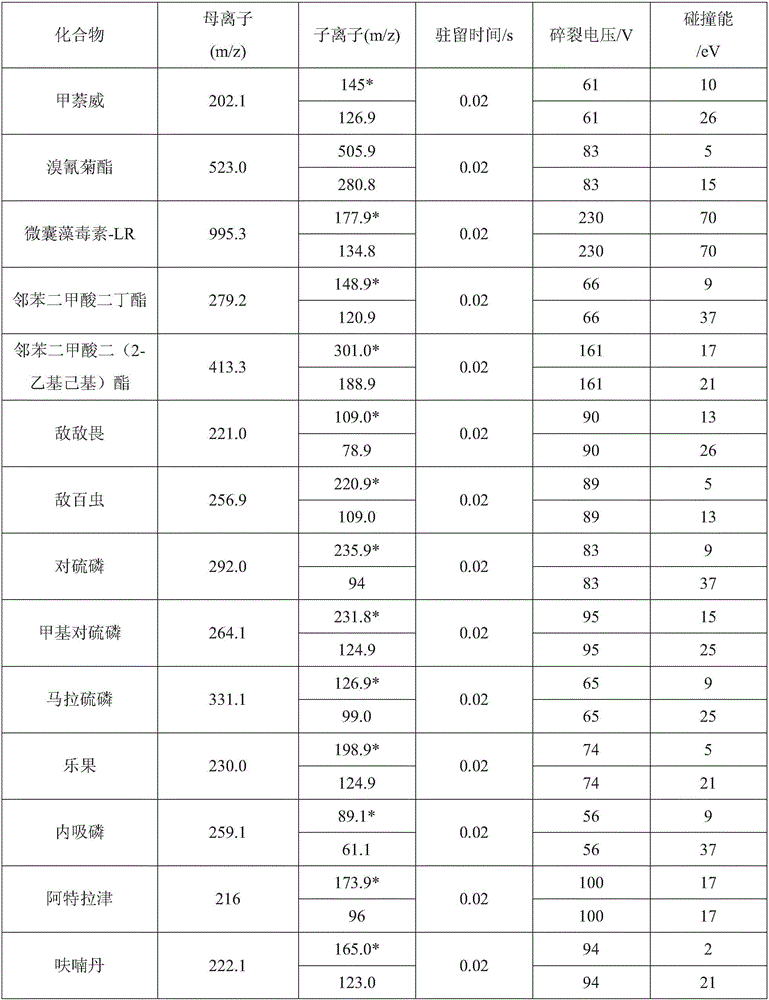
[0034] 2. Optimization of mass spectrometry conditions ...