
High Bandwidth Bend Insensitive Multimode Fiber
A bend-insensitive, multi-mode optical fiber technology, applied in the field of optical communications, can solve the problems of reducing the bending sensitivity of optical fibers, unspecified cladding materials, etc., and achieve the effect of being suitable for large-scale production, simple and convenient production control, and high work efficiency
- Summary
- Abstract
- Description
- Claims
- Application Information
AI Technical Summary
Problems solved by technology
Method used
Image



Examples
Embodiment Construction
[0037] Specific examples will be given below to further illustrate the present invention.
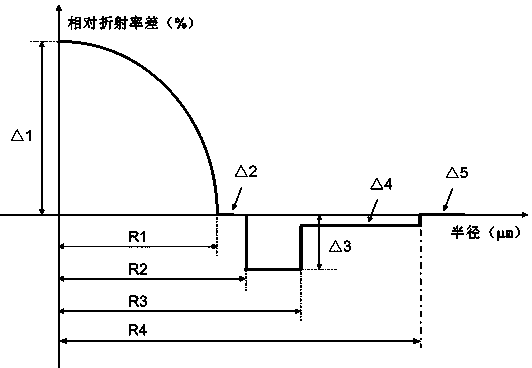
[0038] The present invention comprises a core layer and a cladding layer surrounding the core layer, the refractive index profile of the core layer is parabolic, the distribution index is α, the radius of the core layer is R1, and the maximum relative refractive index difference at the center of the core layer is Δ1; The cladding is sequentially from the inside to the outside the inner cladding, the first sunken cladding, the second sunken cladding and the outer cladding, the radius of the inner cladding is R2, and the radial width of one side is (R2-R1) , the relative refractive index difference is Δ2; the radius of the first depressed cladding layer is R3, the unilateral radial width is (R3-R2), and the relative refractive index difference is Δ3; the radius of the second depressed layer is R4, the radial width on one side is (R4-R3), and the relative refractive index difference is Δ4;...
PUM
| Property | Measurement | Unit |
|---|---|---|
| radius | aaaaa | aaaaa |
| dispersity | aaaaa | aaaaa |
Abstract
Description
Claims
Application Information
 Login to View More