
Fortified composition for breeding, application, feeding method and preparation method
A technology of composition and application, applied in the field of breeding, can solve problems such as enhanced bacterial resistance, impact on human health, serious drug residues, etc., to regulate gastrointestinal dysfunction, prevent intestinal diseases of farmed organisms, and improve lipid Effects of Metabolic Disorders
- Summary
- Abstract
- Description
- Claims
- Application Information
AI Technical Summary
Problems solved by technology
Method used
Image

Examples
Embodiment 1
[0071] The Johnson & Johnson composition for cultivation is prepared from the following components: 45 parts by weight of purslane (traditional medicine), 10 parts by weight of astragalus (traditional medicine), 20 parts by weight of Atractylodes macrocephala (traditional medicine) and 25 parts by weight of Poria cocos (traditional medicine).
Embodiment 2
[0073] A Johnson & Johnson composition for cultivation, made by the following steps:
[0074] ① Take 45 parts by weight of purslane (traditional medicine), 10 parts by weight of Astragalus (traditional medicine), 20 parts by weight of Atractylodes macrocephala (traditional medicine) and 25 parts by weight of Poria (traditional medicine).
[0075] ②Add 10 times of clean water to soak for 1 hour, heat to 100-120 degrees Celsius to extract for 1-2 hours, filter to get the filtrate; add 8 times of water to the filter residue, heat to 100-120 degrees Celsius to extract for 1 hour, filter to get the filtrate, combine two secondary filtrate;
[0076] ③ Concentrate the filtrate to form an extract with a relative density of 1.3 to 1.5;
[0077] ④ Add an appropriate amount of white carbon black to the extract, stir well, and put it in a vacuum oven for drying (drying temperature is not higher than 70°C);
[0078] ⑤ Grinding the dried extract to form a powder, the mesh of which is not ...
Embodiment 3
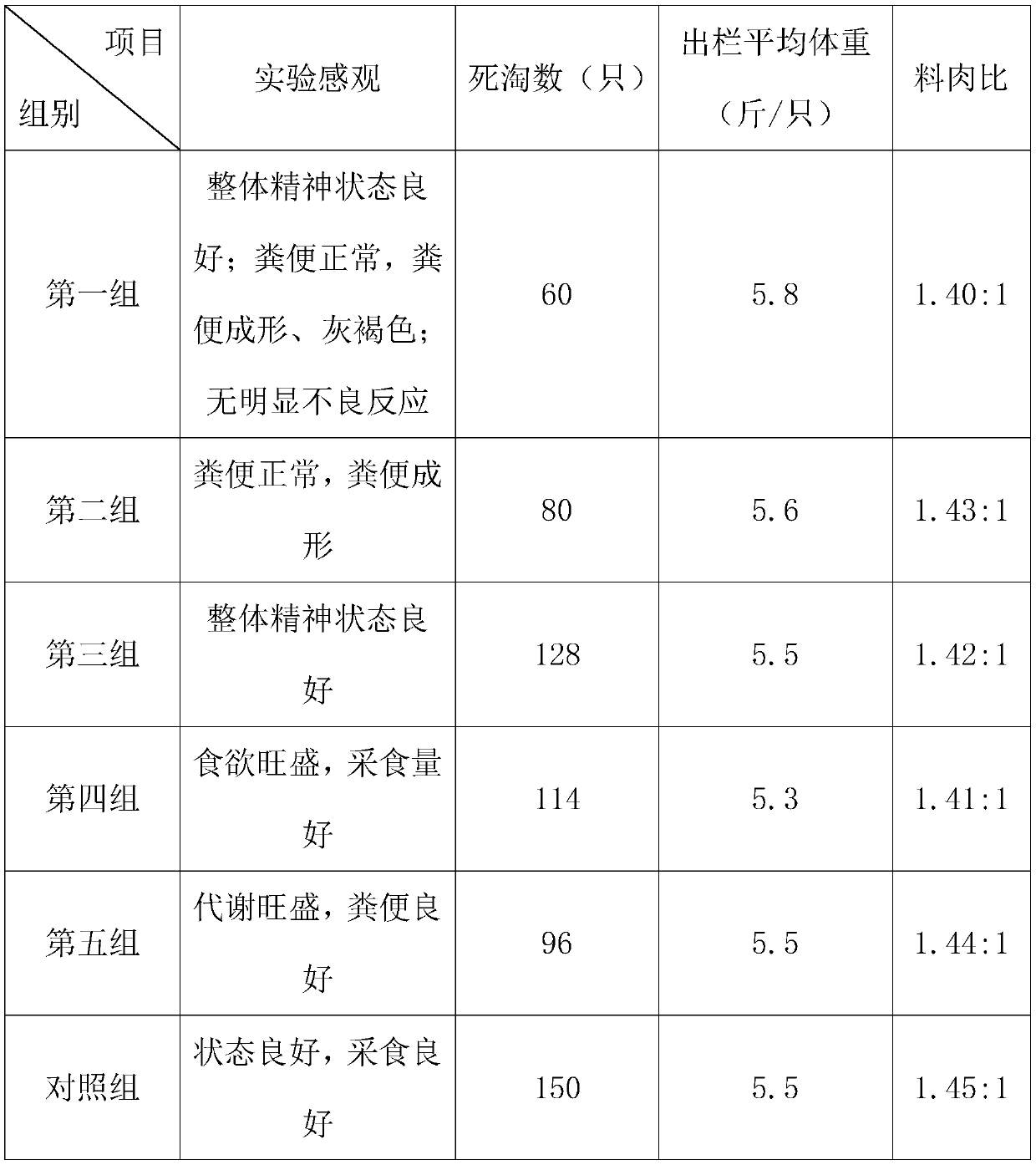
[0115] 18,000 1-day-old broilers were randomly divided into 6 groups (3,000 in each group) from a large farm.
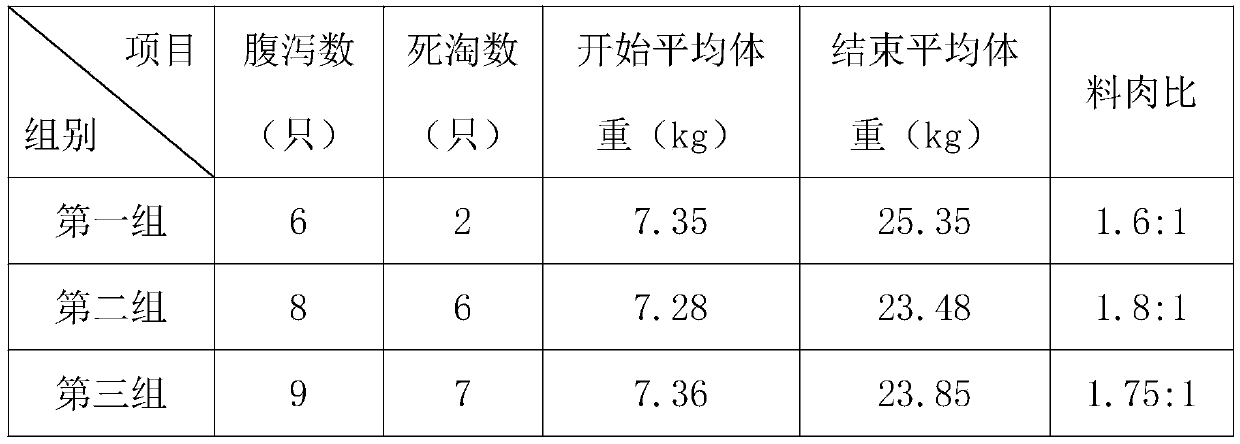
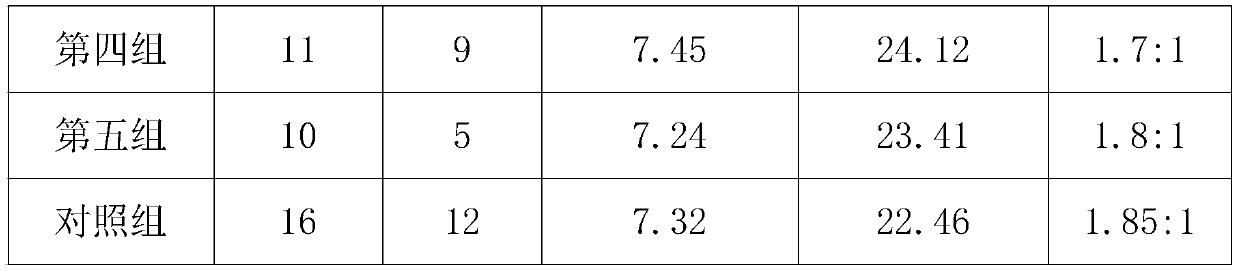
[0116] Take respectively the Johnson & Johnson composition for cultivation (marked as the first group) prepared in Example 2, the extract of purslane (marked as the second group) prepared in Comparative Example 1, and the extract of Astragalus membranaceus prepared in Comparative Example 2. (marked as the third group), the Atractylodes Rhizome extract (marked as the fourth group) prepared in Comparative Example 3 and the Poria cocos extract (marked as the fifth group) produced in Comparative Example 4, and the control group (marked as the fifth group) in addition antimicrobial peptides) (marked as the sixth group).
[0117] Feed the chickens of the above-mentioned first group-the fifth group with respective corresponding articles respectively, the first group-the fifth group additions are all equal, add 300g for 1 ton of feed, the sixth group additions are convention...
PUM
| Property | Measurement | Unit |
|---|---|---|
| Mesh | aaaaa | aaaaa |
Abstract
Description
Claims
Application Information
 Login to View More