
Wireless ad hoc network routing protocol propagation range dynamic control method
A wireless ad hoc network and routing protocol technology, applied in wireless communication, network traffic/resource management, electrical components, etc., can solve the problems of occupying wireless bandwidth, updating information occupying a lot of bandwidth, increasing protocol overhead, etc., to reduce overhead , enhance diversity and reliability, and reduce network delay
- Summary
- Abstract
- Description
- Claims
- Application Information
AI Technical Summary
Problems solved by technology
Method used
Image

Examples
Embodiment 1
[0041] Embodiment 1: The process of establishing a route is the process of continuously providing the transmission direction to the destination for information.
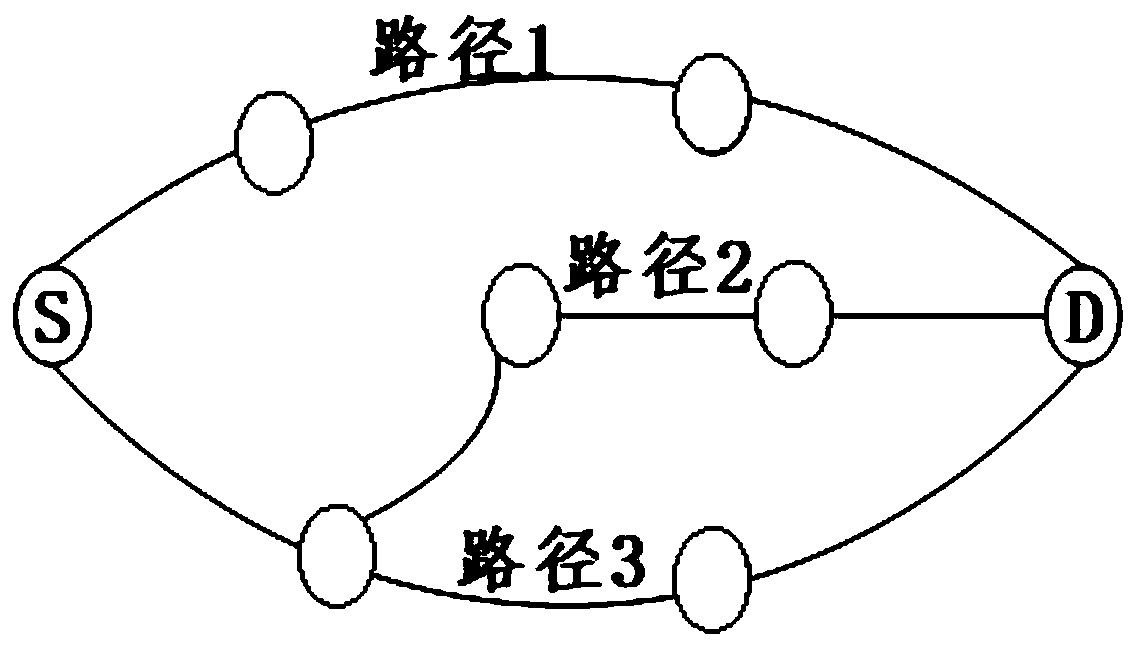
[0042] as attached figure 1 Shown:
[0043] a) In the ad hoc network, the source node S transmits information to the destination node D.
[0044] b) There may be many links or paths between the source node S and the destination node D, such as path 1, path 2, and path 3.
[0045] c) The source node S does not need to find the shortest path to the destination node D, such as path 1.
[0046] d) The source node S can establish a path to the destination, so that information can be continuously transmitted to the destination.
[0047] e) The route may change continuously depending on the position of the node relative to the destination, but always towards a specific destination, eg destination node D.
[0048] f) In an ad hoc network, when the information to be transmitted to the destination node D is at a relatively...
PUM
 Login to View More
 Abstract
Description
Claims
Application Information
 Login to View More