Salt separation and destruction of PFAS utilizing reverse osmosis and salt separation
What is AI technical title?
AI technical title is built by Patsnap AI team. It summarizes the technical point description of the patent document.
a technology of reverse osmosis and salt separation, applied in the nature of treatment water, multi-stage water/sewage treatment, membranes, etc., can solve the problems of legacy contamination, known human health risks, and introduction of replacement pfas compounds
Active Publication Date: 2022-08-09
REVIVE ENVIRONMENTAL TECH LLC
View PDF32 Cites 1 Cited by
Summary
Abstract
Description
Claims
Application Information
AI Technical Summary
This helps you quickly interpret patents by identifying the three key elements:
Problems solved by technology
Method used
Benefits of technology
Benefits of technology
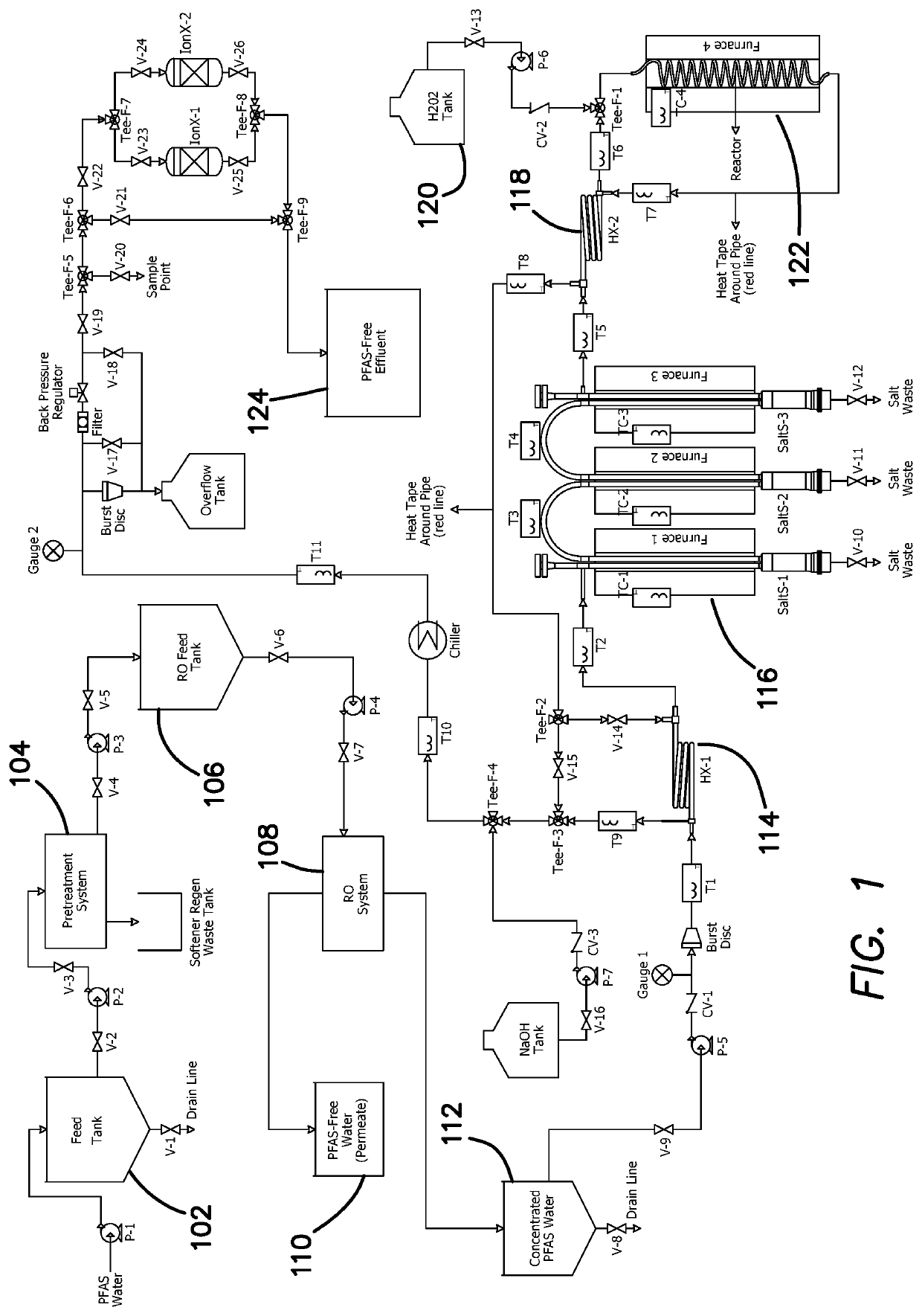
The patent describes a method to quickly and efficiently remove PFAS from water or soil samples using a process called Supercritical Water Oxidation (SCWO). The process involves concentrating the PFAS and destroying it using fuel, such as methanol or other organic materials, which provides most of the heat needed for the oxidation. The resulting effluent is then released as safe, clean water. Additionally, the patent notes that removing salt from the concentrated PFAS mixture helps prevent clogging and reduces corrosion.
Problems solved by technology
There are significant concerns associated with these compounds due to widespread contamination coupled with uncertainties about risks to human health and the environment.
Although some PFAS compounds with known human health risks have been voluntarily phased out (PFOA and PFOS), legacy contamination remains.
Replacement PFAS compounds have been introduced with limited understanding of their health risks.
Currently used techniques for treating PFAS-contaminated water are expensive, and management of spent media is costly and may result in long-term liability.
Application of SCWO to PFAS is relatively new and presents new challenges.
Method used
the structure of the environmentally friendly knitted fabric provided by the present invention; figure 2 Flow chart of the yarn wrapping machine for environmentally friendly knitted fabrics and storage devices; image 3 Is the parameter map of the yarn covering machine
View more
Image
Smart Image Click on the blue labels to locate them in the text.
Viewing Examples
Smart Image
Click on the blue label to locate the original text in one second.
Reading with bidirectional positioning of images and text.
Smart Image
Examples
Experimental program
Comparison scheme
Effect test
example
[0067]Reverse Osmosis—364 kg of well water was spiked with PFAS to a concentration of 2400 ug / L. The spiked sample was passed through a water softener (measured PFAS concentration showed no change in the water softening step). The softened PFAS water was run through a Reverse Osmosissystem for 160 minutes until the retentate mass was 38.5 kg. The results, where % efficiency=(Cfeed−Cperm / Cfeed)×100, is shown in the Table below:
[0068]
RO Feed Concentrate - Permeate - % AnalytesTankEnd of RunEnd of RunEfficiencyTOTAL PEAS2,383.8814,416.5822.8699.0%PFBA256.991,535.071.4099.5%PFPeA221.031,574.071.3999.4%PFHxA238.421,526.351.7199.3%PFHpA211.281,425.791.9799.1%PFOA502.523,239.445.7098.9%PFDA209.101,232.773.1398.5%PFUnA235.041,212.242.6998.9%PFDoA165.07783.552.7598.3%PFTrDA0.221.66ND100.0%PFTeDA0.181.43ND100.0%PFHxS0.030.49ND100.0%PFHpS1.475.10ND100.0%PFOS236.631,439.951.1299.5%PENS0.420.61ND100.0%4:2FTS0.371.17ND100.0%6:2FTS103.94431.450.7599.3%8:2FTS0.531.84ND100.0%
[0069]The testing showe...
the structure of the environmentally friendly knitted fabric provided by the present invention; figure 2 Flow chart of the yarn wrapping machine for environmentally friendly knitted fabrics and storage devices; image 3 Is the parameter map of the yarn covering machine
Login to View More
PUM
Property
Measurement
Unit
temperatures
aaaaa
aaaaa
residence time
aaaaa
aaaaa
residence time
aaaaa
aaaaa
Login to View More
Abstract
Per- and polyfluoroalkyl substances (PFAS) are destroyed by oxidation in supercritical conditions. PFAS in water is concentrated in a reverse osmosis step and salt from the resulting solution is removed in supercritical conditions prior to destruction of PFAS in supercritical conditions.
Description
RELATED APPLICATIONS[0001]This application claims priority to U.S. Provisional Patent Application Ser. No. 63 / 062,251 filed 6 Aug. 2021.INTRODUCTION[0002]Per- and polyfluoroalkyl substances (PFAS), including perfluorooctanesulfonate (PFOS) and perfluorooctanoic acid (PFOA), and hundreds of other similar compounds, have been widely used in the United States in a multitude of applications. There are significant concerns associated with these compounds due to widespread contamination coupled with uncertainties about risks to human health and the environment. PFAS are molecules having chains of carbon atoms surrounded by fluorine atoms. The C—F bond is very stable enabling the compounds to persist in the natural environment. Some PFAS include hydrogen, oxygen, sulfur, phosphorus, and / or nitrogen atoms. One example is PFOS:[0003][0004]Although some PFAS compounds with known human health risks have been voluntarily phased out (PFOA and PFOS), legacy contamination remains. Replacement PFA...
Claims
the structure of the environmentally friendly knitted fabric provided by the present invention; figure 2 Flow chart of the yarn wrapping machine for environmentally friendly knitted fabrics and storage devices; image 3 Is the parameter map of the yarn covering machine
Login to View More
Application Information
Patent Timeline
Application Date:The date an application was filed.
Publication Date:The date a patent or application was officially published.
First Publication Date:The earliest publication date of a patent with the same application number.
Issue Date:Publication date of the patent grant document.
PCT Entry Date:The Entry date of PCT National Phase.
Estimated Expiry Date:The statutory expiry date of a patent right according to the Patent Law, and it is the longest term of protection that the patent right can achieve without the termination of the patent right due to other reasons(Term extension factor has been taken into account ).
Invalid Date:Actual expiry date is based on effective date or publication date of legal transaction data of invalid patent.



 Login to View More